
Dedication

For every traveler who has ever taken the long way home.
For those who encouraged me before I could recognize the possibilities before me; for the teachers who opened doors rather than guarded them; for the friends who shared the journey, however briefly; for the broadcasters whose voices kept us company in the quiet hours after dark; and for the dreamers who dared to draw maps of places the world had yet to imagine.
For my father, Fred, and my mother, Terri, who taught me that adventure was not merely something that happened to us, but something worth seeking.
For my Aunt Zookie and my wife, Molly, who recognized roads I had yet to discover, and believed in destinations I could not yet see.
And for everyone who has ever mistaken a difficult chapter for the end of their story, only to discover, sometimes quite unexpectedly, that it was the beginning of something far more extraordinary.
May you never surrender your curiosity, always find something worth noticing; and may you remain willing to wander beyond the familiar, to question the obvious, and to welcome the unexpected. And may your next detour become your favorite chapter, or, at the very least, the one that makes the best story afterward.
Foreword : How I Found My Way Here, and Why This Book Exists
Thank you for choosing to spend part of your journey with me.
If you are reading this, then somehow our paths have crossed. Perhaps you found this book in a bookstore. Perhaps someone placed it in your hands. Perhaps it drifted through the wonderfully unpredictable machinery of the internet and quietly arrived exactly when it was supposed to. However you found your way here, I'm genuinely glad you did.
Before we begin, there is something important you should know. I am not writing this book because I have life all figured out. Quite the opposite. The older I get, the more convinced I become that I understand remarkably little.
When I step back and look at the universe, the stars, the oceans, the forests, the astonishing complexity of humanity, the emergence of artificial intelligence, and the sheer improbability of existence itself, I am reminded of a wonderfully humbling truth: I am a remarkably small creature trying to understand an extraordinarily large reality.
Oddly enough, I find that comforting. Because I've also discovered something hopeful. Small creatures build remarkable things.
Most of history has been shaped by ordinary people who simply kept showing up. Teachers who opened doors. Friends who offered encouragement. Artists who kept creating. Caregivers who quietly loved someone through another difficult day. Broadcasters who turned on the microphone. Dreamers who decided that an idea was worth sharing.
This book exists because of people like that. More personally, it exists because of one person in particular.
Like most people, I once had a map of where I thought my life was going. It wasn't a bad map, either. It was practical, familiar, and pointed toward the sort of future I believed I was supposed to build for my family. Then life did what it has an extraordinary habit of doing.
It introduced a detour.
A health condition forced me to step away from the contracting business I had built with my own hands, and for a while I honestly believed I had reached the end of my story. Looking back now, I realize it wasn't an ending at all, it was simply the place where the road disappeared over the horizon.
While trying to figure out what came next, I started looking through college programs. My first instinct was to choose something practical, something that promised stability and a comfortable living. Then my wife, Molly, asked one simple question that quietly changed my life forever. “Why that program?” she asked. “Making Money,” I answered. She smiled in that wonderfully patient way spouses sometimes do and said, “You know... You should follow your heart instead.” Then she handed me a flyer. It was for the brand-new Media Technology program at Owens Community College in Toledo, Ohio. In that moment I remembered something I had forgotten. As a kid, I was always making something. Little movies with bulky VHS cameras. Puppet shows in the living room. Mixtapes. Homemade special effects. Costumes. Ridiculous productions that probably entertained me far more than anyone else.
For me creating had never really felt like work, it felt more like breathing. So, for perhaps the first time in my adult life, I followed curiosity and wonder, instead of sensible certainty. It turned out to be one of the best decisions I have ever made.
Attending College awakened something that had been dormant in me. I rediscovered that I loved learning. More importantly, I discovered that I loved sharing what I was learning with other people.
One opportunity led to another. One conversation opened the door to the next. Before long, my life had wandered into broadcasting, teaching, music, storytelling, business, and a wonderfully unexpected little adventure called The Drew Scott Show.
Looking back, all of those destinations appeared separate while I was traveling through them. Now I can see they were all part of the same road leading me right here.
Over the years, people have occasioned to asked me what my work is really about. Why am I doing this? Well, the simplest answer I can give is this: It’s about paying attention.
It's about becoming curious enough to notice the extraordinary hiding inside the ordinary. It's about asking better questions than we asked yesterday. It's about recognizing that some of life's greatest gifts arrive disguised as interruptions, inconveniences, or unexpected detours.
The longer I spend paying attention to this beautiful world, the more convinced I become that there is always something new to learn, someone interesting to meet, another perspective worth considering, another reason to smile, and another opportunity to leave the world just a little better than we found it.
This book isn't a collection of answers. It's a collection of observations. Notes gathered while wandering through classrooms, studios, airports, friendships, conversations, successes, failures, campfires, rabbit holes, and more than a few unexpected adventures, and these upcoming chapters are not instructions for becoming someone else. They are invitations to become more fully yourself. Aware to notice more, to wonder more, to build more. To fear less. To actually participate. Because one of the many lessons this beautiful, wonderfully unfinished world continues to teach me is this:
Life is far too interesting to spend entirely in the audience. At some point, each of us is invited onto the stage to help write the next act, so join me on stage. I've been expecting you.
Now…
Let's see where the show leads.
Introduction : Bring a Map, Then Look Up
I've always liked maps.
Although I'm not particularly good at following them, mind you. If my life has demonstrated anything, it's that I have an uncanny ability to set out for one destination, become fascinated by something completely unrelated along the way, and eventually arrive somewhere I never intended to go. Oddly enough, those unexpected destinations have usually turned out to be the ones worth remembering.
When I was young, adventure wasn't something we planned for. It was simply what we did.
My mom and dad had an extraordinary gift for encouraging curiosity. They trusted us to explore, to imagine, and to discover the world one seriously crazy adventure at a time. Entire afternoons disappeared as my friends and I searched for hidden places, invented imaginary kingdoms, climbed trees, followed creeks, ponds, lakes and oceans. Convincing ourselves that every unexplored path probably led to something remarkable.
Which sometimes it did. Whole worlds opened up, and sometimes it simply led us home with a bigger smile and a little dirtier than when we left. Either way, the day was never wasted.
Looking back, I don't think I was searching for places nearly as much as I was searching for possibilities. Every unfamiliar path seemed to offer the same irresistible invitation: “I wonder what's over there?”
And sometimes, what I found wasn't particularly grand or life-changing. Sometimes it was a small discovery, an unexpected kindness, a different way of looking at something I thought I already understood. Little secrets hiding in plain sight. Small sparks that somehow made the road ahead a little brighter.
Somewhere along the way, I began to understand that curiosity isn't simply about finding answers. It's about discovering new perspectives, asking better questions, and realizing that the world is almost always a little bigger, a little stranger, and a lot more interesting than we first imagined.
And occasionally, it's about finding something you didn't even know you were looking for.
Perhaps that's why I've always been drawn to maps. Maps are hopeful things.
A map is evidence that someone has been somewhere before you. Someone got lost, figured something out, came home, and left notes. That is a remarkably kind thing to do when you stop and think about it.
The trouble begins when we mistake the map for the destination. Which we do all the time.
We create plans, schedules, goals, business strategies, five-year projections, educational pathways, relationship advice, self-help books, instruction manuals, and increasingly complicated smartphone applications designed to organize the increasingly complicated smartphone applications we already have.
Then we become surprised when reality refuses to cooperate.
Reality is stubborn like that. The map says there should be a road. Reality says a beaver built a dam there sometime around Tuesday. The map says success should take six months. Reality says it will take six years and involve three unexpected mentors, one spectacular mistake, and a lesson you weren't planning to learn.
The map says life should proceed in a straight line. Reality laughs so hard it nearly spills its coffee.
Fortunately, that's not bad news. In fact, it may be the best news in this entire book. Because the most important things in my life were never on the map. Not the people. Not the opportunities. Not the friendships. Not the projects. Certainly not the radio stations.
I never planned to leave a career because of a heart condition. I never imagined returning to college as a nontraditional student. I never expected curiosity to lead me into broadcasting, classrooms, music, business, artificial intelligence, or eventually to writing this very book.
If someone had shown me a complete map of my life when I was younger, I wouldn't have believed it. And I almost certainly would have tried to improve it. Poorly, I'm sure.
Now I suspect that wisdom isn't about finding a perfect map. It's about learning how to travel well. To pay attention. To remain curious. To listen carefully. To notice when the road changes. To ask good questions. To help fellow travelers whenever you can. And occasionally to admit that the twelve-mile detour turned out to be better than the reason for the trip in the first place.
That's really what this book is. Not a destination. Not a blueprint. Not a promise. It's a map. A collection of notes from one traveler to another. Some of those notes may prove useful. Some may not. A few may even turn out to be completely wrong. If so, I hope you'll improve upon them and leave better notes for whoever comes next.
That's how progress works. One generation scribbles observations in the margins. The next generation adds their own. Eventually the map becomes richer, wiser, and more beautiful. The destination, however, remains the same wonderful mystery it has always been.
Life. And what a strange and beautiful destination that turns out to be.
So before we begin, I'd like to offer one small piece of advice. Bring the map. Maps are useful. Plan carefully. Dream boldly. Prepare well. Just don't become so focused on the map in your hands that you forget to look up at the extraordinary world unfolding all around you. After all...
The map was never the point. The journey was, so let's travel well.
PART I : GETTING OUR BEARINGS
Chapter 1 : Our Universe Is Still Being Built
Every journey deserves a good orientation.
Not because we know exactly where we're going, but because it's comforting to know someone has walked part of the trail before us.
If the Foreword welcomed you, and the Introduction suggested bringing a map without becoming overly attached to it, then this chapter offers one more piece of encouragement before we set off together.
Relax.
Nobody completely knows what's going on.
Oddly enough, I've found that to be one of the most comforting discoveries of adult life.
That realization didn't arrive all at once. It arrived gradually, a little piece here, a little piece there, like slowly discovering that the Wizard behind the curtain wasn't really a fraud after all. He was simply a person doing the best he could with the tools he had.
As it turns out… that's true of most of us.
When I was younger, I assumed there must be a room somewhere filled with Real Adults. You know the ones. The people who completely understood taxes, relationships, healthcare, economics, careers, home repairs, and what all the buttons on the television remote actually do.
Surely, I thought, somebody was running the place.
Then life invited me into larger and larger rooms. Boardrooms. Classrooms. Studios. Organizations. Awards ceremonies. Professional associations. Committees. Conferences. The rooms became bigger. The titles became longer. The coffee improved slightly.
The people, however, remained gloriously human. They asked questions. They made mistakes. They worried. They laughed. They improvised. They changed their minds when better information arrived. They succeeded. They failed. Then, with remarkable courage, they kept building anyway.
That realization changed the way I see the world.
The universe, as near as I can tell, appears to be under construction. Not broken. Not finished. Just under construction.
That distinction matters.
A broken thing has failed. An unfinished thing is becoming. Those are two very different stories.
Look around for a moment. Cities are growing. Children are learning. Ideas are being tested. Businesses are being launched. Songs are still waiting to be written. Scientists continue asking questions no one has answered before. Teachers keep discovering better ways to teach. Artists keep helping us see familiar things with new eyes.
Even while you're reading these words, somewhere in the world someone is creating something that has never existed before.
I think that's extraordinary.
Artificial intelligence is a wonderful example. Depending on whom you ask, it's either the greatest opportunity of our generation, the opening scene of a science-fiction movie, or an incredibly sophisticated way to remember where we left our car keys.
The truth is much simpler, I’m sure: we’re still figuring it out.
Just as earlier generations figured out radio. Television. Airplanes. The internet. Every generation inherits an unfinished world. We add what we can. Learn what we must. Then pass the toolbox to the next generation.
That's how civilization has always worked. And honestly… I'm grateful it does. Can you imagine a completed universe? Every mystery solved. Every mountain climbed. Every road mapped. Every song already written. Every question answered. No, thank you. Wonder requires unfinished places.
Of course, construction sites aren't always tidy. There are detours. Unexpected delays. Occasional loud noises. Every now and then somebody accidentally builds a staircase that leads directly into a wall. History, if I’m being honest, contains more examples of that than most textbooks are willing to admit.
People aren't much different. We're all renovation projects.
The person you were ten years ago isn't the person reading this page. If all goes well, the person you'll become ten years from now will smile kindly at today's version of you and quietly say, "We did the best we could with what we knew."
That isn't failure. That's growth. Good builders don't begin by knowing everything. They begin by being willing to learn. That's true of teachers. Neighbors. Parents. Scientists. Artists. Engineers. Broadcasters. Friends.
The best of them all remain students.
One of the unexpected gifts of seeing the universe this way is that it becomes much easier to extend grace. To ourselves. To one another. And even to the world around us. Not because mistakes don't matter, they do.
But because construction sites are noisy places. Progress rarely looks as polished while it's happening as it does years later in photographs.
So if you've been feeling uncertain lately...
If you've wondered whether you're behind...
Or if you've secretly suspected everyone else received an instruction manual that somehow never arrived at your address. May I offer another possibility? Perhaps you're exactly where every builder eventually finds themselves. Learning. Adjusting. Growing. Contributing.
The construction crew isn't made up of people who know everything. It's made up of people willing to keep building anyway.
Which means you don't need permission to participate. You've been part of the project from the very beginning. You simply may not have noticed the hard hat. And if the universe really is under construction… perhaps the question isn't whether you belong here.
Perhaps the question is simply this: What would you like to help build?
Kevin & Avery’s Wonder Stop
What part of the world still feels like a mystery to you, and what would you like to learn about it?
Chapter 2: You’re Not Late for Your Own Life
There is a particular kind of panic that arrives quietly. It doesn't knock. It doesn't announce itself. One day it simply appears while you're standing in the kitchen, driving to work, or scrolling through something you probably weren't meant to see at that hour. It leans over and whispers, "You're behind."
Behind what, exactly, is never fully explained. Just… behind. Behind your peers. Behind your potential. Behind the life you imagined you would have by now. Behind some invisible schedule no one ever handed you, yet everyone else somehow seems to be quietly following.
At first you ignore the feeling. Then you argue with it. Eventually, if you're like most people, you begin reorganizing your entire life around catching up. So we shift our lives into hurry mode. We optimize, accelerate, and go into fix-it mode. Before long, you're chasing a finish line with the irritating habit of moving a little farther away every time you think you're getting close.
I've lived in that neighborhood. I wouldn't recommend it. The lighting is harsh. The rent is far too high. And the neighbors all seem equally convinced they're late for something important too.
Over the years I've watched people build remarkable lives, meaningful careers, beautiful relationships, successful businesses, and creative work that changed other people's lives. I've also watched people fail, begin again, change directions, and discover opportunities they never would have chosen for themselves.
If there's one lesson those years have quietly taught me, it's this:
You are not late. You are not early. You are not behind. You are on time for the life you are actually living. Not the imagined one. Not the comparison one. Not the one assembled from carefully edited biographies, social media highlight reels, or success stories that quietly skip over the long, uncertain middle.
Most meaningful things simply don't arrive on schedule. They arrive when the conditions are ready. And those conditions are almost never visible from the outside. A radio station doesn't come to life the moment someone has the idea. A song doesn't appear because the calendar says Tuesday. A business isn't built over a weekend. A meaningful life has never shown much interest in obeying the timetable of anxiety. I know that because I've lived it.
There was a season when I genuinely believed I'd fallen behind. A heart condition changed the direction of my life. My business disappeared, and for a while I believed I had somehow missed whatever opportunity everyone else seemed to have found.
Then Molly quietly changed the conversation. She encouraged me to follow my heart instead of simply following the money.
That conversation led me through the doors of Owens Community College, where I rediscovered something I'd forgotten about myself. I loved learning. One opportunity led to another. One degree led to the next. One conversation opened another door. Eventually those unexpected detours led to broadcasting, teaching, music, storytelling, and, later, to writing these very words.
Looking back now, I smile at how convinced I was that I had arrived late.
I hadn’t. I had simply arrived at the beginning of a chapter I couldn't yet see. Life has a wonderful sense of irony that way. The more desperately we try to catch up, the more life seems to sprint ahead of us. But when we stop chasing and begin paying attention instead, something subtle changes.
We realize our lives have been unfolding all along. Quietly. Patiently. Without asking anyone's permission. The relationships you've built count. The skills you've learned count. The difficult seasons you've survived count. The things you've created that nobody applauded loudly enough for still count. In fact, I suspect those unseen moments often matter the most.
I've come to think about timing a little differently over the years. Not as something measured by clocks, but as something revealed through experience. Some people bloom early. Others bloom much later. Some spend years underground, looking as though nothing at all is happening, until one day they emerge and everyone calls them an overnight success.
Very little about that success happened overnight.
One of the quiet truths about building anything, a family, a friendship, a career, a business, a radio station, or even a sense of self, is that you're always arriving just a little after the version of yourself who was worried about arriving.
Now, that worried version wasn't lying. It was simply afraid and fear has a remarkably loud voice. Wisdom rarely raises its own. So if you've been carrying the feeling that you've somehow missed your moment, I'd like to offer a gentle correction.
You haven't missed it. You're living it. Right now. Even if it doesn't look the way you imagined. Especially if it doesn’t. Life isn't a race toward a predetermined finish line. It's a long conversation with time itself. And time, I've found, is surprisingly patient with those who stop trying to outrun it.
Perhaps today doesn't require another five-year plan. Perhaps it simply asks you to notice where you're standing. The people beside you. The gifts you've quietly gathered. The lessons you've earned. The person you're becoming. Because whatever you're building, learning, or trying to understand isn't waiting somewhere off in the distance.
It's already unfolding right here right now. And I have a feeling that years from today you'll look back on this season with a smile, because you'll finally see what you couldn't see at the time.
You were never late. You were simply becoming.
Kevin & Avery’s Wonder Stop
When have you felt behind, only to discover you were moving at your own pace?
Chapter 3: Everybody Is Figuring It Out as We Go
For a long time, I assumed there had to be a master manual.
Not a literal one, mind you. I wasn't expecting to find it tucked away in a filing cabinet beneath a mountain or hidden inside a vault guarded by monks and a particularly suspicious golden retriever.
Still, I figured there must come a day when life finally started making sense. A day when someone handed you the Official Guide to Life, smiled with quiet satisfaction, and said, "Congratulations. You've made it. Here are the answers.” As far as I can tell, that day never arrives, and if there is a manual, mine must have been lost in the mail. And after watching people for a while, I've started wondering if everyone else's copy got lost too.
That realization changed the way I look at people.
When we're young, it's easy to imagine everyone else has things figured out. Teachers know. Managers know. Doctors know. Politicians know. Parents know. Surely somebody knows.
Then life plays one of its little jokes. One day, you're the teacher. Or the manager. Or the parent. Or simply the person everyone else turns toward when the room becomes quiet. And that's when you discover something equal parts humbling and reassuring.
You're still you. You still ask questions. You still make mistakes. You still change your mind. And every so often you find yourself staring at a situation thinking, "Well... this certainly wasn't covered in the training materials."
It turns out confidence and certainty aren't the same thing.
Most of us are simply doing the best we can with the understanding we have today. Tomorrow, if we're paying attention, we'll know a little more than we know now. That seems to be how learning works.
It also explains people a little better.
Think about someone you crossed paths with this week. The exhausted cashier. The distracted coworker. The nervous student. The frustrated customer. The quiet neighbor. Or perhaps the overly enthusiastic radio host who somehow transformed a simple weather report into a conversation about philosophy, weather patterns, music history, and the meaning of existence.
Every one of them is carrying a story you can't fully see. Every one of them learned how to navigate life from somewhere. Some lessons came from family. Some from teachers. Some from success. Some from failure. Some from heartbreak. Some from unexpected kindness. Some instructions served them well. Others probably should have been retired years ago.
That's true for all of us.
Years ago, one of my teachers, Bill Palmer, shared a simple idea with me.
"The truth is self-evident.”
I've carried those words with me for years, because they remind me to keep asking better ones.
Looking back, I don't remember every lesson Bill taught me. But what I do remember is the way he taught me to think. Maybe that's what good teachers really leave behind. Not complete answers. Better questions.
Once I started looking at people this way, something changed. Instead of asking, "What's wrong with this person?” I found myself asking, "I wonder what taught them to see the world that way?"
Those are very different questions. The second one doesn't excuse harmful behavior. It doesn't erase responsibility. It simply makes understanding a little easier. Oddly enough, it also works on the person in the mirror.
One of the least fair things we do to ourselves is judge yesterday's decisions using today's information. We criticize an earlier version of ourselves for failing a test whose answers hadn't yet been revealed. That hardly seems fair. The person you were five years ago was doing the best they could with the instructions they had. So is the person reading this page. And, if I'm being honest...
So is the person writing it.
Fortunately, life doesn't seem interested in handing us a perfect manual. It prefers revisions. We learn. We notice. We cross something out. We scribble a note in the margin. We discover that something we were certain about turns out not to be true. Then we continue.
I think that may be one of humanity's greatest strengths. Not certainty. Revision.
The willingness to learn. The humility to change. The courage to improve the instructions and pass them along. When you think about it, that's what books are. It's what conversations, classrooms, friendships, and radio have always been at their best. One person quietly saying, "I bumped into this wall so maybe you won't have to.” That isn't weakness. That's civilization. Millions of people sharing incomplete instructions and gradually making them a little less incomplete. One conversation. One discovery. One lesson. One margin note at a time.
So the next time someone leaves you scratching your head, consider the possibility that they're following instructions that once made perfect sense to them. You don't have to agree with every direction they choose. You certainly don't have to follow them. But understanding them may become just a little easier.
And the next time you find yourself revisiting one of your own old mistakes, try offering yourself the same kindness. You made the best decision you could with the understanding you had. Then you learned something. Now your instructions are a little better than they were yesterday. Tomorrow, if all goes well, they'll be better still.
That's how travelers find their way. One note in the margin at a time.
Kevin & Avery’s Wonder Stop
What is something you are still learning, and who could you learn it with?
Chapter 4: Wonder Makes a Fine Compass
When most people think about navigation, they think about certainty. Maps. Compasses. Coordinates. Directions scribbled on a napkin. Or a calm GPS voice confidently instructing you to turn left into a lake.
Navigation, we are told, is about knowing exactly where we are going.
I’m not convinced. I suspect that many of life’s most meaningful journeys begin in exactly the opposite place. They begin with not knowing. More importantly, they begin with being curious enough to take the next step anyway.
That is where wonder quietly enters the story.
Wonder is one of those words that sounds gentle until you stop and consider what it has accomplished. Then you realize that a surprising amount of human history began because someone looked at the world and asked:
“I wonder…”
I wonder what is over that hill. I wonder why birds can fly. I wonder what those lights are in the night sky. I wonder whether there is a better way to do this. I wonder what would happen if… Wonder built telescopes. Wonder crossed oceans. Wonder created libraries. Wonder landed on the Moon. Wonder looked at lightning and asked, “What is that?” Wonder looked at a bird and asked, “Could we do that?” Wonder looked at a blank page and asked, “What if?”
Entire discoveries, inventions, and civilizations have grown from questions no larger than those and honestly the more I pay attention, the more I suspect that wonder is not simply something we feel.
It’s something that points.
Children seem to understand this instinctively. Give a child a cardboard box, and they may spend the afternoon discovering fourteen different uses for it. Give an adult the same box, and the first question is usually where it should be stored.
Neither response is wrong. One is simply more curious.
Somewhere along the way, many of us become remarkably efficient. We organize our calendars, optimize our workflows, improve our routines, refine our careers, and occasionally attempt to optimize breakfast.
Then one day we look up and realize that we have become exceptionally good at getting things done. We are simply no longer certain where we are going.
Wonder has a way of interrupting that. It quietly taps us on the shoulder and says:
“Well… that’s interesting.”
Looking back, I can trace many of the best chapters of my life to those three words. A microphone. A college class. A conversation. A story. A piece of music. A new technology I nearly ignored because it looked far more complicated than I felt qualified to understand.
None of those moments arrived with guarantees. They arrived with curiosity.
I didn’t know where they would lead. They simply seemed interesting enough to deserve another step. One step became another. Eventually, those steps became paths I never would have planned for myself.
The initial step was rarely confidence. It was curiosity.
That is why I do not believe wonder belongs only to children, artists, scientists, inventors, dreamers, or people who own an alarming number of notebooks.
Wonder belongs to everyone.
In fact, I am beginning to suspect that losing our sense of wonder is one of the quickest ways to become lost. Without it, everything slowly becomes transactional. Every experience must justify itself. Every hobby needs to become profitable. Every activity must produce a measurable result. Every moment should be productive. Every question demands an immediate answer.
Life may become more efficient. It rarely becomes larger. Wonder makes the world feel spacious again. It reminds us that there are still books worth reading, people worth meeting, places worth exploring, songs worth hearing, mysteries worth sitting with, and questions worth asking even when an answer is not immediately available.
It reminds us that existence is still astonishing.
I have also noticed something else. Understanding is rarely the beginning of the journey. Wonder is. The night sky was beautiful long before we understood the stars. Music moved people long before anyone explained acoustics. Friendship mattered long before psychology attempted to describe it.
We do not always need to understand something before we can appreciate it. Often, appreciation is what makes us want to understand it in the first place. Wonder invites us forward. Understanding catches up when it can. Sometimes it never catches up completely. That may be all right too.
Wonder and listening are close relatives. It is remarkably difficult to remain curious while assuming you already know everything there is to know. You cannot truly wonder about a person, an idea, or a possibility if you have already decided what it means.
Curiosity opens doors. Certainty has a habit of quietly closing them.
Both wonder and listening begin with a simple admission: “There may be more here than I currently understand.” That sentence has improved nearly every part of my life. It has made me a better student. A better broadcaster. A better collaborator. A better listener. And, I hope, a better friend. More than anything, it has helped me remain pleasantly surprised.
I am grateful that the world still surprises me. I hope it always does. A world without surprises might be wonderfully efficient, but I do not think I would enjoy living there very much.
So if you find yourself uncertain about where to go next, may I offer a navigational technique that has served me remarkably well?
Pay attention to what fascinates you. Notice what quietly captures your attention. Listen for the ideas that make you lean forward instead of checking the time. Follow the questions that continue returning after the conversation has ended. Remain teachable. Permit yourself to wonder.
You don't have to chase every interesting thing. But perhaps you should not ignore them either. And while I do not always know exactly where I am going, I usually know what is interesting. More often than not, that has been enough to take the next step.
A compass does not show you the entire journey. It simply points toward a direction worth exploring. Wonder does the same. It may not immediately reveal your destination. But it can give you a direction. Sometimes, that is even better.
Maybe, just maybe, it will do the same for you.
Kevin & Avery’s Wonder Stop
What makes you curious enough to take a closer look?
Chapter 5: Look Again. There’s More to See
I have a confession to make: I am wrong more often than I would like to admit. This may not sound particularly profound. In fact, if you have ever met another human being, you have probably already arrived at a similar conclusion about our entire species. I mention it because one of the most useful skills I have ever developed is not intelligence, experience, or education. It is not even curiosity, although curiosity certainly helps.
It is the willingness to look again.
The first time we see something, we rarely see it completely. We see our assumptions about it, our expectations, the labels we have attached to it, and the story we have already begun telling ourselves. Then, without realizing it, we quietly mistake that story for reality.
This happens everywhere. We do it with people, ideas, places, history, and ourselves, especially ourselves. A person makes a mistake and suddenly becomes “careless.” A project struggles and suddenly becomes “a failure.” A dream takes longer than expected and suddenly becomes “unrealistic.” A stranger disagrees with us and suddenly becomes “the problem.”
Our minds are wonderfully good at recognizing patterns. The trouble is, they also enjoy finishing stories before all the pages have been written. We are remarkably efficient pattern-recognition machines, but efficiency sometimes comes at the expense of accuracy. The mind loves shortcuts; reality often prefers scenic routes.
One of the reasons I enjoy broadcasting is that it has taught me this lesson repeatedly. A song you barely notice one day may quietly become your favorite six months later. A conversation that seemed ordinary may reveal itself years afterward to have changed your life. A student may ask what sounds like a simple question, only to reveal an entire universe hiding underneath it.
I learned this lesson another way after taking The Drew Scott Show to New York as a finalist for Most Innovative and Creative College Radio Show in America at the Intercollegiate Broadcasting System Awards. I had poured everything I knew into that show, and I was proud of it.
I didn’t win.
The award went to a much larger team from Rutgers University. On the flight home, I realized I had two stories available to me. The first was that bigger schools simply had bigger advantages. The second began with a different question:
“What did they see that I did not?”
That question changed the way I approached the work. When I returned to Owens, I stopped trying to build the next great show by myself and started building teams. Not long afterward, one of those teams created From Monroe to Tokyo with Rashada Jones. I had the privilege of serving as the announcer, and this time we walked away with a win.
Looking back, I know the trophy was not the lesson.
Looking again was.
The important thing was noticing what needed to change, then adapting.
The first look rarely tells the whole story. The second look is often where things become interesting; the third is where they become educational. By the fourth look, you have usually discovered that the situation was more complicated than anyone originally thought, including you.
Nature seems to understand this instinctively. Walk through a forest once, and you see trees. Walk through it again, and you notice birds. Walk through it a third time, and you begin to see patterns. By the fourth visit, you recognize familiar landmarks. Eventually, you realize the forest has been introducing itself to you in stages, not because it was hiding, but because you were learning how to see.
People are much the same. The first conversation introduces a name; the second introduces a personality; the third introduces a story; the fourth introduces a struggle; the fifth introduces a dream. Spend enough time with someone, and you eventually discover that they are carrying an entire world inside them.
Most worlds cannot be understood at a glance. Neither can our own.
One of the nicest surprises about growing is discovering that it is not only about collecting years; it is also about collecting perspective. It is the ability to revisit an old memory and discover something you missed, to reread a book and find a different lesson, or to listen to a song and hear something entirely new because you have become a different listener.
The song did not change. We did, and sometimes that is enough to change everything.
One of the hidden dangers of modern life is how quickly we are encouraged to reach conclusions. We are surrounded by instant reactions, instant judgments, instant opinions, and instant expertise. Reality, however, remains stubbornly unwilling to become simple merely because we are in a hurry.
Most worthwhile things deserve another look, and another, and sometimes several dozen more.
That is not inefficiency. That is exploration.
Imagine if the explorers of history had stopped at their first impressions. Imagine sailing into a bank of fog and declaring, “Well, I suppose that is all there is.” Imagine a scientist observing a strange result and saying, “Interesting. Let us never investigate that again.” Imagine an artist looking at a rough sketch and announcing, “Perfect. No revisions necessary.”
Civilization would have become very boring very quickly.
Most progress begins when someone quietly says, “That cannot be the whole story,” and then looks again, and again, and again.
Most of what I have shared in this book was not learned the first time. It was learned the second time, the fifth time, or perhaps the eleventieth. Many lessons arrived disguised as mistakes. Some arrived disguised as failures, and a few arrived disguised as complete disasters. Only later did they introduce themselves as teachers.
That is one reason I try not to finalize my understanding too quickly. The world has surprised me too many times, people have surprised me too many times. I have surprised myself too many times that I have begun to suspect that surprise is often evidence that learning is still taking place.
So, if you take only one thing from this chapter, let it be this:
Before deciding what something means, look again. Before deciding who someone is, look again. Before deciding what you are capable of, look again.
Sometimes the difference between being lost and finding a new path is nothing more than the willingness to take a second look. After all, exploration rarely begins by discovering something entirely new.
More often, it begins by seeing something familiar with new eyes.

Kevin & Avery’s Wonder Stop
What changed when you looked at a familiar thing one more time?
PART II: TRAVELING TOGETHER
Chapter 6: The Space Between Us
There is something strange about people. The closer you look, the stranger it becomes. Not bad strange. Not alarming strange. Just wonderfully, frustratingly, mysteriously strange.
For example, have you ever noticed that people sometimes move away when you move toward them, then move toward you when you begin giving them space? Not always. Not everyone. But often enough that it begins to feel as though there should be a warning label somewhere.
CAUTION: HUMAN BEINGS MAY REQUIRE MORE SPACE THAN WE APPEAR TO NEED.
Results may vary.
I first began noticing this years ago. The harder someone chased approval, the harder approval seemed to become. The harder someone tried to force a friendship, the more awkward the friendship became. The harder someone tried to hold on, the more likely the thing they were holding would slip through their fingers.
Meanwhile, the people who appeared calm, grounded, and comfortable in their own company often attracted others almost effortlessly.
This puzzled me.
Naturally, I responded by overthinking it for several years. As one does. Eventually, I arrived at a theory. We appear to be balancing two competing needs almost all the time: the need for connection and the need for autonomy.
We want to belong, but we also want to remain ourselves. We want companionship, but we also want freedom. We want to be seen, but we also want privacy. Much of our behavior seems to be an attempt to maintain a comfortable distance between those desires. Too much distance, and we feel lonely. Too much closeness, and we feel trapped. Somewhere between those two extremes is a place that feels comfortable.
The challenge is that everyone measures that distance a little differently. Which explains a great deal. It explains friendships. It explains families. It explains romance. It explains why one person believes they are being attentive while another feels overwhelmed. It explains why one person feels abandoned while another feels crowded.
Most of the time, neither person is entirely wrong. They are simply standing at different points on the same map.
Broadcasting taught me something about this. People tune in because they want connection, but they also appreciate the distance. A broadcaster enters their life without taking it over. A voice accompanies them during a commute. A song finds them during a difficult evening. A story keeps them company for a little while. Then, eventually, the signal fades back into the night.
There is something beautiful about that. Perhaps that is one reason radio has always felt so natural to me. It respects the space between people.
The same principle applies to friendship. The strongest friendships I have known were never maintained through constant effort. They were maintained through trust, the quiet confidence that the connection remained real, even during periods of silence. Some people can go six months without speaking and resume a conversation as though it had merely been paused.
That is a remarkable achievement. Not because of constant proximity. Because of mutual understanding.
I suspect this is one reason relationships sometimes become difficult. We often assume that closeness is created through more. More communication. More explanation. More contact. More effort, and sometimes that is exactly what a relationship needs.
But sometimes closeness is created through space. Through trust. Through the absence of pressure. Through allowing another person enough room to remain themselves.
A campfire offers a useful metaphor. Sit too far away, and you miss the warmth. Sit too close, and you become uncomfortable. Most meaningful relationships involve a lifetime of adjusting your chair, a little closer, a little farther away, as the fire changes, the night grows colder, and the people around it change too.
What fascinates me most is that this applies to the relationship we have with ourselves as well. Many people spend years trying to become someone else. A more successful version. A more accomplished version. A more confident version. A more acceptable version. They spend so much time pursuing themselves that they never become acquainted with themselves.
Perhaps self-understanding works much the same way meaningful relationships do. Not by forcing. Not by chasing. But by paying attention. By creating enough space to observe ourselves honestly. By becoming curious instead of judgmental. By learning when to move closer, and when to stop crowding the person we are still becoming.
After all, every relationship is ultimately a conversation. Including the one we have with ourselves.
Maybe people are less like machines and more like constellations. You cannot understand a constellation by staring at a single star. You have to notice the stars and the spaces between them. That is where the pattern begins to emerge. The shape becomes visible through the gaps.
Perhaps that is why we remain so endlessly fascinating. We are all trying to solve versions of the same puzzle. How close should we stand? How much should we share? How much should we protect? How do we belong without disappearing? How do we remain ourselves without becoming isolated?
I don’t claim to know the answers. If I did, this chapter would be considerably shorter, but what I do know is this:
Most people are trying. Most people want connection. Most people want to be understood, and most people are carrying invisible boundaries they do not always know how to explain.
A little patience helps.
A little listening helps.
A little grace helps.
And occasionally, when the moment is right, moving one chair closer to the fire helps too. Just not so close that somebody catches their eyebrows on fire. That would be an entirely different chapter.
Kevin & Avery’s Wonder Stop
What helps you feel close to someone, even when you see things differently?
Chapter 7: Let Friendship Find Its Own Pace
There is an old joke that says if you chase a cat, the cat runs away. But if you ignore the cat, it eventually appears in your lap at precisely the moment you are trying to accomplish something important.
I am not entirely certain this is a joke. I suspect it may simply be a description of cats.
As it turns out, human beings are not entirely different. Not because we are cats, although I have met a few individuals who would strongly support that theory, but because many of the things we value seem to behave in much the same way.
The harder we pursue them, the more elusive they sometimes become. Approval. Happiness. Friendship. Love. Success. Creativity. Confidence. Sleep. Especially sleep. Sleep appears to operate under the management philosophy of a mildly sarcastic wizard. The moment you desperately need it, *POOF* it vanishes. Then when you have somewhere to be, it arrives uninvited.
Many worthwhile things seem to follow similar rules.
The reason, I suspect, is that chasing changes us. It does not simply change what we are doing. It changes the atmosphere we bring with us.
Someone who loves making music carries a different presence than someone who desperately needs music to prove something. Someone who enjoys conversation sounds different than someone searching for approval. Someone who creates because they love creating feels different than someone creating only to avoid failure.
The activity may be identical but the atmosphere is not.
People notice atmosphere more than they realize. We often sense it long before we can explain it. When someone desperately wants something from us, we usually feel it, sometimes consciously and sometimes not.
The result is often a small step backward.
No one is doing anything wrong. The goal may be good; pressure is what creates resistance. A hand extended in friendship feels welcoming. A hand gripping too tightly feels entirely different.
I’ve noticed this pattern in creativity as well.
Some of my favorite ideas have arrived while I was doing something completely unrelated: driving, walking, listening to music, taking a shower, or occasionally staring thoughtfully at a wall while claiming to be working.
The moment I sit down and demand, “Produce a brilliant idea immediately,” my brain usually responds, “I am afraid that is not how this works. Coffee, please.”
Creativity seems to enjoy being invited more than being commanded.
Relationships often work the same way. The strongest friendships I have known were never manufactured. They grew. Conversation unfolded naturally, shared experiences accumulated, and trust developed because both people continued showing up, not because either person tried to force the connection.
Success has always seemed a little suspicious in this regard too.
Many of the people I have admired most never appeared obsessed with becoming successful. They were busy becoming useful, helpful, curious, skillful, and dedicated.
Success often arrived as a side effect, because they spent their energy becoming the sort of person capable of creating meaningful work.
This is where I think many of us become confused. We mistake pressure for progress. Sometimes more pressure produces better results. More often, it simply produces more anxiety.
There is a difference between movement and chasing. Movement is purposeful. Chasing is desperate. Movement says, “I am heading somewhere.” Chasing insists, “I must have this right now.” One tends to create momentum. The other tends to create exhaustion. Now none of this means effort is unimportant. Far from it. The world is full of unfinished projects that hoped enthusiasm alone would carry them across the finish line.
Effort matters. Discipline matters. Persistence matters. Showing up matters.
What rarely helps is panic. Douglas Adams seemed to understand that. In The Hitchhiker’s Guide to the Galaxy, the advice printed on the cover was wonderfully simple:
“DON’T PANIC.”
I have always thought that was excellent advice for far more than interstellar travel. Panic is an exceptionally poor navigator. It points in every direction at once. Perhaps a quieter approach serves us better.
Plant the seed. Do the work. Learn the skill. Make the call. Write the chapter. Send the application. Record the song. Launch the project. Then allow time to become your partner.
Nature seems to understand this instinctively. No gardener spends the afternoon shouting at tomatoes, at least not one expecting good tomatoes. The seed is planted. The conditions are maintained. Growth happens in its own time.
People are much the same. Ideas are much the same. Lives are much the same.
One of the stranger discoveries of my elder adolescence is that many of the things we spend years chasing become easier to find once we stop trying to capture them. Not because we stopped caring, but because we stopped gripping.
That difference matters.
A bird lands more easily on an open hand than on a clenched fist. Perhaps that is true of many things. Friendship. Creativity. Meaning. Peace. Even happiness.
So, if there is a lesson hiding somewhere in this chapter, perhaps it is this: pursue what matters. Work hard. Remain curious. Show up consistently. Care deeply. But be careful not to squeeze the life out of the things you hope to hold.
After all, the goal is not possession. The goal is participation.
Participation leaves room for surprise. It leaves room for another person’s freedom. It leaves room for creativity to arrive in its own time. Most importantly, it leaves room for something wonderful to choose to meet you halfway.
In my experience, that is how many of life’s best things happen.
Kevin & Avery’s Wonder Stop
How can we show care while still giving another person room to choose?
Chapter 8: Leave Room for One Another
One of the most underrated skills in life is knowing when to stop.
I do not mean quitting. I do not mean giving up, abandoning something important, or deciding that it no longer matters. I simply mean knowing when enough has been said, enough has been done, and enough pressure has been applied.
That sounds easier than it is.
Most of us are surprisingly uncomfortable with empty space. A conversation pauses, and someone rushes to fill the silence. A relationship encounters uncertainty, and someone immediately begins trying to repair it. A problem appears, and before we fully understand it, we are already explaining, advising, organizing, or fixing. We reach for solutions almost automatically, as though every unanswered question were a loose screw waiting for the nearest screwdriver.
Sometimes that is exactly the right response.
Sometimes we have interrupted something that was quietly doing its own work.
I do not believe most people behave this way because they enjoy control. Quite the opposite. Usually, they are trying to help. They are trying to reassure someone, contribute something useful, reduce discomfort, or make a difficult moment easier to bear. Those are generous instincts.
The difficulty is that growth has never seemed particularly interested in our schedules.
Imagine trying to help a young tree grow by pulling on its branches. The intention may be kind; the result would still be disappointing. Some things respond better to patience than pressure.
People are among them.
One of the more surprising lessons broadcasting taught me had very little to do with broadcasting itself. It had to do with silence.
When someone first sits behind a microphone, silence can feel dangerous. Every quiet moment feels like a mistake. If listeners are not hearing your voice, surely you must be doing something wrong.
Experience slowly teaches a different lesson.
Silence is not the opposite of communication. Often, it is part of communication.
Without pauses, stories lose their rhythm. Without rests, music becomes noise. Without contrast, everything begins to blur together. Sometimes the most important thing happening in a conversation is the part where nobody is speaking.
Think back to the conversations that have stayed with you over the years. Chances are, they were not memorable because someone had all the answers. More often, they mattered because someone listened long enough for the real conversation to emerge. The pauses were not empty. They were allowing something important to arrive.
Relationships often work the same way.
One of the great mistakes we make is assuming that closeness requires constant contact. Sometimes it does. More often, it requires confidence: confidence that the connection can survive a little distance, confidence that silence is not rejection, and confidence that another person can disappear into the demands of their own life for a while and still find their way back.
The strongest friendships I know possess this quality. They are not maintained through constant maintenance. They are maintained through trust. The relationship has enough room to breathe, enough room to stretch, and enough room to remain alive.
Creativity requires space as well.
Ideas rarely emerge while being interrogated. They prefer wandering. They arrive during walks, long drives, showers, rainstorms, quiet evenings, or moments when the mind is allowed to loosen its grip on the problem. Some of my favorite ideas have appeared while I was pretending to work and my thoughts had quietly wandered somewhere far more interesting.
Whenever I sit down and demand that a brilliant idea appear immediately, my imagination usually responds with remarkable indifference. I have learned not to take that personally. Ideas seem to appreciate invitations more than demands.
Perhaps that is why nature feels like such a patient teacher.
A forest is not a solid wall of trees. A song is not a continuous stream of notes. A painting is not a single sheet of color. Even the night sky, which appears crowded with stars, is composed mostly of space.
For a long time, I thought of space as the absence of something. Now I wonder whether space is one of the things holding everything else together. The gaps matter.
Perhaps that is true of people as well.
We all need room to think, room to change our minds, room to make mistakes, room to fail, and room to become someone we could not have imagined a year earlier. We also need people willing to give us that room without assuming they have been forgotten, rejected, or pushed away.
Those people leave a lasting impression.
Years later, we may not remember exactly what they said. We remember something quieter than that. We remember how it felt to be around them. We remember feeling heard instead of managed, accepted instead of evaluated, and encouraged instead of corrected.
That is no small gift. In many ways, it may be one of the greatest gifts we can offer another person. Not another solution. Not another explanation. Not constant intervention. Simply enough space for them to hear their own thoughts. Enough space for an idea to mature. Enough space for a relationship to deepen naturally. Enough space for growth to occur without being forced.
As I worked on this chapter, I realized that it owed something to its own subject. Had I written it immediately after the previous chapter, it probably would have become little more than an extension of the same idea. Instead, I left it alone for a while. Life continued happening. Other observations quietly appeared. When I returned, the chapter had become something I had not planned.
Maybe ideas need room to grow just as much as people do. If that is true, then perhaps the lesson is simpler than it first appears.
Not every silence needs to be filled. Not every question deserves an immediate answer. Not every problem becomes better because another person rushed in to solve it. Sometimes the most generous thing we can do is step back just enough to let life continue becoming what it was already becoming.
After all, gardens need paths as much as they need flowers. Music needs rests as much as it needs notes. The stars need distance as much as they need light.
And we, strange and wonderful creatures that we are, often grow best when someone cares enough to leave a little room around us.
Kevin & Avery’s Wonder Stop
Where might a little extra space help an idea, a friendship, or a feeling grow?
Chapter 9: Everyone Is Carrying Something
One of the stranger realities of being human is how little of another person’s story we ever get to see.
We see a face across the room. We notice a profession, a conversation, an accomplishment, or a mistake. These days, we may even see carefully chosen photographs and updates that create the impression that we know someone’s life surprisingly well.
We do not.
What we rarely see is everything that arrived before they did.
The difficult phone call over breakfast. The diagnosis they have not shared. The grief that still catches them by surprise. The dream they quietly packed away because life asked something different of them. The responsibility they cannot put down. The fear they are trying not to show. The exhaustion they have learned to disguise as professionalism.
We are a little like icebergs moving through the world. The visible part is real, but it is not the whole story. Most of the structure exists below the surface, quietly supporting everything above it. Yet we have an odd habit of judging one another almost entirely by the portion we can see.
Perhaps we simply forget there is more. Or perhaps we are busy carrying our own invisible pieces.
Somewhere along the way, I began noticing that nearly everyone is carrying something. Not always something dramatic. Not always something tragic. Sometimes it is uncertainty about the future. Sometimes it is disappointment. Sometimes it is exhaustion. Sometimes it is the quiet effort of trying to become the person they hope they can be.
Whatever it is, it is real to them.
That realization has changed the way I try to move through the world. I say “try” because I certainly have not mastered it. I still become impatient. I still make assumptions. Every now and then, I discover that I have misunderstood a situation so completely that it probably deserves its own commemorative plaque.
Life has a gentle way of correcting us.
You learn that the cheerful person is grieving someone they loved. The confident person has been questioning themselves for months. The successful person feels lost. The strong person is exhausted. The difficult person has been hurting for longer than anyone realized. The quiet person has simply grown tired of explaining.
Nothing about them changed. Only our understanding did.
I have always admired people whose lives place them in the middle of other people’s stories: teachers, nurses, caregivers, counselors, broadcasters, and good friends. Most of the time, they will never know the entire picture, yet they choose kindness anyway.
That choice matters.
Kindness does not erase illness. It does not remove grief. It does not repair every broken relationship or solve every impossible problem. Life occasionally refuses to cooperate with even our very best intentions.
But kindness does something else. It changes the environment in which those battles are being fought. Sometimes that matters enormously.
I have watched people receive terrible news and somehow keep showing up. I have watched caregivers find the strength for one more day when they were convinced they had nothing left to give. I have watched students struggle through semesters that seemed determined to defeat them. I have watched families absorb setback after setback, and friends quietly carry burdens they never expected life to hand them.
From the outside, those moments may look ordinary. From the inside, they may be acts of extraordinary courage.
One of adulthood’s greatest illusions is the belief that successful people eventually stop struggling. They do not. More often, they simply become better at carrying what life has handed them. Sometimes they become better at hiding it as well.
Those are not the same thing. A calm surface does not always mean calm waters.
Many of the strongest people I have known earned that strength honestly. Not because life spared them difficulty, but because it did not. They learned to continue through disappointment, uncertainty, loss, and days when everything felt heavier than they believed they could carry.
Not without pain. Not without setbacks. Not without moments when continuing felt impossible. They continued anyway. Which brings us to something all of us eventually discover.
Everybody loses some battles.
The student who graduates failed a few exams. The entrepreneur watched promising ideas collapse. The artist created work nobody noticed. The caregiver had days when they felt overwhelmed. The teacher taught lessons that simply did not work. The broadcaster finished shows they wished they could do over. The traveler became hopelessly lost. The dreamer became discouraged.
Even the philosopher occasionally forgets where their glasses are.
That last one may not qualify as one of life’s great battles, but it can feel surprisingly convincing at the time. The point is that losing a battle is not evidence that you are losing your life. It is evidence that you are living one.
Anyone who attempts something worthwhile eventually collects disappointments along with accomplishments. The two seem to travel together.
So do scars.
We usually think of scars as reminders of what hurt us. Perhaps they are also reminders of what healed. Evidence that something difficult happened, and we continued.
That is worth remembering. Especially when the person you are looking at is yourself.
Most of us find it surprisingly easy to extend compassion to other people while quietly withholding it from the one person who may need it most. We understand why someone else became exhausted. We forgive another person’s mistakes. We recognize that everyone reaches their limit from time to time.
Then we look in the mirror and expect perfection. That has never struck me as entirely fair. The person looking back has been carrying invisible things too. Not as an excuse. Simply as the truth.
If this chapter has a purpose, it is not to convince you that everyone is secretly miserable. Life contains far too much beauty for that. It is simply this:
Every person you meet is carrying a story you cannot fully see. Some chapters are joyful. Some are heartbreaking. Most, if we are honest, contain a little of both. So lead with grace whenever you can. Be patient a little longer than seems necessary. Offer kindness even when you do not yet understand why it might be needed. And if today happens to find you carrying one of the heavier chapters yourself, remember this:
You do not have to win every battle. You simply have to keep walking, one step at a time.
History is filled with people who survived days they were absolutely certain they would never survive. Many of them eventually discovered that the chapter they believed would end their story became the chapter that gave the rest of it new meaning.
That seems worth remembering, and as we discovered earlier in this book, the universe appears to be under construction.
And, perhaps thankfully, so are we.
Kevin & Avery’s Wonder Stop
What might someone be carrying that you cannot see, and how could kindness help?
Chapter 10: Listening Helps Us Find Each Other
If there is one skill that quietly holds this entire section of the book together, I believe it is listening. Not waiting politely for your turn to speak. Not quietly rehearsing what you are about to say next. Not searching for advice before the other person has even reached the end of the sentence. Certainly not treating every conversation as a problem waiting for a solution.
Just listening.
It is an interesting conclusion for someone who spent much of his life behind a microphone. People occasionally assume broadcasting taught me how to speak. In truth, I think it taught me something much more valuable. It taught me how to listen. The microphone was simply what happened afterward. That probably sounds backwards. Some of life's better lessons usually do.
For years, I believed listening meant remaining quiet while someone else spoke. It seemed perfectly reasonable. After all, if I was not interrupting, surely I was listening. Eventually, I discovered those two things are related, but they are not the same.
It is entirely possible to sit quietly, nod at all the appropriate moments, maintain excellent eye contact, and still miss the most important part of what another person is trying to tell you. While their words continue filling the room, your own thoughts have already wandered elsewhere, busily preparing advice, constructing rebuttals, remembering similar experiences, or wondering how long it might be before the conversation circles back to you.
Outwardly, you have remained exactly where you were. Inwardly, you have already left. The remarkable thing is that people usually know the difference, even if neither person can fully explain how. Most of us have experienced the strange feeling of finishing an important conversation only to realize that our words were heard, yet somehow our meaning never quite arrived.
The sentences reached the other person. The story did not. There is an important difference between those two things.
Over the years, I have become convinced that being genuinely heard is one of the greatest gifts we can offer another human being. Not because agreement is so important, nor because every conversation must end with a solution, but because there is something quietly healing about discovering that another person cared enough to understand what life looked like from where we were sitting. I did not fully appreciate that until I began spending more time around people carrying difficult chapters of life. Caregivers. Students. Families. Friends.
People whose challenges could not be solved before lunch, and often could not be solved at all. Again and again, I noticed the same pattern. The people who helped the most were rarely the ones with the quickest answers or the longest list of credentials. More often, they were the people who simply stayed.
They could sit beside uncertainty without feeling compelled to chase it away. They resisted the urge to improve the conversation before they understood it. That takes more courage than we usually give it credit for.
Most of us genuinely want to help. Give us a problem, and almost before the last sentence has been spoken, our minds begin designing solutions. We build plans, strategies, spreadsheets, committees, and, if left unsupervised, perhaps an entirely new operating system.
Sometimes that is exactly what is needed. Sometimes it is not. Sometimes the person sitting across from us is not asking to be rescued. Sometimes they are simply asking not to be alone. Those are very different requests.
One of adulthood's quieter discoveries is realizing how many people spend years feeling unheard. Not ignored. Unheard. Their words were received, but their experience quietly slipped through the cracks.
Listening, I have come to believe, is not really the art of collecting words. It is the patient work of discovering meaning. That requires curiosity. It also requires humility, the willingness to admit that another person's life may be far more complicated than our first impression allows.
The moment I become certain I already know what someone means, I usually stop listening. Without realizing it, I begin translating. Replacing their story with my version of their story. I suspect we have all done that.
Someone tells us about a fear, and we explain why they should not worry. Someone describes a disappointment, and we immediately remember one of our own. Someone quietly admits they are struggling, and before they have finished speaking we are already searching for the perfect encouragement. None of those responses come from a bad place. Most come from kindness. They simply arrive a little too early.
I have started noticing that one of the most generous phrases in any conversation is surprisingly short. "Tell me more.” Not because we necessarily need more information, but because the other person may need more room.
People often discover what they think while they are speaking. Feelings untangle themselves. Memories connect in unexpected ways. Questions become clearer simply because someone else remained curious long enough for the whole story to appear.
Good listeners create that kind of room.
In many ways, listening reminds me of exploration. When you arrive somewhere you have never been before, you do not immediately assume you understand the landscape. You slow down. You pay attention. You ask questions. You notice small things that would otherwise pass unnoticed. Every so often, you discover that the map you arrived with was nowhere near as complete as you thought.
Perhaps that is why I have always enjoyed conversations more than arguments. Arguments usually begin with certainty. Conversations begin with curiosity. One is trying to win. The other is trying to understand. Only one of those leaves room for discovery.
The beautiful thing about genuine listening is that it changes everyone involved. The speaker often leaves feeling lighter because they no longer have to carry it alone for a little while and the listener leaves having seen another corner of the world they could never have discovered by themselves. If both people are fortunate, they leave understanding one another, and perhaps themselves, a little better than they did an hour earlier.
That seems like time well spent. Especially now.
We live in an extraordinary age, one overflowing with opportunities to speak. Platforms. Podcasts. Feeds. Channels. Comments. Opinions. They travel around the world before most of us have finished our morning coffee.
What feels increasingly rare is not the opportunity to speak. It is the willingness to give another person our complete attention.
Undivided attention has quietly become one of the rarest gifts we can offer. Like most rare gifts, it seems to become more valuable with every passing year. So the next time someone sits across from you and begins telling you their story, resist the urge to solve it before you have understood it. Resist the temptation to compare it with your own. To improve it. To redirect it. To tidy it into something easier to carry.
Just listen.
Listen as though something important might be hiding beneath the words, because more often than not, there is. A hope. A fear. A disappointment. A dream that has not yet found the courage to introduce itself. Perhaps even a question the other person did not realize they were asking until they heard themselves say it aloud.
Treat those moments gently. Another human being has trusted you with a piece of a life you cannot see. There are few greater compliments than that.
The world has never lacked people willing to speak. I wonder what might happen if it became just as well known for people willing to hear.
Kevin & Avery’s Wonder Stop
What helps you listen with your whole attention?
Chapter 11: Friendship Has Its Own Gravity
One of the most fascinating things about being human is that we spend our entire lives moving through one another’s skies.
Some people appear briefly, like shooting stars that brighten an evening before disappearing beyond the horizon. Others remain for years, becoming familiar landmarks we scarcely notice because we have grown so accustomed to seeing them there. Then, every once in a great while, someone enters our life with such quiet consistency that it becomes difficult to remember what the story looked like before they arrived.
I have often wondered why that happens.
Why do certain friendships survive extraordinary distances while others slowly fade, even when the people involved genuinely care about one another? Why do some individuals seem destined to cross our path again and again, despite geography, changing careers, growing families, and the occasional best efforts of common sense?
I find myself thinking about friendship less as a contract and more as a solar system. Bear with me. I am a broadcaster. We occasionally make unusual turns.
A solar system is never standing still. Every planet is moving. Every moon is moving. Comets appear unexpectedly, remain for a while, and then continue their long journeys elsewhere. Objects drift. Distances change. Yet the system remains connected because something invisible is quietly holding it together.
Gravity.
The more I thought about it, the more I realized that friendships often work in much the same way.
When we are young, it is easy to believe friendship is mostly about proximity. Our friends are the people in our classrooms, on our streets, at work, or sitting beside us during lunch. Shared geography certainly helps. It is difficult to become close friends with someone you have never met, although the internet continues to find increasingly creative ways to challenge that assumption.
Still, proximity is not what keeps a friendship alive.
Gravity is.
Shared values. Shared laughter. Mutual respect. Honest conversations. Trust built one small decision at a time. Difficult days survived together. The quiet freedom of knowing that neither person has to pretend to be someone else.
Those things possess a kind of gravitational pull. They continue working long after schedules change and life begins rearranging the furniture. They are the reason some friendships remain wonderfully intact even when months, or occasionally years, pass between conversations.
That realization explained something that puzzled me for a long time.
Not every friendship is meant to occupy the same orbit.
Some people travel close beside us for decades. Others gradually drift farther away, not because anyone failed, but because life has a remarkable talent for introducing new responsibilities, new opportunities, and new directions. A few disappear from daily view altogether.
I have come to believe that motion is not the same thing as loss.
There are people I have not spoken with in years for whom I still carry enormous affection. If one of them called tomorrow, I suspect we would skip the formalities and continue somewhere near the middle of the conversation, as though the years themselves had simply been an unusually long commercial break.
That is not proximity. That is gravity.
The opposite can also be true.
Some relationships are maintained through constant contact while containing surprisingly little connection. The messages arrive. The phones ring. The meetings happen. The calendars remain full. Yet everything depends upon continuous effort because very little is naturally pulling the relationship forward.
That can become exhausting.
The strongest friendships I have known possess a certain ease about them. Not because they require no work, every worthwhile relationship requires care, but because the work belongs to both people. Neither person spends years carrying the entire friendship alone. The connection develops its own quiet momentum, much like planets settling into stable orbits that no longer require constant adjustment.
One of the great surprises of adulthood is discovering how many friendships exist in different seasons. Some are spring friendships, full of beginnings, discovery, and the excitement of learning who another person really is.
Others belong to summer, when life is busy, laughter comes easily, and shared adventures seem to multiply almost without effort.
Autumn friendships possess a different beauty. They are thoughtful and reflective, rich with accumulated history, shared disappointments, private jokes, and memories that no longer require explanation.
Then there are winter friendships. They do not arrive because life is easy. They arrive because it is not.
These are the friendships that bring warmth when warmth has become unexpectedly scarce. They remind us that companionship often shines brightest against a difficult sky.
Every season matters. Every season teaches something.
The challenge is resisting the urge to judge one season by the standards of another. Not every friendship is meant to last forever in its original form. Not every goodbye is a failure. Not every distance is abandonment.
Sometimes people help us through a single chapter. Sometimes they remain long enough to help us write an entire volume. Both are gifts.
Perhaps the most beautiful aspect of friendship is that it remains largely voluntary. No law requires it. No contract enforces it. No regulation compels loyalty. No obligation demands that another person continue walking beside us.
And yet we choose one another anyway. Again and again. Across decades. Across cities. Across disagreements. Across changes in circumstance. Across all the strange twists and turns of being alive.
That seems extraordinary when you stop and think about it.
Friendship is, in many ways, a continuing act of mutual choice. It is a quiet promise, rarely spoken aloud, that says, “Of all the people in this vast and wonderfully complicated world, I would like to continue sharing a portion of the journey with you.”
I am not sure many things are more beautiful than that.
So, if this chapter leaves you with only one thought, perhaps let it be this:
Do not measure your friendships solely by distance. Measure them by gravity.
Pay attention to the people who pull you toward your better self. The people who make you laugh without asking you to perform. The people who tell you the truth with kindness instead of cruelty. The people who remain when circumstances become inconvenient. The people whose presence feels less like another obligation and more like coming home after a long journey.
When you find people like that, take good care of them.
The universe is unimaginably large. Finding fellow travelers whose orbits complement our own may be rarer than it appears, which makes their presence all the more remarkable.
Fortunately, life seems more generous than probability. Those people do appear. Sometimes unexpectedly. Sometimes quietly. Sometimes for a season. Sometimes for a lifetime. Whenever they do, the journey becomes richer, not because the road itself has changed, but because we are no longer traveling it alone.
And if they occasionally drift beyond the horizon for a while, do not be too quick to assume they have disappeared. Simply remember, gravity has always done its best work invisibly.
Kevin & Avery’s Wonder Stop
Who has helped you feel supported, and how might you pass that feeling along?
PART III: GROWING IN OUR OWN TIME
Chapter 12: Clocks Tell Only Part of the Story
Before we begin, I'd like to make something perfectly clear. I have nothing against clocks. In fact, I rather like them.
Without clocks, radio stations would become wonderfully confusing, airplanes would become adventurous in all the wrong ways, and somewhere, at this very moment, millions of meetings would continue indefinitely because no one could prove they were ever supposed to end.
Clocks are remarkably useful inventions. The difficulty begins when we quietly ask them to do a job they were never designed to perform.
A clock can tell us what time it is. It cannot tell us what that time means. There's an important difference.
A clock can faithfully report that five minutes have passed; it cannot explain why those same five minutes felt endless while waiting for difficult news, or disappeared almost unnoticed while sharing dinner with an old friend. It can tell us that two people spent thirty years together, but it cannot say whether those years were lonely or filled with laughter. It can measure the length of a song with astonishing precision, yet remain completely unaware that one melody quietly changed someone's life while another faded before the final note.
The clock isn't wrong. It's simply measuring something different.
Somewhere along the way I began to suspect that measured time and lived time are not the same thing. They often travel together, but they don't always tell the same story, and I think much of our unnecessary frustration begins when we mistake one for the other.
The older I became, not merely in years, but in experience, the more often I noticed that life's most meaningful events displayed remarkably little respect for schedules. Friendship arrived unexpectedly. Love ignored the calendar. Grief appeared without checking whether Tuesday afternoon happened to be convenient. Learning took longer than I wanted, healing longer still, and creativity developed an almost mischievous habit of appearing only after I stopped insisting it arrive on command.
I tried negotiating. The results were mixed.
You cannot schedule wisdom for three-fifteen on Thursday afternoon, nor politely inform grief that forty-five minutes should be more than enough time to process a life-changing event. Personal growth has never seemed particularly interested in calendars, and inspiration possesses an equally stubborn independence.
For a while that felt frustrating. Now it feels oddly reassuring.
The more closely I've paid attention, the more I've realized that many of life's greatest transformations occur so quietly we don't notice them while they're happening. Days pass. Weeks pass. Months pass. Outwardly, very little appears different.
Then one ordinary morning you discover that a fear no longer has the same hold on you. A skill that once seemed impossibly difficult has quietly become second nature. A wound has softened. A friendship has deepened. An idea that existed only as a faint possibility has grown into something sturdy enough to build upon.
Nothing dramatic happened overnight.
Everything important happened over time.
Nature seems to understand this far better than we do.
A tree spends long seasons appearing to do very little. Then one spring we notice it's taller, stronger, and somehow more firmly rooted than we remembered. The growth didn't suddenly begin that morning. It had been taking place all along, quietly hidden beneath bark, beneath soil, beneath the limits of our attention.
People, I think, grow much the same way.
Perhaps that's why so many travelers become discouraged. We glance at the clock before we look at the journey. We ask, "Why am I not there yet?" The clock, doing exactly what clocks were designed to do, politely informs us that several months have passed.
Technically, it's correct. Practically, it hasn't answered the question at all.
A better question might be, "What has changed since I began?” That question leads somewhere interesting.
Perhaps you're more patient than you once were. Perhaps you've learned to recognize a mistake a little sooner, to forgive a little more easily, or to remain calm in situations that once would have overwhelmed you completely. Maybe you've discovered strengths you never intended to develop, simply because life quietly required them.
None of those things fit neatly inside a stopwatch.
They're measured in becoming.
That may be one of adulthood's more comforting discoveries. Life isn't really a race against time. It's a relationship with time.
Like any worthwhile relationship, it occasionally feels effortless, occasionally confusing, and every so often it becomes an honest disagreement. Yet even then, the relationship continues. Time remains remarkably patient with us, inviting us to grow at a pace that often makes much more sense in hindsight than it did while we were living through it.
There are seasons for building, seasons for learning, seasons for resting, seasons for mourning, and seasons for beginning again. Problems usually arise when we insist one season should behave like another. We become impatient with winter because it refuses to resemble spring, and then, without noticing, we extend that same impatience toward ourselves. We expect blossoms while our roots are still quietly learning how to reach deeper.
The clock watches all of this with admirable neutrality.
Tick.
Tick.
Tick.
It faithfully records the passage of time while remaining wonderfully incapable of interpreting its purpose.
That task belongs to us.
Which brings me to something I wish someone had explained much earlier in my own journey. Being older is not the same as having truly lived. Being busy is not the same as making progress. Being fast is not the same as arriving.
Those distinctions have become increasingly important to me because our culture often celebrates movement without stopping to ask whether we're actually moving toward anything worth reaching. The clock happily measures speed; it remains completely silent about meaning.
Fortunately, that's still our responsibility.
So by all means, keep a clock nearby. Arrive on time. Respect schedules. Meet your deadlines whenever possible, or, as Douglas Adams might gently remind us, at least wave politely as they sail past overhead making that fascinating whooshing sound.
Just remember what the clock was built to do. It is a magnificent instrument of measurement. It was never intended to become an instrument of understanding.
The clock can tell you how long the journey lasted. Only you can discover what the journey meant. And if these years have taught me anything at all, it's this:
The moments that shape our lives rarely arrive according to schedule. Fortunately… they arrive anyway.
Kevin & Avery’s Wonder Stop
Which clock in your life would you like to slow down for a little while?
Chapter 13: The Sound Deadlines Make as They Fly Past
Douglas Adams once wrote, “I love deadlines. I love the whooshing noise they make as they go by.” The older I become, the more convinced I am that this was not merely a joke.
It was field research.
I have spent enough years working in broadcasting, returning to school, building projects considerably larger than my calendar believed possible, and balancing ordinary life with extraordinarily unpredictable responsibilities to recognize that deadlines occupy a fascinating place in the human experience.
We complain about them. We negotiate with them. We occasionally ignore them. Then, every so often, we discover that they helped us accomplish something we might never have attempted otherwise.
Deadlines, I have concluded, are rather like fences. They are useful. They are simply not the entire landscape.
There seem to be two broad approaches to deadlines.
The first person receives a due date and immediately begins organizing folders, creating spreadsheets, color-coding calendars, establishing milestones, and designing systems sophisticated enough to coordinate a small expedition to Mars.
The second receives exactly the same deadline and thinks, “Wonderful. There is plenty of time.”
Three weeks later: “Still plenty of time.”
Three days later: “Interesting.”
Three hours later: “Now we are entering the focus zone.”
Three minutes later: “I have never been more alive.”
I have known both kinds of people. Occasionally, they have been the same person, depending on the week.
The truth is that deadlines occupy a curious place in our lives because we both resent them and depend upon them. Without deadlines, an astonishing number of worthwhile projects would never begin. Without flexibility, an equally astonishing number would never be completed.
Life, as usual, seems to prefer balance over extremes.
For many years, I thought successful people had somehow discovered the secret of controlling time. Then I paid closer attention.
What I discovered was considerably more encouraging. Most successful people do not control time. They become remarkably good at working with reality.
Reality, unfortunately, has a personality.
Cars decide that today is the day they would like a vacation. Phones ring at exactly the wrong moment. Our families need us. Unexpected opportunities appear disguised as interruptions. Crises arrive without appointments, while inspiration has developed the charming habit of visiting just after we have promised ourselves an early night.
Life walks into the room carrying entirely new instructions. The schedule sighs, straightens its tie, and quietly makes room.
Time behaves less like money than it does like weather. We can prepare for it, adapt to it, and make good use of it, but controlling it completely remains frustratingly difficult. A week can vanish unexpectedly. An afternoon can become surprisingly productive. A month can disappear into responsibilities we never planned for.
Anyone who has ever been a caregiver, a parent, a student, a broadcaster, a business owner, or several of those things at once can testify to this phenomenon.
The calendar always looks calmer from a distance.
That realization changed the way I think about planning.
For a long time, I believed progress required perfect execution, perfect consistency, perfect discipline, and perfectly arranged circumstances. It sounded wonderfully sensible.
Reality remained politely unconvinced.
The more carefully I observed my fellow human beings, the more comforting the picture became. Organized people miss things. Spontaneous people miss things. Experts improvise. Beginners improvise. Even the people who appear to have everything under control are often making more of it up as they go than anyone realizes.
Civilization itself appears to be held together by an impressive combination of competence, determination, duct tape, coffee, and optimism.
Mostly optimism.
That may sound alarming. Personally, I find it encouraging. It reminds me that a missed deadline is not a moral verdict. It is navigation information.
A lighthouse does not criticize a ship for arriving late. It simply continues shining, helping sailors understand where they are and where they are headed next. Deadlines can serve much the same purpose. They help us orient ourselves, but they were never intended to measure our worth.
Sometimes missing one carries real consequences.
Sometimes important ones.
Even so, missing a deadline is not proof that you have failed. More often, it is evidence that you are participating in the wonderfully complicated business of being alive, where carefully prepared plans occasionally encounter equally determined reality.
That is one reason I have grown rather fond of the phrase, “Progress beats perfection.” Perfection is an attractive destination. Unfortunately, it seems to move slightly farther away every time we approach it.
Progress, on the other hand, is available almost immediately. One page written. One call made. One conversation begun. One lesson learned. One mistake repaired. One small decision repeated often enough to become a habit.
History, when viewed honestly, is filled with magnificent accomplishments that began under less-than-magnificent circumstances. Very little was created by people waiting for ideal conditions. Most remarkable things were built by individuals who looked around, took an honest inventory of what they had available, shrugged with quiet determination, and said something remarkably close to, “Well, this should be enough to begin.”
Then they began.
The first step was rarely elegant. It did not need to be.
I have also noticed something else. Consistency usually accomplishes far more than intensity.
A single afternoon of heroic effort certainly has its place, but a modest amount of work, repeated faithfully over weeks, months, and years, possesses extraordinary power. A chapter at a time becomes a book. A weekly broadcast becomes a career. One class at a time becomes a degree. One conversation at a time becomes a friendship.
Tiny efforts accumulate until, one day, they quietly resemble something extraordinary.
The clock records every hour. Time records every habit. There is a difference. The clock measures moments. Time measures accumulation. One counts. The other compounds.
Perhaps that is the greatest gift deadlines offer us. Not that they force us to finish. That they encourage us to begin.
They remind us that eventually there comes a moment when planning has accomplished everything planning can accomplish. Beyond that point, only action can carry the journey forward.
So, stop preparing forever. Stop waiting for certainty. Stop imagining that the perfect conditions will arrive and introduce themselves politely.
Begin.
Even if the result is messy. Even if it is imperfect. Even if the deadline eventually passes overhead making that familiar whooshing sound.
Some of the finest ideas humanity has ever produced began as projects that were late, underfunded, overly ambitious, slightly untidy, and pursued by people who were quietly inventing the process while pretending they knew what they were doing.
If we are being honest, that description covers a surprising amount of history. It also covers quite a few Tuesdays.
So, the next time a deadline sails gracefully overhead, do not panic. Wave politely. Learn whatever the experience has to teach. Then sit back down and continue the work.
The goal was never to impress the calendar. The goal was always to create something worthy of the time we were given.
Kevin & Avery’s Wonder Stop
What helps you take the next small step when a deadline feels loud?
Chapter 14: Busy Doesn’t Mean We’re Getting Somewhere
If visitors from another world ever decided to spend a few weeks observing earthlings, I suspect they would eventually reach a wonderfully curious conclusion that these people are in an extraordinary hurry.
Exactly where they are all going remains something of a mystery, but they are unquestionably determined to arrive there as quickly as possible.
Cars hurry. Phones ring. Calendars overflow. Notifications reproduce with astonishing enthusiasm, while meetings somehow possess the remarkable ability to generate entirely new meetings, which occasionally require additional meetings simply to discuss the meetings already scheduled.
If the aliens possess a sense of humor, they would probably be fascinated. If they possess wisdom, they might also be a little concerned.
One of the more interesting developments of modern life is that busyness has quietly become something to admire. We rarely ask one another, “How are you?” Nearly as often, we ask, “Busy?” The expected answer, of course, is “Very.” Ideally, this is accompanied by a tired smile suggesting both accomplishment and exhaustion, as though fatigue itself had become evidence of a meaningful life.
I understand how we arrived here. Busyness feels productive. Movement feels reassuring. A full calendar creates the comforting impression that important things must surely be happening.
Sometimes they are and sometimes we are simply running very quickly on a treadmill, covering impressive distances while remaining in exactly the same place.
I know because I have done it. More than once.
There have been seasons of my life when every hour seemed occupied. The work was genuine. Projects moved forward. Emails were answered. Problems were solved. Schedules were maintained with admirable determination, and by the end of each day I was thoroughly convinced that I had accomplished something significant.
Then I would pause long enough to look backward and that was usually when the uncomfortable questions arrived.
What actually mattered? Not what had I completed. Not how much had I managed. What had genuinely mattered? Those are very different questions. One measures activity and the other measures purpose. That distinction, like a sunrise, quietly changed the way I began looking at my days.
Purpose has an interesting habit of simplifying life. It does not remove responsibilities or magically shorten the to-do list, but it has a remarkable way of rearranging priorities. Caregivers understand this. Teachers understand it. Parents understand it. Good friends understand it.
Whenever something genuinely important enters the room, an astonishing number of previously urgent things quietly lose their voice. The inbox survives. The paperwork waits. The dishes are surprisingly patient. Life occasionally teaches this lesson gently. Sometimes it introduces the subject with something considerably larger than a gentle reminder.
Either way, the lesson tends to stay with us.
One reason modern life can feel so exhausting is that urgency has become remarkably skilled at disguising itself as importance. Almost everything now arrives demanding immediate attention. Phones vibrate. Watches buzz. Screens light up. Somewhere, another notification insists that the universe cannot continue functioning until we have looked at it.
Most of them are mistaken. A ringing phone may be urgent. A meaningful conversation may be important. A notification may be urgent. A friendship is important. A deadline may be urgent. A purpose is important.
One demands your attention. The other deserves it.
I have begun to notice that the people I admire most are rarely the busiest people I know. They are usually the most intentional.
Their lives are certainly active, but the activity has direction. They understand what deserves their energy, and perhaps even more importantly, they have become comfortable allowing lesser things to remain unfinished for a while.
That creates an extraordinary kind of freedom.
Once you know what truly matters, you gradually discover that disappointing a lesser priority is not always failure. Sometimes it’s wisdom.
That sentence may deserve to sit with us for a moment…
Many of us spend years attempting the impossible task of satisfying everything simultaneously: every request, every opportunity, every obligation, every expectation, and every notification that politely insists it is the most important thing in the universe.
The result is almost predictable.
The important things inherit whatever energy remains after the urgent things have finished demanding ours. Unfortunately, the urgent things are never finished.
They reproduce like rabbits with email accounts.
The truly important things behave very differently. They rarely interrupt. They seldom insist. They almost never arrive carrying flashing lights or urgent reminders. A friendship waits quietly. A sunset asks nothing. A child does not schedule wonder. A good conversation does not announce itself as life-changing before it begins. A dream patiently survives another busy week, Because these things whisper instead of shout, they require protection.
Time with people we love. Meaningful work, health, curiosity, learning, and rest. Creating something that was not in the world yesterday. These moments rarely compete well against urgency. Yet they are the very moments we remember decades later. Few people tell stories about answering one more email. They remember laughing until they could not breathe. They remember finishing the project they almost abandoned. They remember the song. The conversation. The hand they held. The lesson that changed them. The ordinary afternoon that quietly became unforgettable.
The more rings I count in my own tree, the less I believe a meaningful life is built by maximizing activity. I think it is built by aligning our activity with what matters most. Doing a little less of what matters least. Doing a little more of what matters most. Then repeating that choice often enough that it slowly becomes the architecture of an ordinary life.
Simple? Perhaps. Easy? Not even slightly.
Importance is not something we discover once and then carry confidently forever. It is much more like navigation. A sailor does not check the compass once before leaving harbor and then ignore it for the remainder of the voyage. The compass is consulted again and again because currents exist, storms appear, distractions happen, and drift is simply part of traveling.
Life works much the same way. Busyness is abundant. Distraction is relentless. Meaning requires intention.
So, if this chapter leaves you with only one question, perhaps let it be this:
What in my life is important, but not urgent? Then spend a little more time there. Call the friend. Take the walk. Write the page. Begin the project. Listen a little longer. Watch the sunset. Visit the dream that has been patiently waiting for your attention.
One day, the clock will stop counting. When that day arrives, I doubt many people will wish they had attended one more meeting or answered one more email before dinner. I suspect far more of us will wish we had spent a little more time with the people, places, and purposes that quietly gave our lives their meaning.
The encouraging news is that those opportunities rarely disappear all at once. They usually begin with today. And today, unlike tomorrow, is wonderfully, gloriously, still available.
Kevin & Avery’s Wonder Stop
What matters to you even when it does not shout for attention?
Chapter 15: Hurry Isn’t the Same as Progress
There is a feeling modern life produces with astonishing efficiency.
It often arrives before breakfast, disguised as a vibrating phone, an overflowing inbox, a flashing notification, or the sudden realization that you have somehow promised to be in three different places at precisely the same time.
Before the day has properly introduced itself, your attention has already been divided into small, anxious pieces, each one insisting that it deserves to be first.
The feeling is remarkably convincing. It whispers that everything matters. It insists that everything matters right now. I have come to know that feeling rather well.
I call it urgency. But urgency is not the villain of our story.
Like so many useful things, it simply works best when confined to its proper purpose. If your house is on fire, urgency is entirely appropriate. If someone you love suddenly needs your help, urgency becomes an extraordinary gift. If a radio station unexpectedly falls silent ten seconds before airtime, urgency has an almost magical ability to focus the mind.
Real urgency exists. The difficulty is that we have allowed it to become far too common. Every advertisement insists that today is the final opportunity. Every update declares itself essential. Every platform believes its latest notification deserves immediate attention. Somewhere, at this very moment, a tiny red circle is patiently waiting to convince you that the future of civilization depends upon clicking it before lunch. Most of them are exaggerating.
Momentum behaves very differently. Momentum is almost quiet enough to overlook. It rarely interrupts dinner. It seldom insists on being noticed. It does not wave its arms or flash brightly enough to compete with everything else demanding our attention. Momentum simply continues. And that, I think, is the entire difference. Urgency seeks your reaction. Momentum rewards your consistency. Urgency feels fast. Momentum moves far.
From a distance, they can appear remarkably similar. Both involve movement. Both involve effort. Both may even leave us feeling productive. Yet the experience of each could not be more different. Urgency feels hurried, compressed, and slightly breathless, as though life has become a race we do not remember entering. Momentum feels surprisingly calm. It whispers a single word. Continue.
I have grown rather fond of that word. Continue.
There is something wonderfully reassuring about it because it asks only for the next faithful step, not the entire journey. It reminds us that worthwhile things are rarely accomplished through a single heroic afternoon. They are built almost quietly, through ordinary moments repeated often enough that they eventually become extraordinary.
I was not always convinced of that. For years, I admired intensity. Work harder. Stay later. Push farther. Sleep less. Surely, I reasoned, remarkable success belonged to remarkable effort. Occasionally, that approach worked. More often, it resembled attempting to sprint across an entire continent. You make astonishing progress for a little while, impress everyone watching, and eventually discover that you have become so exhausted even standing still requires careful planning.
The people I admired most eventually showed me another way. They were not necessarily working harder than everyone else. They were simply harder to stop.
There is a profound difference.
Meaningful accomplishments rarely appear because someone produced one unforgettable burst of effort. They emerge because someone quietly kept showing up. One chapter at a time becomes a book. One broadcast at a time becomes a career. One lesson each week becomes an education. One conversation every so often becomes a lifelong friendship. One careful improvement, repeated often enough, eventually becomes mastery.
The individual step rarely attracts much attention while the accumulation changes everything. Nature has understood this for considerably longer than we have.
Rivers do not carve canyons because they are in a hurry. They carve them because they refuse to stop flowing. Trees do not spend their mornings anxiously wondering whether they have grown enough since yesterday. They simply continue reaching upward while their roots continue reaching downward, trusting that today’s invisible growth will become tomorrow’s visible strength. Even the sunrise never seems particularly rushed. It simply arrives. Again. And again. And again.
I suspect there is wisdom hiding in that sort of reliability.
One of urgency’s cleverest tricks is convincing us that the loudest thing in our lives must also be the most important. Experience has taught me otherwise. The squeaky wheel may receive the grease, but it is not the wheel doing the steering. The dashboard may flash warnings, but the engine is still what carries the journey forward.
Life works much the same way.
Many dreams are postponed not because people lack talent, but because urgency continually borrows time from momentum. The important project waits until next month. Health becomes something we will address once life settles down. Friendships receive whatever attention survives after everything else has taken its share.
Unfortunately, life has shown remarkably little interest in settling down. Which is precisely why momentum matters so much. Momentum quietly protects what is important from what is merely loud. It creates continuity. Direction. A gentle confidence that tomorrow’s effort will remain connected to today’s.
Miss a day, and momentum survives. Miss a week, and momentum survives. Encounter a difficult season, and momentum may slow. But slowing is not the same thing as stopping. That distinction has become increasingly comforting as the years, and the gray hairs, have accumulated.
Life contains seasons that demand our attention elsewhere. Caregiving. Family. Illness. Loss. Responsibility.
No thoughtful traveler expects to climb every mountain at exactly the same pace. Sometimes the bravest thing we can do is simply refuse to abandon the path altogether. A page. A paragraph. A phone call. A quiet walk. A promise kept. A prayer whispered.
Small acts, faithfully repeated, possess astonishing power. The clock notices very little, yet time remembers every one. Perhaps that is the quiet secret hidden inside this entire chapter. Momentum is almost never built on extraordinary days.
It is built on Tuesdays.
The ordinary Tuesdays when nobody applauds. The Wednesdays when nothing dramatic seems to happen. The Thursdays when progress appears almost invisible. Those unremarkable days quietly become the foundation beneath achievements other people later describe as sudden success.
You will know differently. You remember the Tuesdays.
You remember the mornings when inspiration failed to arrive, but you sat down anyway. You remember the evenings when progress amounted to little more than a paragraph, a practice session, or a single thoughtful conversation. None of those moments looked particularly important while you were living them. Together, they changed everything.
So, if this chapter leaves you carrying only one thought, perhaps let it be this:
When urgency arrives, pause long enough to ask whether it truly deserves your attention. When momentum appears, protect it. Feed it. Trust it. Because urgency can move you quickly. Momentum can move you almost anywhere.
Stay with what matters long enough, and remarkable things begin happening almost before you notice. Signals travel farther. Friendships grow deeper. Skills become second nature. Dreams that once seemed impossibly distant slowly become familiar ground beneath your feet.
Or, as an old broadcaster might be tempted to say: Stay on the air long enough, and eventually the signal reaches places you never imagined. Still on the air.
Kevin & Avery’s Wonder Stop
What is one thing you can do steadily instead of hurriedly?
Chapter 16: Some Things Need Time to Grow
There comes a moment in almost every worthwhile project when enthusiasm has a rather uncomfortable meeting with reality.
The idea is exciting. The destination is visible. Energy is abundant, optimism is overflowing, and naturally we ask the universe what seems, at least to us, like an entirely reasonable question.
“Would it be possible to skip ahead a little?”
The universe, in my experience, is remarkably polite. It simply says: “No.” Not angrily. Not impatiently. Just with the quiet confidence of a gardener explaining that shouting at tomatoes has never been recognized as an advanced agricultural technique.
I have grown oddly fond of that image. Not because I have ever expected vegetables to respond particularly well to motivational speeches, but because it reminds me how often we confuse encouragement with acceleration. We imagine that enough determination, enough effort, enough enthusiasm, or perhaps one more late night will somehow persuade reality to abandon its own timetable in favor of ours.
Reality rarely accepts the proposal. Not because it opposes progress but because it is very fond of process. A tree requires time. Trust requires time. Friendship requires time. Wisdom requires time. Healing requires time. Mastery requires time.
There are entire categories of human experience that seem wonderfully uninterested in our preferred schedule, which is unfortunate because most of us arrive carrying one. I certainly did. For many years, I quietly imagined life as a sequence of destinations. Graduate. Find the job. Launch the project. Reach the goal. Arrive. Pause briefly to admire the view. Then, almost immediately, locate another mountain.
It seemed like a sensible system. Until I noticed something peculiar. Every finish line behaved suspiciously like another starting line. At first, that felt disappointing. Eventually, it became one of the most comforting discoveries of my life. It suggested that growth was never meant to be a destination. Growth was always a direction.
That realization changed the kinds of questions I began asking. Instead of wondering, “How much farther?” I found myself wondering: “Am I still growing?” Those are surprisingly different questions. One is interested in arrival. The other is interested in becoming.
I have begun to suspect that much of our discouragement comes from underestimating invisible progress. We expect transformation to announce itself with fireworks, dramatic music, or at the very least an inspiring montage worthy of a documentary.
Instead, transformation usually looks wonderfully ordinary. Another morning. Another attempt. Another lesson. Another conversation. Another page. Another practice session. Another quiet act of faith that today’s seemingly insignificant effort might someday become part of something remarkable.
While we are living those ordinary days, they rarely appear extraordinary. That is part of the challenge. The tree does not notice itself growing. The traveler does not celebrate every mile. The student does not recognize every lesson becoming understanding. The caregiver seldom notices every quiet act of courage. The teacher rarely sees every life being shaped. The broadcaster has no way of knowing which listener quietly needed that particular story on that particular afternoon.
Only later, looking backward, does the pattern become visible. Looking forward, it mostly resembles Tuesday and that creates one of history’s favorite illusions.
We admire the visible result while remaining almost completely unaware of the invisible accumulation beneath it.
People call a book successful. The author remembers the years. People admire the business. The entrepreneur remembers the uncertainty. People applaud the musician. The musician remembers the empty rooms. People celebrate the championship. The athlete remembers thousands of ordinary mornings that nobody else ever saw. Almost everything we admire stands on a foundation that was invisible while it was being built.
Nature, as always, understood this long before we did. A butterfly cannot be hurried through its becoming. The seasons have never accepted scheduling advice from impatient gardeners. Spring does not arrive because winter grows tired of waiting. The ocean reaches the shore at exactly the speed oceans have always reached the shore. Remarkably, it arrives every single time.
There may be more wisdom in that than we first realize.
Patience, I have discovered, is often misunderstood. People imagine patience means quietly doing nothing while hoping circumstances eventually improve. I do not think that is patience at all. Patience is continuing to do today’s work while trusting tomorrow to arrive in its own time. There is a great deal of strength hidden inside that definition. It asks us to believe in processes we cannot completely observe. It asks us to plant seeds without digging them up every afternoon to check their progress. It asks us to trust that today’s effort possesses value even when today’s evidence appears remarkably unconvincing.
That is not easy. Our minds enjoy immediate feedback. Immediate results. Immediate reassurance.
Yet many of life’s finest gifts operate according to delayed visibility. The work comes first. The understanding arrives later. The planting comes first. The harvest arrives later. The investment comes first. The return arrives later. The conversation comes first. The friendship quietly deepens somewhere along the way.
The challenge is continuing during the later. Perhaps that is why one question has become increasingly helpful to me over the years:
What if this is taking exactly as long as it takes? Not because every delay is beneficial. Not because urgency never matters. Simply because so much frustration comes from comparing reality with an imaginary schedule that reality never agreed to follow in the first place.
The longer I’m here, the more deeply I admire people who understand this. The craftsperson who keeps improving. The teacher who keeps investing. The caregiver who quietly shows up again tomorrow. The artist who continues creating long before applause arrives. The entrepreneur who keeps building. The dreamer who refuses to surrender the dream simply because it has become unfashionably slow. They have discovered something that took me many years to appreciate. Speed is impressive. Endurance is transformative.
There is, however, one final distinction worth making. Rushing often creates the feeling of progress because it creates movement. Movement and development are close relatives. They are not twins. You can rush a conversation and lose understanding. Rush a friendship and lose trust. Rush healing and create fresh wounds. Rush learning and miss wisdom. Rush a life… and quietly miss much of what made it worth living.
Some things become better when accelerated. Many become smaller. Learning which is which may be one of the quiet arts of living well.
So, if this chapter leaves you carrying only one thought, perhaps let it be this:
The next time you become frustrated by how long something seems to be taking, pause for a moment before assuming the process is broken. Look at the trees. Watch the river. Notice the seasons. Then remember your own life. Almost everything that truly shaped you required more time than you originally hoped. Perhaps the process is not broken. Perhaps the process is simply occurring.
Some things are becoming. And becoming has its own timetable.
Time, I have come to believe, is not merely something we are asked to manage. It is something we are invited to cooperate with. And cooperation, unlike rushing, has a wonderful habit of producing better stories.
Stories with stronger roots. Kinder endings. And journeys that, when we finally look back upon them, seem to have taken exactly as long as they needed.
Kevin & Avery’s Wonder Stop
What are you willing to give time to grow?
PART IV: MAKING AND IMAGINING
Chapter 17: Every Adventure Starts with a First Draft
Every once in a while, life hands you a wonderfully disappointing moment. It usually arrives near the beginning of a creative project.
Perhaps you're writing a book. Perhaps you're composing a song, sketching an idea on the back of an envelope, building a business, designing a radio station, or attempting to reorganize the garage without somehow creating two entirely new garages hiding inside the first one. The details change, but the moment never seems to.
You step back.
You look at what you've made. You squint ever so slightly, as though changing the angle might somehow improve the result. Then, almost instinctively, you say the same sentence creators have been saying for centuries.
"Well... that's not quite what I had in mind."
If that has ever happened to you, I have some wonderfully good news. You're creating. Not thinking about creating. Not planning to create.
Actually creating.
I've begun to suspect that this moment deserves recognition as one of the quieter laws of nature. It isn't as famous as gravity, nor nearly as useful as thermodynamics, but it is remarkably dependable. Every worthwhile creative endeavor seems to wander through it sooner or later.
I've come to call it the First Draft Principle. It’s wonderfully simple.
The version living inside your imagination will almost always appear better than the version sitting on your desk. At least at first.
You see, the imagination enjoys several unfair advantages. It has an unlimited budget, perfect lighting, ideal weather, flawless performances, and absolutely no technical difficulties. It has never missed a deadline, spilled coffee on itself, or accidentally deleted three hours of work because it confidently clicked the wrong button.
Reality, meanwhile, is simply trying to make something beautiful with whatever happens to be available this Tuesday afternoon.
When viewed from that perspective, reality deserves considerably more credit than we usually give it. It explains why the first attempt at almost anything feels slightly disappointing. The melody doesn't quite sing yet. The chapter wanders. The painting seems to be negotiating with itself. The prototype looks less like an invention and more like optimism held together with duct tape.
For years I quietly mistook that feeling for failure. Now I think it means something entirely different. I think it means you've arrived.
Yesterday your idea lived only inside your imagination. It couldn't be tested there. It couldn't surprise you there. It couldn't teach you anything there. It simply existed, perfectly protected from reality. Today it exists in the world. Perhaps awkwardly. Perhaps imperfectly. Perhaps with more enthusiasm than polish. But it exists. And that changes everything because reality, unlike imagination, can be revised.
You cannot improve what does not yet exist, and that realization quietly changed the way I think about creativity.
For a long time I believed talented people simply started closer to the finish line than everyone else. Surely great writers produced graceful first chapters. Great musicians must hear finished symphonies before their fingers ever touch the piano. Successful entrepreneurs probably open a notebook on Monday morning and accidentally invent remarkable companies before lunch.
Then I began paying attention. Really paying attention.
We almost never meet someone's first draft. We meet the finished book. The finished song. The finished painting. The finished invention. We applaud the performance without ever seeing the rehearsal. The audience receives the destination. The creator remembers the journey.
Hidden somewhere behind nearly every beautiful piece of work is a notebook or more filled with crossed-out paragraphs, abandoned sketches, forgotten melodies, and computer folders carrying names like Final Version, Final Version 2, Final Version 2 ACTUAL, and everyone's personal favorite, Final Version 2 ACTUAL REALLY THIS TIME. Every creator owns a folder like that. The honest ones simply laugh about it. HAHAHA.
I've started wondering whether one of the defining characteristics of a masterpiece is not that it began brilliantly, but that it survived long enough to become one.
There is another misunderstanding about creativity that has fascinated me for years.
We tend to imagine that great creators possess some mysterious gift the rest of us were never issued. We picture novelists effortlessly filling page after page with beautiful prose. We imagine musicians hearing complete symphonies before they ever touch an instrument. We assume inventors simply wake up one Tuesday morning, wander into the workshop, and accidentally improve civilization before lunch.
It is a pleasant theory. It is also wonderfully incomplete.
The longer I have watched people build remarkable things, the more convinced I become that talent is only part of the story. Persistence writes far more pages than inspiration ever does.
We admire the finished work because that is the part we are invited to see. The finished book. The finished bridge. The finished painting. The finished performance. The finished company. Every masterpiece arrives looking calm and confident, as though it always knew exactly what it wanted to become.
Creators remember a very different story. They remember changing their minds. Starting over. Deleting entire chapters. Throwing away ideas they once loved. Staring at ceilings. Taking long walks. Making coffee they forgot to drink. Finding the answer somewhere around the middle of a completely unrelated conversation.
The audience receives the destination.
The creator remembers the journey. Notebooks with more crossed-out sentences than finished ones. Sketches that looked nothing like the final painting. Songs that wandered through half a dozen melodies before discovering the right one. Computer folders carrying names that become increasingly optimistic with every revision.
History, when viewed from backstage instead of the front row, begins to look remarkably comforting. You discover that masterpieces rarely announce themselves at birth. They spend a great deal of time pretending to be ordinary.
Perhaps that is one of the defining characteristics of a masterpiece. The fact that it survived long enough to become one.
The wider my feet become, and I continue to suspect my shoes have been quietly trying to communicate this for years, the more convinced I become that creativity has less to do with inspiration than permission. Permission to begin before you feel ready. Permission to experiment before you know the outcome. Permission to make something that currently possesses considerably more enthusiasm than polish.
Those permissions sound almost too simple to matter. Yet they seem to change everything.
Countless books remain unwritten because someone was waiting to become a better writer before writing the first sentence. Songs remain unsung because someone hoped confidence would arrive before courage was required. Businesses remain imaginary because the plan was expected to become perfect before it became real.
Dreams are remarkably patient. Sometimes they wait an entire lifetime. They weren’t impossible. They simply never received permission to have an imperfect beginning.
Meanwhile, someone else quietly begins. The first attempt is clumsy. The second is only slightly less clumsy. By the fifth attempt something interesting begins to happen. By the tenth, friends start saying, "You're really good at this.” The creator usually laughs. They remember attempts one through nine.
That may be one of creativity's best-kept secrets. Mastery often looks suspiciously like curiosity that simply refused to go home. Broadcasters learn this lesson rather quickly. My first interviews certainly did not sound effortless. Neither did my first live broadcasts. Buttons were occasionally pressed with tremendous confidence and absolutely the wrong result. Words sometimes arrived in an order that surprised both me and the listeners. There were moments of silence that seemed determined to qualify for overtime.
Then something remarkable happened.
The mistakes began teaching. Lessons slowly became experience. Experience quietly became instinct and one day I found myself doing things that once seemed impossible, and someone watching from the outside might easily have assumed I had always known how.
They had simply arrived later in the story.
That seems to be true of almost every worthwhile craft.
Musicians learn scales before they learn concerts. Writers learn sentences before they write books. Artists learn revision before they discover style. Entrepreneurs learn resilience before they discover success. Teachers learn patience. Parents learn improvisation. Caregivers discover strength they never imagined they possessed.
Every worthwhile craft begins with someone who has absolutely no idea what they are doing. That thought used to discourage me. Now I find it wonderfully reassuring.
Nature has never seemed embarrassed by humble beginnings. The oak tree is perfectly content to begin life as an acorn. The river never apologizes for starting as a trickle. Even mountains begin with movements so small that nobody notices them for centuries.
Everything worthwhile begins by becoming.
Why should our ideas be expected to arrive fully grown?
Kevin & Avery’s Wonder Stop
What would you try if your first draft did not have to be perfect?
Chapter 18: Follow the Rabbit Hole
I have a confession to make. I am extraordinarily susceptible to rabbit holes. In fact, if curiosity were a fishing lure, I would be considered an exceptionally cooperative fish. It usually begins with a sentence so innocent that no reasonable person would suspect the amount of trouble hiding inside it.
"I wonder how that works."
Those five words have probably cost me thousands of hours over the years. They have also given me some of the happiest hours of my life.
The trouble with curiosity is that it never bothers to announce how far it intends to travel. It arrives looking like a tiny question, a harmless observation, or a mystery so ordinary that you imagine it will require no more than five minutes of investigation before you return to whatever responsible task was patiently waiting for you. Then something unexpected happens. The answer introduces another question. That question quietly opens another door. The door reveals a hallway. The hallway contains several more doors, each wearing a little sign that politely suggests,
"You might find this interesting..."
Three hours later you have accumulated seventeen browser tabs, two notebooks filled with observations, a documentary paused halfway through, and a growing suspicion that Roman engineering, radio broadcasting, fungal communication networks, whales, and modern database design may all be distant cousins.
I recognize that this sounds improbable. In my defense, curiosity has never shown much interest in probability.
I've begun to suspect that creative people share this peculiar condition.
Their minds rarely travel in straight lines. They wander. They meander. They notice side roads that everyone else drives past. They stop to examine unusual rocks. They become fascinated by questions nobody else seems particularly interested in asking. Then, every so often, they come home carrying something nobody expected.
That, I think, is the Rabbit Hole Principle.
The shortest path to an original idea is surprisingly unlikely to be a straight line.
Highly organized people sometimes find this mildly unsettling. Calendars find it deeply offensive. A calendar has perfectly reasonable expectations. Begin Task A. Finish Task A. Proceed directly to Task B. Maintain an appropriate level of efficiency. Curiosity listens politely before saying,
"Before we do that... have you ever wondered how whales communicate across an entire ocean?"
The calendar sighs. The afternoon quietly disappears. Oddly enough, the whale eventually becomes part of the chapter.
I've noticed something else over the years. The mind gathers pieces long before it understands why. A songwriter becomes fascinated with astronomy. An engineer studies forests. A teacher wanders into theatre. A broadcaster quietly falls in love with psychology. An entrepreneur develops an unexpected interest in music. At first, none of it appears connected. Years later, the connections seem almost unavoidable.
That's one of creativity's quieter miracles. Our minds are constantly building bridges beneath our awareness.
Information collected in one place unexpectedly solves a problem somewhere entirely different. A conversation becomes an idea. An idea becomes a project. A project becomes a company. A company becomes a story. A story quietly changes another person's life. Only afterward do we notice the bridges. By then they appear obvious. While they were being built, they looked suspiciously like distraction.
Perhaps that's why I've become increasingly suspicious whenever someone tells me they're interested in too many things. Maybe. Or perhaps they're simply collecting pieces of a puzzle that hasn't introduced itself yet.
Our culture quite understandably admires specialization. Become the expert. Master the niche. Stay in your lane. It's sensible advice, until it isn’t…
Some of history's most interesting discoveries happened because someone accidentally carried knowledge from one field into another. Art borrowed from mathematics and became architecture. Biology whispered to engineering and inspired remarkable machines. Psychology wandered into marketing. Music fell in love with technology. Broadcasting borrowed from storytelling. Artificial intelligence learned from language. The sparks almost always seem to fly where two worlds unexpectedly meet.
Rabbit holes have a remarkable talent for finding those intersections. Of course, they also possess certain occupational hazards.
It is entirely possible to begin researching microphones and emerge four hours later with a surprisingly detailed understanding of medieval lighthouse construction, migratory birds, and the economic history of cinnamon. I wish I could present that as a hypothetical but experience prevents me from doing so.
Curiosity, wonderful though it is, occasionally needs a traveling companion. Otherwise every fascinating question quietly becomes a permanent detour. The goal isn't to live inside the rabbit hole. The goal is to return carrying something. An idea. A skill. A story. A better question. A fresh perspective. Perhaps even an answer no one expected. That's an important distinction. Exploration without return eventually becomes wandering. Return without exploration gradually becomes repetition. Creativity asks us to practice both.
The poorer my eyesight becomes, the more convinced I am that knowledge is wonderfully portable. Very little we learn stays where we first found it. A book quietly changes the way we lead. A difficult season teaches compassion. A conversation becomes tomorrow's song. A scientific discovery inspires a painting. A child's question reshapes an entire career. The universe seems remarkably economical. Almost nothing is wasted. At least not if we're paying attention.
The more hair I discover growing in places where hair never seemed especially necessary, the more convinced I become that curiosity may be one of humanity's greatest gifts. Not because curiosity guarantees answers. It doesn’t. Curiosity guarantees questions. And questions have always been where adventures begin.
When I look back across my own life, nearly every meaningful project seems to have started with the same wonderfully dangerous phrase.
"I wonder..."
I wonder if I could learn that. I wonder if this might work. I wonder what would happen if we tried. I wonder whether these two ideas belong together.
Entire careers have begun with less. Entire friendships have begun with less, come to think of it, entire civilizations may simply be the accumulated result of millions of curious people refusing to leave well enough alone.
Which explains rather a lot.
This book began with a rabbit hole. Because I wondered about the curious distance between people. I wondered. Looking back, that seems to describe almost every meaningful chapter of my life. I didn't always know where I was going. I simply followed the next honest question. Wonder has an interesting habit of introducing us to destinations we never knew we were seeking.
So if this chapter leaves you with only one piece of advice, perhaps let it be this. Follow your curiosity. Treat it kindly. Feed it often. Allow it enough room to wander. Carry a notebook, carry a compass, and every so often, remember to come home. Because curiosity's greatest gift isn't helping us become lost. Its greatest gift is helping us return with something worth giving away.
A rabbit hole is only a tunnel, the real adventure begins when we climb back into the sunlight and discover that the world looks different than it did before we went in. Usually because we've changed along the way.
Kevin & Avery’s Wonder Stop
What small curiosity would you like to follow a little farther?
Chapter 19: Stories and Songs Can Carry Us
I've been thinking about transportation lately.
I'm planning an especially ambitious vacation and I've begun to suspect we've been talking about transportation far too narrowly. When most people hear the word, they imagine roads, railways, airports, bicycles, ships, and perhaps that one shopping cart in every grocery store that insists on turning left no matter how sincerely you encourage it otherwise.
Reasonable assumptions. But I have a feeling transportation has always been much bigger than that.
One of the great mysteries of human civilization is that we invented ways to travel long before we fully understood all the places we wished to go. First we trusted our own two feet. Then we persuaded horses to lend us theirs. Ships carried us beyond the horizon. Trains stitched continents together. Airplanes convinced the sky to cooperate. Rockets quietly suggested that perhaps even the stars were not entirely out of reach.
It seems we've always possessed a wonderfully persistent desire to travel.
The wrinklier I become, however, the more convinced I am that physical transportation tells only half the story.
We’ve been traveling without moving for as long as we've been telling stories. A song can transport you. A photograph can transport you. The smell of fresh bread can quietly return you to your grandmother's kitchen before you've even realized you've left the present. A familiar voice on the radio can place you back inside a car you haven't driven in twenty years. A sentence tucked away in an old novel can escort you into a conversation with someone who lived centuries before you were born. A memory can carry you so completely that, for a brief moment, your feet remain exactly where they are while your heart quietly travels somewhere else.
No ticket required. No luggage necessary. No passport.
I've always found that rather astonishing. Three minutes of music can sometimes move a person farther than a commercial jet. A novel can carry someone across centuries. A photograph can preserve a smile long after time has carried the moment away. A conversation over coffee can gently alter the direction of an entire life. A radio broadcast can make someone feel understood while driving home alone through the darkness. And somehow, we’ve become so accustomed to these miracles that we rarely stop to notice how miraculous they really are.
Imagine trying to explain music to someone who had never encountered it. You might find yourself saying something wonderfully ridiculous.
"We arrange vibrations in the air."
"And then?"
"Sometimes the vibrations make us laugh."
"Anything else?"
"They occasionally make us cry."
"Without touching you?"
"Yes."
"And people volunteer for this?"
"Quite enthusiastically."
Written down, it sounds suspiciously made up. Stories are no less extraordinary.
Someone sits quietly in a room. Perhaps it's raining outside. Perhaps the coffee has gone cold. Perhaps the next chapter continues refusing to cooperate. Eventually they arrange tiny black symbols across a white page. Years later, perhaps on another continent, another person opens that book. Somewhere around page sixty-two they smile. Somewhere around page one hundred and forty they quietly stop reading for a moment because something inside them has just shifted.
The two people never meet. Yet somehow, they've had a conversation.
That strikes me as one of our finest inventions.
Information travels. Ideas travel. Experience travels. Hope travels. Comfort travels. Meaning travels. Again, no airplane required.
The longer my eyebrows begin auditioning for supporting roles, the more convinced I become that this may be creativity's greatest achievement. It allows one mind to visit another. Not perfectly. Not completely. But enough. Enough to say,
"I've been there."
Enough to whisper,
"You're not alone."
Enough to remind another traveler that someone else once stood where they're standing and somehow found a way forward.
Perhaps that's why art matters as much as it does.
It not only decorates life, it also enlarges it. A song lets us borrow another person's emotions. A painting teaches us to notice light we would have walked past. A poem lends us words we didn't know we were searching for. A story allows us to spend an afternoon living through another pair of eyes before gratefully returning to our own, now just a little wider than before.
Maybe that's what creators have really been building all along. Not products. Not content. Transportation devices.
Perhaps that's why I fell in love with broadcasting. Radio has always felt less like electronics and more like transportation. A signal quietly leaves one place. Moments later it arrives somewhere else. Between those two points something invisible, and occasionally life-changing, takes place. Someone hears a favorite song. Someone driving home after a difficult day laughs unexpectedly. A lonely evening becomes just a little less lonely. A child hears a story they'll remember for decades.
The broadcaster almost never knows. That's part of the beauty. Once the signal leaves the tower, it begins having adventures of its own. It crosses towns you've never visited. It slips through open kitchen windows. It rides beside truck drivers, nurses coming home from long shifts, parents driving children to school, students wondering what comes next, and dreamers quietly trying to convince themselves not to give up just yet.
The broadcaster remains in the studio. The signal keeps traveling.
I've come to believe that all creative work behaves this way. A song leaves the recording studio. A painting leaves the easel. A photograph leaves the camera. A conversation leaves our lips. A book leaves the writer's desk.
The creator stays behind. The creation keeps traveling.
It begins meeting people its creator will never know. It visits places its creator may never see. It comforts strangers. It inspires decisions. It quietly becomes part of birthdays, weddings, hospital rooms, classrooms, road trips, celebrations, and perfectly ordinary Tuesday afternoons.
Occasionally we hear one of those stories.
Someone writes to tell us a chapter arrived at exactly the right moment.
A song became our song. A broadcast helped them through the hardest week of their life. A photograph reminded them of someone they thought time had taken away.
Those moments are wonderful.
I suspect they represent only a tiny fraction of the journeys our work actually takes. Most of the adventures happen beyond our sight. I've always found that strangely comforting. It reminds me that creativity was never meant to be tightly held once it entered the world. It was meant to travel. That can be surprisingly difficult for creators to accept. Most of us quietly hope people will understand our work exactly as we intended. History suggests otherwise. Thankfully. Every listener arrives carrying different memories. Every reader brings different experiences. Every viewer sees through different eyes. The same song reminds one person of falling in love. Another hears farewell. Someone else simply enjoys the guitar solo.
The transportation hasn't failed. It's working exactly as it should. Every traveler carries different luggage.
The creator builds the vehicle but the traveler completes the journey. That isn't misunderstanding. It's collaboration.
One of the happiest discoveries a creator can make is realizing that you don't have to transport everyone. You only have to transport someone. One listener. One reader. One student. One dreamer. One weary traveler who quietly encounters something you've made and thinks,
"I needed that today."
Entire careers have been built on less. Entire lives have been changed by less.
I've also noticed something curious.
The creators who leave the deepest mark aren't always the most technically gifted. More often, they're simply the people who keep building bridges. Song after song. Story after story. Broadcast after broadcast. Conversation after conversation. Book after book. They continue constructing transportation devices.
Some carry millions. Some carry hundreds. Some carry only one. The bridge remains worthwhile. Because somewhere, someone is crossing it.
When I was younger, I believed creativity was mostly about expression. I thought the goal was simply to say what I wanted to say as clearly as possible. There is certainly truth in that. But somewhere along the journey I began noticing something even more interesting. The finest creative work isn't remembered because the creator finally spoke. It's remembered because someone else finally felt understood. That's an entirely different destination. Perhaps every worthwhile creative act has always been extending the same invitation. Every painting quietly asks,
"Would you like to see the world this way for a little while?"
Every story asks,
"Would you care to walk beside me?"
Every song asks,
"Would you like to feel this with me?"
Every broadcast asks,
"Would you like a little company while you're on your way?"
Every book asks,
"Shall we take a journey together?"
Maybe every creator has been in the transportation business all along. Not moving bodies. Moving hearts. Moving perspectives. Moving possibilities. So the next time you create something, don't ask only,
"Is this good?"
Ask something even more adventurous.
"Where might this take someone?"
What memory might it awaken? What courage might it encourage? What loneliness might it quietly ease? What hope might it gently restore? Because every song, every story, every photograph, every conversation, every broadcast, every book, and every dream is asking exactly the same question.
Would you like to go somewhere for a little while?
And when the finest journeys come to an end, they perform one final miracle. They bring us home. Home with a wider horizon. A gentler heart. A brighter hope. A deeper understanding. Not because we've escaped the world. Because we've learned to see it differently.
Which, now that I think about it, is exactly what every worthwhile journey has been trying to do all along. .
Kevin & Avery’s Wonder Stop
Which song or story can carry you somewhere else for a while?
Chapter 20: The Static Might Be Part of the Signal
I've noticed something curious over the years.
Almost everything worthwhile comes with interference. Relationships have misunderstandings. Dreams encounter obstacles. Projects develop delays. Families experience difficult seasons. Learning becomes confusing just about the time it ought to become interesting. Even the best conversations occasionally include awkward silences that nobody seems entirely sure what to do with.
For a long time I assumed these interruptions were evidence that something had gone wrong. Now I'm not so certain. In fact, I've begun to suspect they may be evidence that something wonderfully right is happening.
I spent enough years around radio stations to learn an important lesson. People love the signal. Almost nobody loves the static. The signal is why everyone tuned in. The song. The story. The interview. The ballgame. The laughter. The moment someone remembers years later.
The static is everything else.
The microphone that develops opinions five minutes before airtime. The cable that worked perfectly yesterday but has quietly chosen rebellion today. The computer update that couldn't possibly have waited until tomorrow. The silence that arrives exactly where words were expected. The unexpected noise. The unexpected everything.
In broadcasting, static is usually considered a problem.
Life, however, appears to have a different opinion.
The more moles I grow, and the shorter I continue insisting I haven't become, the more convinced I am that almost nothing meaningful arrives without some form of interference. Every worthwhile dream contains uncertainty. Every meaningful relationship experiences misunderstanding. Every creative project wanders through doubt. Every adventure takes at least one wrong turn. The signal and the static seem remarkably committed to traveling together.
I'll admit, this struck me as questionable engineering, and had I been invited to participate in the planning stages of reality, I would almost certainly have suggested a cleaner system. One where learning occurred with fewer mistakes. Growth happened without discomfort. Creativity arrived without revision. Love flourished without heartbreak. Broadcasts aired without technical difficulties.
Reality appears to have misplaced my proposal.
Instead, it continues operating according to the original specifications. Which means static remains part of the package, and this realization quietly changed the way I think about successful people.
For years I imagined they must have experienced less interference than everyone else. Surely the accomplished songwriter wrote songs that worked the first time. Surely the successful broadcaster hosted flawless shows. Surely the respected author produced graceful first drafts. History tells a different story. The songwriter wrote songs that never left the notebook. The broadcaster stumbled through awkward interviews. The entrepreneur launched ideas that quietly disappeared. The artist painted canvases no one noticed. The author wrote chapters that deserved another chance.
The static was present. The signal simply kept moving forward.
History has an interesting habit of preserving the signal while quietly editing the static. That's one reason success can appear so effortless from a distance. We inherit the finished performance.
The creator remembers every rehearsal. Every mistake. Every revision. Every evening spent wondering whether any of it would amount to anything at all. Behind every polished performance stands an untidy collection of moments that politely agreed not to appear in public.
Perhaps that's why comparison is such an unreliable guide. We're comparing someone else's edited broadcast with our own live transmission. Those two experiences were never meant to look alike.
It took me longer than I care to admit to realize that difficulty isn't always a warning. Sometimes it's simply evidence that we're learning. A musician hears mistakes because their ears are becoming more discerning. A student feels confused because they're standing at the edge of understanding something they didn't know yesterday. A caregiver feels overwhelmed because love is often heavier than it first appears. A creator encounters obstacles because they're attempting something that doesn't exist yet.
The static is not always proof that the signal is weak.
Sometimes, it's proof that the signal exists.
I've often thought about this as a guitar string. A perfectly motionless string produces remarkably little music. The sound arrives because the string vibrates. Movement creates resonance. Resonance creates sound. And sound creates music.
The very thing that makes the music possible also introduces instability. Perhaps life works much the same way. People who care deeply experience disappointment. People who love deeply experience loss. People who dream boldly experience failure. People who create inevitably become acquainted with uncertainty.
Those realities don't diminish the signal. They're often part of what gives it depth.
The alternative, unfortunately, is silence. Silence avoids interference rather beautifully. It also avoids music. That's one of the reasons curiosity matters so much. Curiosity asks,
"Why isn't this working yet?"
Fear tends to ask,
"Why am I failing?"
At first glance those questions seem almost identical. They aren’t. One opens a door. The other quietly closes one. I've begun to suspect that's why creative people occasionally appear stubborn. Not because they enjoy difficulty. Most would happily accept fewer technical problems, fewer rejected ideas, and considerably fewer moments of staring at a blinking cursor while hoping inspiration eventually remembers their address. They simply learn something important. Difficulty often sits directly between an idea and its realization. If they stopped every time static appeared, very little would ever reach the airwaves.
The more seasons I experience, the more affection I seem to develop for imperfect things. Live broadcasts. Handwritten notes. Working drafts. Conversations that wander into unexpected places. Songs recorded with slightly more heart than precision.
These things possess texture. Evidence that real people were here. Evidence that someone cared enough to begin before everything was polished. Perfection can certainly be beautiful. Imperfection often feels alive. And life, as we've quietly discovered throughout this book, has never shown much interest in being perfectly tidy.
Fortunately, it doesn't need to be.
I've also noticed that many people postpone the very things they most hope to accomplish while waiting for the static to disappear. They wait for certainty before taking the first step. Confidence before creating. Mastery before practicing. The perfect moment before beginning.
The difficulty, of course, is that the perfect moment has developed a rather unfortunate habit of arriving tomorrow. Tomorrow says much the same thing. Eventually years have gone by, while the dream has been patiently waiting for someone to press the microphone button. Meanwhile, someone else quietly begins. The first transmission crackles. The second one improves. The third reaches a few more people. Before long the signal has become unmistakable. The static hadn’t disappeared; someone decided the message mattered more than the noise.
Perhaps that's the real difference between people who eventually create meaningful work and those who spend their lives wondering whether they could have. One group waits for perfect conditions. The other learns to broadcast through imperfect ones.
If this chapter leaves you carrying only one thought, perhaps let it be this:
Don't wait for the static to disappear. It may never disappear completely. Write anyway. Build anyway. Learn anyway. Love anyway. Sing anyway. Broadcast anyway. The goal was never to create a perfect channel. The goal was always to send something worthwhile across it. And if you listen carefully enough, you may discover that some of the most beautiful parts of the message were never hidden behind the static.
They were being shaped by it.
You see, the signal tells us what happened but it’s the static that reminds us that someone was really there.
Kevin & Avery’s Wonder Stop
What useful idea might be hiding inside a mistake or a bit of noise?
Chapter 21: Building Worlds Where We Feel at Home
When most people hear the phrase world-building, they immediately think of fantasy novels. Towering castles. Ancient kingdoms. Distant galaxies. Dragons. Space stations. Maps whose names seem determined to contain considerably more apostrophes than vowels.
I enjoy those places as much as anyone. A good dragon has rescued many an ordinary afternoon. But over the years I've begun to suspect that the most important worlds are rarely found inside books. They're quietly being built all around us. Every single day. By ordinary people who may never think of themselves as world-builders.
Every one of us is building a world.
Some people build companies. Some build classrooms. Some build neighborhoods. Some build songs. Some build software. Some build traditions. Some build families. Some build friendships. Some quietly build businesses where people don't dread Monday morning. And then there are those remarkable people who build something almost invisible. A single room where another human being finally feels safe enough to exhale. I've begun to suspect that may be one of the greatest acts of world-building any of us will ever accomplish.
Those worlds rarely appear on maps, but people live inside them anyway. That realization that quietly changed the way I think about creativity.
For years I believed creativity was mostly about making things. Books. Songs. Paintings. Projects. Ideas that hadn't existed yesterday and, while those things certainly matter. They always will. But the longer I pay attention, the more I wonder if the greatest creators have been making something else all along.
Places.
A teacher doesn't simply teach mathematics. They build a classroom where curiosity gradually becomes more comfortable than fear. A parent doesn't simply raise children. They build a home where kindness, forgiveness, and laughter slowly become part of everyday conversation. A nurse creates a room where compassion quietly arrives before medicine does. A musician builds a place where complete strangers discover they're carrying the same hope, the same heartbreak, or the same memory without ever exchanging names. A friend creates a conversation where another person finally feels understood.
These aren't merely occupations. They're acts of architecture. Invisible architecture. The kind that shapes hearts instead of skylines. Perhaps that's one reason I fell in love with broadcasting.
People often imagine radio is about transmitting information and certainly information travels across the airwaves. But I've never believed that was the real magic. The real magic is atmosphere. Every memorable station develops a personality. A rhythm. A way of greeting the morning. Certain voices begin to feel familiar. Certain songs somehow arrive exactly when they're needed.
We smile before the host reaches the punchline because you've listened often enough to recognize the rhythm of the conversation. Without ever filling out a change-of-address form, we’ve quietly moved in.
The station has become a place.
Books accomplish something remarkably similar. Have you ever finished a wonderful novel and felt strangely homesick for a place that never actually existed?
I have, and that continues to amaze me.
Tiny marks of ink resting on ordinary paper somehow persuaded the imagination to build an address. By the final chapter, leaving that place feels remarkably similar to saying goodbye to old friends. You close the cover. Yet part of you lingers there for another minute before returning home. Maybe that's because home has never been merely a location.
The longer I’m blessed to be here, the less convinced I am that home can be measured by square footage or found with a street address. Sometimes home is a front porch where conversations last longer than anyone expected. Sometimes it's a kitchen filled with familiar recipes and familiar laughter. Sometimes it's a favorite chair, a workshop, a recurring Tuesday evening with old friends, or a radio frequency you've been listening to for years.
Sometimes, home is another person.
I've gradually come to believe that home is less about geography than permission. It is the place where we no longer feel the need to perform. Where masks quietly become unnecessary. Where silence isn't uncomfortable because acceptance arrived before we did. Where we remember who we are because nobody is asking us to become someone else.
The people I admire most seem to understand this instinctively.
They're not merely builders of projects. They're builders of atmosphere. Walk into their homes and you feel welcome. Walk into their classrooms and curiosity seems perfectly natural. Walk into their businesses and dignity somehow feels woven into the walls. Walk into their conversations and listening receives the same respect as speaking.
None of that happens accidentally. Atmosphere is built. One welcome at a time. One conversation. One patient response. One act of generosity. One ordinary Tuesday after another. Eventually people stop noticing the individual moments. They simply begin calling the place home.
Perhaps that's why belonging is such a remarkable gift.
It cannot be manufactured. It cannot be demanded. It cannot be purchased. It grows quietly through trust. Through consistency. Through the gentle accumulation of ordinary moments in which people discover they are finally safe enough to be honest.
Like most worthwhile things. It takes time.
Sometimes I wonder whether civilization itself is simply our ongoing attempt to build larger and larger homes for one another. Not houses, exactly. Communities. Traditions. Ideas. Cultures. Places where strangers gradually become neighbors. Neighbors slowly become friends. Friends eventually begin building together.
Perhaps that has always been the real project. One conversation. One meal. One classroom. One song. One broadcast. One act of hospitality. One welcome.
The beautiful thing about world-building is that scale has almost nothing to do with significance. Some people build worlds for millions. Some build them for one frightened child. One discouraged student. One exhausted caregiver. One grieving friend.
Neither effort is small.
Ask anyone whose life was changed by a single teacher. A single nurse. A single coach. A single friend. A single song that somehow arrived at exactly the right moment.
The audience was small. The impact wasn't.
Which leaves me with one question I've started asking myself more often. If someone walked into the world I'm building, how would they feel? Would they feel hurried, or peaceful? Judged, or accepted? Smaller, or more capable? Would they leave carrying less hope than when they arrived, or perhaps just a little more? Because every room we enter changes slightly after we leave. Every conversation leaves something behind. Every project quietly teaches people what kind of world we believe is possible. Whether we intend it or not, we are all world-builders.
Maybe that's why creativity has never felt like self-expression alone.
Expression matters. It always will. But perhaps the higher calling is hospitality. Not hospitality in the ordinary sense of opening a front door. Hospitality in the larger sense of creating a corner of the universe where another person can arrive, set down their burdens for a while, breathe a little easier, and quietly think,
"I belong here."
If this chapter leaves you carrying only one thought, perhaps let it be this:
Build places people are relieved to find. Build conversations where curiosity is welcome. Build classrooms where mistakes are treated as evidence of learning. Build businesses where dignity is protected. Build friendships that become harbors. Build homes where laughter echoes louder than fear. Build art that invites instead of excludes. Build worlds where people don't feel pressured to become someone else, but feel wonderfully free to become more completely themselves.
Because I suspect the greatest creators are remembered less for what they made than for how people felt while living inside the worlds they built. And if, years from now, someone quietly remembers your work by saying,
"I always felt at home there."
You will have created something far larger than a successful project. You will have built a place worth returning to. For travelers, teachers, broadcasters, caregivers, artists, builders, dreamers, and other accidental philosophers, there may be no finer work than that..
Kevin & Avery’s Wonder Stop
What makes a place feel welcoming to you?
Chapter 22: When the Muse Takes the Scenic Route
There exists a wonderfully persistent myth about creativity.
According to the story, an artist awakens just before sunrise, stretches thoughtfully toward the morning light, prepares an aesthetically pleasing cup of coffee, gazes through a rain-covered window for exactly the proper amount of time, and is immediately visited by Inspiration.
The Muse arrives without knocking. Brilliant ideas appear before breakfast. A masterpiece quietly enters the world sometime before lunch, leaving the afternoon available for modest interviews about genius.
I've searched rather extensively for mornings like this and I remain unconvinced they exist. My own experience has been considerably less cinematic. More often than not, creativity arrives looking suspiciously like work. Occasionally it disguises itself as procrastination. Every now and then it seems to forget my address entirely, and for a long time that worried me.
I assumed that if I didn't feel inspired, perhaps I wasn't supposed to be creating.
Then I spent enough years around musicians, writers, broadcasters, teachers, entrepreneurs, engineers, artists, and wonderfully curious people to notice something rather interesting.
The professionals all shared the same peculiar habit. They showed up anyway even when the Muse didn’t. Especially when the Muse didn’t, and that may be one of the least glamorous secrets in the creative world.
Inspiration is delightful, but reliability is transformational.
The closer I get to wearing dentures, the more convinced I become that the Muse enjoys being invited. She seems considerably less enthusiastic about being chased. Imagine receiving an invitation that simply read,
"Please arrive precisely when I happen to feel motivated."
You'd probably decline. Creativity appears to feel much the same way. It seems to appreciate appointments. A notebook already waiting on the desk. A guitar resting in its stand. A microphone connected before it's needed. A workshop with the lights already on. A blank page quietly saying,
"Whenever you're ready."
Those are invitations. Sometimes the Muse accepts them immediately. Sometimes she wanders in halfway through the afternoon carrying a road map that's at least fifteen years out of date, apologizes politely for the delay, compliments your choice of coffee, and behaves as though she'd intended to arrive at exactly that moment all along.
I've learned not to argue.
She has an excellent imagination, and a remarkably poor sense of direction.
Apparently inspiration has an interesting relationship with preparedness. It often visits people who are already working.
One of the reasons this surprises us is that we confuse the spark with the fire. The spark matters. It gets our attention. The fire is what keeps us warm. Most creative work isn't spark-building. It's fire-building. One stick. Then another. Then another. Eventually something catches.
The beautiful part is that the fire rarely remembers which stick finally made the difference and neither do we and that's encouraging. Because it means today's ordinary effort may quietly become tomorrow's breakthrough.
There is another misunderstanding worth clearing up. People often imagine that creativity always feels creative. It doesn’t. Sometimes creativity feels like organizing cables. Sometimes it feels like editing the same paragraph six different ways. Sometimes it feels like deleting half of what you wrote yesterday because today's version finally understands what yesterday was trying to say. Sometimes it feels like making a cup of tea while your subconscious politely continues working without requesting supervision.
The mind is wonderfully mysterious that way.
Have you ever spent hours wrestling with an idea, finally admitted temporary defeat, gone for a walk, taken a shower, or driven to the grocery store only to have the solution appear somewhere between the produce section and the frozen vegetables? This is either remarkable neuroscience or vegetables possess extraordinary inspirational qualities. I remain happily open to both possibilities.
One of the healthiest discoveries I ever made was learning to stop measuring creativity by emotion. Some days I feel brilliant. Some days I feel wonderfully ordinary. Some days I become convinced I've somehow forgotten everything I ever knew. Curiously, those feelings have proven to be remarkably unreliable predictors of the finished result. Some of the work I doubted most became the work people connected with most deeply. Some of the ideas I felt absolutely certain about quietly wandered off into obscurity.
Feelings have opinions. Reality votes later, and I've found that oddly comforting too. It means I don't have to feel extraordinary in order to create something worthwhile. I simply have to continue.
None of this is an argument against inspiration. Far from it. When the Muse arrives, welcome her warmly. Offer her coffee. Clear the afternoon if you can. Listen carefully. Take notes. But don't confuse a welcome guest with the owner of the house. The house belongs to practice. It belongs to curiosity. It belongs to patience. It belongs to showing up. It belongs to all the ordinary Tuesdays when nobody applauded because there was nothing yet to applaud.
Those quiet days paid the mortgage long before inspiration ever rang the doorbell.
The Muse may decorate the rooms. She rarely pours the foundation. Perhaps that's why she seems so fond of unfinished places. Unwritten books. Half-finished songs. Workshops with sawdust still on the floor. Companies still finding their footing. People who haven't finished becoming themselves.
Maybe she hasn't been missing the exit after all. Maybe she's simply drawn to places where there's still something left to build. I rather like that thought. Most of us live there. And perhaps that's exactly why she keeps coming back, maybe she’s attracted to the unfinished.
Creation has always preferred possibility over completion. Once something is complete, we admire it. While something is still unfinished; we can join it. Maybe that's why unfinished people often become such wonderful creators. They haven't mistaken growth for failure. They've simply accepted that becoming takes time.
If this chapter leaves you carrying only one idea, perhaps let it be this:
Keep the workshop open. Keep the notebook nearby. Leave the microphone connected. Ask another question. Write another imperfect page. Follow another rabbit hole. Build another little corner of the world that didn't exist yesterday.
Show up tomorrow. Then the day after that. Then the ordinary Tuesday after that. Every day may not feel inspired. But every day offers us another opportunity to be faithful to the work. And when the Muse eventually wanders in, carrying the wrong directions, apologizing for traffic, and insisting she was only five minutes late...
Smile, hand her a pencil, and offer her the good chair. Then get back to work together.
You see, she was never the one building the masterpiece. She was simply reminding you that you could. And perhaps that's been her assignment all along. Not to bring us greatness. But to quietly find us already building and whisper,
"Keep going.” .
Kevin & Avery’s Wonder Stop
What can you do on a day when inspiration takes the scenic route?
PART V: DOING WORK THAT MATTERS
Chapter 23: Work That Helps and Work That Matters
One of the first questions adults ask children is:
”What do you want to be when you grow up?"
I've always found that an interesting question because it quietly assumes that a person is a profession.
We rarely ask, "What problems would you like to solve?" or "What kind of world would you enjoy helping build?" We almost never ask, "What sort of person do you hope to become?" Instead, we ask for a title. Doctor. Teacher. Engineer. Artist. Broadcaster. Carpenter. Astronaut. Professional squirrel negotiator.
Children, being wonderfully imaginative, usually answer with complete confidence. Adults, having accumulated a little more experience and a healthy respect for uncertainty, tend to answer with considerably less.
The more time passes, the more convinced I am that work is one of the places where we most easily confuse labels with purpose. A title describes what you do. Purpose explains why you continue. The distinction seems small until you spend enough time watching people build careers, raise families, and quietly devote themselves to work that matters.
Over the years I've met people whose work was unquestionably useful. They solved difficult problems, managed complex systems, and built impressive careers. By every measurable standard they were successful. Yet many of them quietly wondered whether their work meant anything beyond the next meeting, the next report, or the next promotion.
I've also met people whose occupations would probably never appear on the cover of a business magazine. A caregiver. A crossing guard. A volunteer. A late-night radio host. A school custodian. A neighbor who somehow always seems to know when someone could use a little encouragement. They possessed something remarkably difficult to measure. Their work changed the atmosphere around them. People left feeling lighter than when they arrived. Safer. More hopeful. Somehow the world became just a little easier to live in because they had shown up with kindness and done ordinary things extraordinarily well.
The longer I pay attention, the less convinced I become that usefulness and meaning are identical twins. They're more like old friends. They often travel together, but every now and then one wanders ahead while the other stops to admire the scenery. A hammer is wonderfully useful. A hug is wonderfully meaningful. A spreadsheet may help an organization function beautifully, while a handwritten letter can quietly become an heirloom. A paycheck keeps the lights on. A shared meal may become a memory that warms a family for generations. The trick, I think, isn't choosing one over the other. The trick is learning how to invite both to the same table.
One of the great privileges of my life has been discovering that meaningful work rarely announces itself with fanfare. More often it arrives wearing ordinary clothes. A student asks a thoughtful question. A listener writes to say that a song reached them at exactly the right moment. A colleague smiles because you remembered their name after a difficult week. A project quietly begins helping people you'll probably never meet.
These moments are wonderfully easy to overlook. They rarely appear in annual reports. They almost never receive trophies. Yet years later they're often the moments we remember most clearly, and that realization slowly changed the way I thought about success. There was a time when I imagined success as a destination. Reach a certain position. Earn a particular degree. Win an award. Build something impressive enough that people would notice.
Those things can certainly be wonderful. Some of them have happened in my own life, and I'm grateful for every opportunity. But something curious happened after each achievement. Life continued. The next morning still required breakfast. The dishes remained surprisingly optimistic about reproducing themselves. And if you happen to share your home with a cat, you'll quickly discover that feline admiration for résumés remains disappointingly limited.
Achievement, it turns out, is a milestone.
Meaning is a practice.
Meaning often enters our lives through service because it connects our effort to someone else's story. A bridge matters because someone crosses it. A song matters because someone hears it. A classroom matters because someone leaves knowing a little more than when they arrived. A business matters because it improves something beyond itself. Work becomes meaningful the moment it stops being only about the worker.
Realizing this, I changed the questions I asked myself. Instead of wondering, "How can I make this impressive?" I gradually learned to ask, "How can I make this useful?" Strangely enough, that second question usually led somewhere far more interesting. Useful things have a curious habit of becoming meaningful. Not immediately. Gradually. Quietly. Almost by surprise.
A tool handed to the right person at the right moment can change a life. A conversation offered when someone is struggling can change a future. A radio station can become a companion during a lonely night. A book can become a trusted friend. A company can grow into a community. None of these begin by trying to become significant. They begin by trying to help.
Perhaps that's one of nature's oldest lessons. A tree never wakes up wondering whether it is successful. It simply grows. Along the way it provides shade for people it will never meet, shelters birds that never thank it, steadies soil beneath its roots, and quietly becomes part of something much larger than itself. It doesn't spend its days comparing itself to the forest around it. It simply continues becoming the best tree it knows how to be.
I sometimes wonder if we've made work more complicated than it needs to be. We spend enormous amounts of energy trying to discover the perfect career, the perfect title, the perfect opportunity, when perhaps the better question is much simpler: Who benefits because I showed up today?
It's remarkable how often that question changes everything.
The teacher who stays a few extra minutes after class. The mechanic who explains the repair instead of simply handing over the bill. The nurse who remembers a patient's first name. The cashier who offers genuine eye contact instead of rehearsed politeness. The engineer who makes something safer for people she'll never meet. The parent who comes home tired and still chooses to listen. None of these moments are particularly dramatic. They probably won't become headlines. Yet they quietly improve the world in ways that statistics struggle to measure.
For a long time I thought fulfillment came from finding exactly the right kind of work. I'm no longer so sure. I think fulfillment has far more to do with the spirit we bring to the work we've been given. Almost any honest work can become meaningful when it's offered with enough care, enough generosity, and enough attention to the people it ultimately serves. That's encouraging, because titles have a habit of changing throughout our lives. Careers evolve. Companies close. Technologies appear and disappear. Entire industries reinvent themselves. If our identity rests only on what we do, every change can feel like losing a piece of ourselves. But if our identity rests in becoming someone who contributes, then every new chapter simply becomes another opportunity to do what we've been doing all along.
Perhaps that's why I've become less interested in asking people what they do for a living and more interested in asking what brings them alive. The answers are almost always more interesting. They usually involve people rather than possessions, stories rather than status, and opportunities rather than accomplishments.
The progression of this book has been quietly leading us here all along. First we learned to see the world. Then we learned to understand the people traveling through it with us. We discovered how to live inside time, and we explored the wonderful privilege of creating something that wasn't there before. Now we arrive at another gentle realization.
Creation is only half the story. Contribution is where creation finds its purpose.
A career may answer the question, "What do we do?” A calling answers a different question altogether. "Who is better because we did it?” There is a difference.
In the end, I don't think meaningful work will be measured by the size of a paycheck, the title on a business card, or the applause waiting at the finish line. Those things have their place, and they can certainly be worth celebrating. But they aren't the whole story. The fuller measure is quieter than that. It's found in the number of lives that are just a little brighter because, for a while, you showed up and did your work well. And if somewhere along the way your work also fills you with joy, accept that as one of life's quieter miracles.
Kevin & Avery’s Wonder Stop
What is one way your work could help someone else?
Chapter 24: When a Meeting Is Worth Our Time
There exists a curious phenomenon in modern civilization called a meeting. In theory, it is one of humanity's better inventions. Several thoughtful people gather in one place, combine their knowledge and experience, solve a problem that none of them could have solved alone, make a decision, and leave with greater clarity than when they arrived.
It's a beautiful idea and I remain an enthusiastic supporter of that version.
In fact, I don't think this chapter is really against meetings at all. If anything, it's a love letter to people's time. Time is the one resource every one of us spends at exactly the same rate. To waste someone's hour is a surprisingly expensive thing to do. A truly great meeting, on the other hand, one where ideas collide, decisions become clear, people leave energized, and everyone understands what matters next, is worth every minute.
Unfortunately, somewhere along the journey another species of meeting quietly evolved. No one seems entirely certain how it happened, although scientists continue to investigate.
This second variety usually begins with an email cheerfully announcing, "This should only take fifteen minutes." It concludes ninety-three minutes later with everyone agreeing that another meeting should probably be scheduled. The original problem remains enthusiastically unsolved.
I've attended enough of these gatherings to recognize their distinctive characteristics. The meeting begins five minutes late because everyone is waiting for one person. The one person arrives and immediately asks, "What are we discussing?" Someone generously volunteers to bring everyone up to speed, and twenty minutes quietly disappear. Halfway through, a projector decides it no longer believes in technology. Someone asks, "Can everybody see my screen?" Nobody can. A discussion begins that could probably have been settled by looking out the window. Someone suggests creating a committee. Someone else recommends forming a smaller committee to discuss what the larger committee has been discussing.
Coffee is consumed.
Hope is not.
Eventually everyone leaves carrying exactly the same questions they brought with them, along with several new action items that nobody remembers volunteering for.
It is, in its own peculiar way, a remarkable system.
The fascinating thing is that meetings themselves are not the problem. The problem is forgetting why they exist. A good meeting doesn't exist so people can demonstrate that they're busy. It exists so people can become less busy afterward. Its purpose is to reduce confusion, not manufacture additional varieties of it.
That sentence sounds wonderfully obvious. History suggests otherwise.
The best meetings I've ever attended shared an almost suspicious simplicity. People arrived prepared because they understood why they were there. The purpose was obvious, the right people were in the room, and the wrong people were happily somewhere else doing work that actually required their attention. Questions became decisions. Decisions became action. When the meeting ended, people didn't merely have fuller notebooks. They had clearer direction.
They also left lighter. I've always liked that word. Lighter.
A good meeting returns energy. A poor meeting quietly consumes it, and energy, unlike coffee, is surprisingly difficult to refill.
One of the most valuable questions any leader can ask before scheduling a meeting is remarkably short.
Why? Not When? Not Where? Not even, "Who should bring donuts?” Simply Why?
Why are these particular people needed? Why must this happen together? Why now? Could this be a conversation instead? Could the answer fit on a single page? Could two people solve what twelve have been invited to admire?
Those are wonderfully uncomfortable questions. They're also deeply respectful. Because meetings don't merely occupy calendars. They occupy lives, and an hour with ten people is not one hour. It's ten. The arithmetic becomes surprisingly persuasive once you perform the multiplication.
Perhaps we should begin thinking about meetings as though they were built from hours instead of minutes. The accounting changes rather quickly once you do the arithmetic. An hour with ten people isn't one hour. It's ten. Imagine walking into a room carrying ten crisp hundred-dollar bills. Most of us would spend them carefully. Yet organizations routinely spend ten hours of collective human attention without asking whether the investment is likely to produce a worthwhile return.
None of this is an argument against collaboration. Quite the opposite.
Some conversations absolutely deserve a room full of thoughtful people. Ideas collide, perspectives expand, and problems become solvable because everyone is looking from a slightly different angle. Someone asks the question nobody else thought to ask. Another person quietly notices the missing piece that has been patiently sitting in the corner all morning. A third connects two ideas that had never met before.
You can almost hear intelligence becoming collective. Those meetings are among the finest experiences in professional life. The difference, I think, is intention. Pointless meetings begin by asking, "What should we talk about?” Meaningful meetings begin by asking, "What needs to happen?"
The first often produces conversation. The second produces progress.
The wider my instinct becomes, the more convinced I am that clarity is one of the kindest gifts we can offer one another. Tell people why they're there. Tell them what success looks like. Tell them when they're finished. Then release them back into the important work that only they can do. Remarkably, people tend to appreciate this arrangement.
There is another lesson quietly hiding inside all of this. Listening.
The best meetings are rarely transformed by the person with the highest title. More often they're transformed by the person asking the best question. A quiet engineer notices the missing detail. A new employee sees what everyone else has stopped seeing. A student asks the question that rearranges the entire discussion.
Curiosity contributes more than volume.
The purpose of gathering people is not to hear the loudest voice. It is to discover the wisest idea, and those are not always found in the same chair. Which brings me to my favorite definition of a successful meeting. A successful meeting is one in which everyone leaves knowing what matters next. Not someday. Not eventually. Next.
If that happens, the meeting has earned its place on the calendar. If not, well, there is always the email.
So if this chapter leaves you carrying only one thought, perhaps let it be this: Whenever you invite someone to a meeting, imagine they are handing you an hour of their life. Treat it as a gift. Prepare for it. Honor it. Use it wisely. Then give as much of it back as you possibly can. Because work is not measured by the number of meetings we attend. It is measured by what becomes possible after the meeting ends.
Chapter 23 quietly asked, "Who benefits from your work?” This chapter asks something just as important. "Whose time are you borrowing?” Those two questions belong together. One reminds us why we work. The other reminds us to respect the people we work beside.
Meetings, like every worthwhile tool, exist to serve people, not the other way around. When being together creates more value than working apart, gather with enthusiasm. When it doesn't, have the kindness to let people return to the work that only they can do.
I suspect that's why the very best meetings rarely become stories. People are simply too busy getting meaningful work done. Which, if we're being honest, was the whole point of getting together in the first place.
Kevin & Avery’s Wonder Stop
What would make a meeting or conversation worth everyone’s time?
Chapter 25: Efficiency Isn’t the Same as Progress
We have become remarkably efficient.
We can order groceries while standing in line for coffee. We can answer emails in seconds, attend meetings without leaving home, send photographs around the world before deciding whether we actually like them, and ask machines to remember things we forgot years ago. We carry more computing power in our pockets than entire organizations once possessed, travel farther in a day than our ancestors could in weeks, and communicate across continents almost as easily as across the dinner table.
By almost any historical measure, it is an extraordinary time to be alive. There is just one small complication. Efficiency tells us how quickly we're moving. It says remarkably little about whether we're headed somewhere worth going. That distinction, I have gradually discovered, changes almost everything.
Imagine boarding the fastest train ever built. The engineering is magnificent. The seats are comfortable. The schedule is flawless. The conductor deserves every compliment for arriving exactly on time. Then someone quietly asks, "Where are we going?” An uncomfortable silence settles over the carriage. Because direction has always outranked speed.
The longer my ear hair grows, the more fascinated I become by that simple truth. We often assume that doing more naturally means accomplishing more. Sometimes it does. Sometimes it simply means becoming tired more efficiently.
I've certainly been guilty of that myself.
There have been seasons of my life when every hour was scheduled, every minute had a purpose, and every task disappeared beneath the satisfying confidence of a check mark. By the end of the week I'd accomplished an astonishing number of things. Many of them, unfortunately, were not the things that mattered most.
Productivity has one of the most convincing disguises in modern life. It allows us to mistake movement for momentum. A hamster can travel several miles in a wheel. The scenery remains surprisingly consistent.
One of the great challenges of our age is that activity has become much easier to measure than significance. We count emails, meetings, followers, sales, downloads, hours, calendars filled from morning until evening, and enough statistics to convince ourselves that progress must surely be occurring.
Those numbers can certainly be useful. They simply have an unfortunate habit of pretending they're the whole story. They rarely are. A conversation with a friend may accomplish more than fifty emails. An afternoon spent thinking may prevent six months of unnecessary work. A quiet walk through the woods may solve a problem that refused to cooperate inside an office. None of those activities appear particularly efficient. Yet history suggests they can be astonishingly productive.
Nature, once again, offers a gentle reminder. Watch a river for long enough and you'll notice something interesting. It doesn't rush because the ocean is waiting. When it encounters a mountain, it doesn't organize a committee to complain about geology. It bends. It adapts. It finds another path. Patiently, almost quietly, it continues moving toward the sea. The river's genius isn't speed. It's direction sustained over time. Perhaps that's what progress has been all along. Not frantic acceleration. Faithful continuation. One thoughtful step. Then another.
The irony, I've discovered, is that many of our greatest leaps forward begin by stopping. Stopping long enough to notice. Stopping long enough to question. Stopping long enough to ask whether we're climbing the right mountain before investing another year climbing it faster.
That isn't weakness. It's wisdom.
Society quite rightly admires perseverance. Difficult things are rarely accomplished without it. But perseverance attached to the wrong destination eventually becomes exhaustion, and exhaustion has persuaded many good people that they were failing when they were simply walking in the wrong direction.
Sometimes wisdom whispers something wonderfully small.
"Turn."
It isn't a dramatic word. It doesn't arrive with fireworks or applause. It simply points toward a different horizon. I've come to believe that quiet little word has probably saved more lives, more careers, more friendships, and more dreams than we'll ever be able to count.
Changing direction isn't admitting defeat. It's admitting that the destination matters more than the speed.
The people I've admired most have always had an unusual relationship with progress. They rarely spend much time comparing themselves with everyone else. They seem to understand that comparison is an endless race with no finish line, because someone will always appear to be moving faster. Instead, they ask quieter questions.
Am I becoming a little kinder?
A little wiser?
A little more patient?
Did I build something useful today?
Did I encourage someone?
Did I learn something I didn't know yesterday?
Did I listen well?
Those questions produce a kind of progress no stopwatch has ever been able to measure. Perhaps that's exactly why they matter. The world, of course, will continue advertising speed. Faster internet. Faster shipping. Faster promotions. Faster success. Occasionally, faster disappointment.
Speed has accomplished remarkable things for humanity. I'm grateful for nearly all of them. But speed has never answered the question of purpose.
Direction does. Always has. Always will.
When I was younger, I imagined that arriving somewhere impressive was the goal. These days I'm not so sure. The longer I travel, the more I suspect the real miracle isn't arriving ahead of everyone else. It's arriving as someone you're glad to have become.
Those are very different victories. One can be measured with a calendar. The other quietly reshapes a life.
Perhaps that's why meaningful work has never really been about keeping pace with the world. It's about keeping pace with your conscience. Building things that deserve to exist. Serving people who matter. Continuing to learn. Continuing to wonder. Continuing to leave each place a little better than you found it.
Those kinds of progress rarely make headlines. They do, however, tend to make lives worth living. Which brings me to what may be the quiet heart of this chapter.
Your life is not a race against other people.
It is an ongoing conversation between who you were, who you are becoming, and the kind of world you're quietly helping create along the way. That conversation cannot be rushed. Nor should it be. Some days you'll move quickly. Some days you'll barely move at all. Neither determines whether you're making progress. Only direction can answer that. So if this chapter leaves you carrying only one question, perhaps let it be this:
The next time you find yourself moving very quickly, pause for just a moment and ask, "Am I becoming more efficient...or am I actually making progress?” Because one helps you travel faster. The other helps you arrive somewhere worth being. And if you discover that you're moving a little slower while becoming a little wiser, a little kinder, a little more curious, a little more patient, and a little more useful to the people around you… don’t be too quick to assume you've fallen behind. You may discover that you've been making remarkable progress all along but you were simply measuring the wrong things.
I've begun to suspect that's true of many of the finest journeys. From a distance they don't always look impressive. They simply look faithful. One thoughtful decision after another. One honest day's work. One course correction. One conversation. One ordinary Tuesday that quietly becomes part of a remarkable life.
Perhaps that's why the universe has never seemed especially interested in asking us to hurry. It simply keeps inviting us to continue walking toward the light. And if we keep doing that, patiently, thoughtfully, and with enough courage to change direction whenever wisdom asks us to, we usually arrive exactly where we needed to be.
Not because we traveled the fastest but because we traveled well.
Kevin & Avery’s Wonder Stop
What is the difference between finishing quickly and making real progress?
Chapter 26: Work Without Becoming a Machine
Modern civilization has accomplished something remarkable.
We've learned to optimize almost everything.
We optimize schedules, supply chains, manufacturing, search engines, transportation, communication, databases, and productivity. Some of us have even managed to optimize our coffee, which, considering coffee's already impressive performance, seems an ambitious undertaking.
Somewhere along the way, however, many of us quietly began trying to optimize ourselves. We became productivity systems with birthdays. Calendars with pulse rates. Task managers that occasionally remembered to eat lunch.
The curious part is that this usually happens to people with the very best intentions. Teachers. Nurses. Entrepreneurs. Parents. Broadcasters. Engineers. Caregivers. Artists. The people most likely to forget themselves are often the very people trying hardest to serve everyone else.
I understand the temptation.
There is always one more email waiting to be answered. One more meeting to attend. One more project to finish. One more problem to solve. One more person who could use a little help. And, if you're writing books, one more chapter that somehow still isn't quite finished.
The work is endless.
We are not.
That distinction is worth remembering, because modern life quietly rewards behavior that resembles machinery. Instant responses. Perfect availability. Infinite capacity. Continuous output. Machines excel at those things. People do not. Nor should they. A machine processes information. A person notices beauty. A machine follows instructions. A person asks whether the instructions make sense. A machine produces consistency. A person produces compassion. A machine calculates. A person forgives.
The difference matters. Perhaps now more than ever.
One of the great misconceptions about meaningful work is the belief that caring more always requires doing more. Sometimes it does. Sometimes caring more means stopping long enough to recover. Long enough to listen. Long enough to laugh. Long enough to remember why the work mattered in the first place. Sometimes it means taking a walk.
Watching birds conduct what appears to be a remarkably efficient meeting that somehow finishes in under two minutes. I've yet to discover whether they distribute minutes afterward.
Nature possesses a refreshing lack of urgency. Trees are astonishingly productive, yet none of them have ever checked their email. The seasons continue arriving with admirable reliability despite holding no quarterly planning sessions. Even rivers seem strangely confident that they will eventually reach the sea.
Nature works constantly. It simply refuses to panic while doing so.
I've begun to suspect that's one of its better ideas.
There was a season of my life when I quietly believed exhaustion was evidence of commitment. If I was tired, I must be working hard enough. If I felt overwhelmed, surely I was accomplishing something important. If every hour was accounted for, then my priorities must be in good order. Eventually I noticed something curious. The quality of my work had begun depending upon the quantity of my fatigue.
That struck me as poor engineering.
It turns out rested minds ask better questions. Curious minds solve better problems. Kind people build healthier organizations. People who spend meaningful time with family and friends usually remember why they were working so hard in the first place.
None of that is accidental.
Work exists to support life. Life was never intended to support work. That quietly rearranged my priorities.
I still enjoy working. Perhaps a little too much. I genuinely love building projects, learning new skills, solving interesting problems, and helping ideas find their way into the world. There is deep satisfaction in creating something that wasn't there yesterday. But every now and then I ask myself a different question.
Is this work enlarging my humanity…..or slowly replacing it?
The answer rarely appears on a spreadsheet. It usually reveals itself in much smaller places. Do I still notice sunsets? Do I still call old friends? Do I still laugh at terrible jokes? Do I still have patience for beginners? Do I still become fascinated by questions that have absolutely no commercial value? Can I sit quietly beside someone who needs company without feeling guilty that I'm not accomplishing something else?
Those, I've discovered, are surprisingly useful performance indicators.
The most deeply felt qualities, often produce the finest work.
Empathy builds better products because it understands the people who will use them. Curiosity discovers better solutions because it is willing to ask one more question. Humility creates better leaders because it leaves room for other voices. Wonder notices possibilities that efficiency alone would have walked right past. Kindness builds stronger teams because people do their finest work when they know they matter.
None of those qualities fit neatly into productivity software.
Every one of them improves the outcome.
Perhaps efficiency has been asking the wrong question all along. Instead of asking, "How can we get more out of people?” perhaps we should begin asking, "How can people bring more of themselves into the work?” Those are entirely different philosophies. One produces workers. The other develops craftsmen. Teachers. Artists. Builders. Neighbors. People who care because they still remember they are people.
I've also become convinced of something else.
Machines can repeat but only people can care.
Technology is one of humanity's greatest achievements. Artificial intelligence can assist. Calculators can calculate. Algorithms can recommend. Automation can accelerate. These are remarkable tools, and I suspect they will continue helping us accomplish extraordinary things for a very long time.
But tools have never replaced wisdom. They have never replaced kindness. They have never replaced imagination. And they have never replaced the quiet moment when one human being looks another in the eye and says,
"I'm listening."
There is something wonderfully stubborn about humanity. We laugh before we have permission. We cry at songs made from nothing more than carefully arranged vibrations in the air. We become homesick for places that never existed outside a novel. We forgive people who never deserved it. We spend years building something simply because we believe it might help someone we'll probably never meet.
No machine has ever explained that to my satisfaction. Perhaps it never will.
I suspect that the future won't belong to the people who become most like machines. It will belong to the people who learn how to use remarkable tools while remaining unmistakably human. People who can calculate without losing compassion. Who can automate without surrendering imagination. Who can move quickly without forgetting how to wonder. Who can build extraordinary things without forgetting why they wanted to build them in the first place.
That strikes me as a future worth working toward. Which brings me to what may be the quiet heart of this chapter.
The finest work is rarely created by people who sacrifice their humanity for their profession. It's created by people who allow their humanity to flow into it. The parent who brings patience into the home. The teacher who brings curiosity into the classroom. The engineer who brings empathy into the design. The entrepreneur who brings integrity into the company. The caregiver who brings dignity into the hardest moments. The artist who brings wonder into an ordinary Tuesday. The broadcaster who remembers there is always another human being listening on the other side of the microphone.
Those are not interruptions to the work. They are the work.
So if this chapter leaves you carrying only one thought, perhaps let it be this:
Work hard. Keep your promises. Pursue excellence. Build beautiful things. Solve difficult problems. Learn constantly. Show up when people need you. But every now and then, step outside. Listen to the wind. Watch children invent games whose rules somehow change every five minutes without anyone filing an official complaint. Notice the stars. Call someone you've been meaning to call. Give a pet some attention. Read a poem. Sit on the porch a little longer than your schedule recommends. Laugh at something wonderfully ridiculous.
Remember what it feels like to be gloriously, unapologetically alive. Because the goal isn’t to become the world's most efficient machine. The goal is to become fully alive as a person who happens to do remarkable work. One of those lasts much longer than the other. And, in my experience, it also produces considerably better stories.
Perhaps that's the great paradox of meaningful work. The more life you live beyond your work, the more life your work carries within it. And maybe that's what the universe has been trying to teach us all along. It never asked us to become machines. It simply invited us to become more completely ourselves. If we can manage that, the work has a wonderful habit of taking care of itself.
Kevin & Avery’s Wonder Stop
What helps you remember that work is part of life, not all of it?
Chapter 27: Let Your Mind Wander a Little
There comes a moment in almost every classroom when a teacher asks, "Drew Scott... are you paying attention?” This is usually followed by the uncomfortable realization that my body has remained faithfully in its chair while my imagination has quietly accepted a temporary assignment somewhere else.
Perhaps at the time, I was designing an electronic bulletin board system. Perhaps I was wondering why birds seem to understand aerodynamics without attending engineering school. Or perhaps I'd become distracted by the fascinating possibility that someone, somewhere, was building the world's first Curiosity Engine, a machine that didn't answer questions so much as quietly invent better ones.
The details are unimportant.
The point is that I was, by every traditional measurement, daydreaming, and for many years I regarded this as a character flaw.
Daydreaming was presented as the opposite of working, the opposite of productivity, and certainly the opposite of paying attention. If your eyes drifted toward the window, someone would eventually helpfully guide them back toward the worksheet.
Then something curious happened. I began looking backward through my own life, and I noticed that nearly every worthwhile project I'd ever built had started in exactly the same place.
Not with a fully made plan but with a question. Not with a spreadsheet, with a possibility. Not while concentrating harder on the work already sitting on my desk. But while allowing my mind to wander just far enough to discover work that didn't yet exist.
That little insight caused me to reconsider the reputation of daydreaming. Perhaps it had been unfairly accused.
Modern civilization has become wonderfully efficient at occupying our attention. Phones vibrate. Screens glow. Notifications arrive with remarkable enthusiasm. Every quiet moment is quickly offered something to consume. Waiting has quietly become scrolling. Walking has become checking. Silence has become suspicious.
Somewhere in all this marvelous technology, empty space quietly disappeared. That concerns me because empty space has always been one of imagination's favorite workplaces.
The mind behaves strangely when it's left alone for a little while. It wanders through old conversations, invents impossible machines, rehearses futures that may never happen, and quietly connects ideas that had previously lived on opposite sides of experience.
At first glance, this appears wonderfully unproductive. History tells a different story. Many discoveries arrived during walks. Many inventions appeared while someone was quietly curious. Songs introduced themselves while dishes were being washed. Solutions arrived somewhere between the shower and the grocery store, after the conscious mind finally stopped insisting on being in charge.
Apparently the subconscious enjoys working without supervision. It has earned my respect.
One of the reasons rabbit holes are so valuable is that they begin with wandering. One of the reasons creativity survives is that it occasionally ignores the schedule. One of the reasons children ask astonishing questions is that no one has yet convinced them every thought must immediately become useful.
Children possess remarkable imaginations. Adults possess calendars. I suspect both are important. The challenge is remembering not to trade one entirely for the other.
There is, however, an important distinction. Distraction pulls us away from what matters while exploration invites us toward something that might.
From a distance those two can look remarkably similar. One gradually empties our attention. The other quietly expands it.
I’ve gradually become convinced that protecting moments when nothing obvious appears to be happening is important. A quiet porch. A slow walk. A train ride. Watching clouds that seem strangely committed to becoming improbable animals. Listening to rain on the roof. Sitting beside a campfire while it continues its endless negotiations with gravity.
Those moments accomplish something that's difficult to measure. They return me to myself. Curiously, they also improve my work. I’m not working harder; I’ve remembered why the work matters.
One of my favorite questions has quietly become this: What if boredom isn't the enemy? What if boredom is simply the doorway the imagination has been patiently waiting beside?
Some of us seem to understand this instinctively.
Tell a child there's nothing to do and, before long, they've established a kingdom, recruited a dragon, negotiated a peace treaty with invisible squirrels, and somehow transformed a cardboard box into an interstellar spacecraft.
Adults receive the very same empty afternoon and immediately begin looking for Wi-Fi.
Perhaps we've become a little too efficient at avoiding our own imagination.
Nature, as it so often does, offers a gentle correction. Watch a hawk circling on rising air. It isn't flapping frantically in every direction. It is noticing currents that were already there. It cooperates with forces larger than itself, allowing those unseen movements to carry it farther than frantic effort ever could. Perhaps thought works the same way. Perhaps our best ideas arrive not because we force them into existence but because we learn to notice the currents already moving through the mind.
That isn't laziness.
It's listening.
Which brings me to what may be the quiet heart of this chapter. People often imagine daydreaming as an escape from reality. Not me. I’ve gradually become convinced it's one of the ways we prepare to improve reality. Every bridge existed first as an impossible thought. Every company. Every symphony. Every broadcast. Every book. Every act of kindness that interrupted an ordinary afternoon.
Someone imagined a different future before anyone else could see it. Civilization has always depended upon responsible daydreamers. People willing to look beyond what was, without forgetting to return and help build what could be.
So if this chapter leaves you carrying only one thought, perhaps let it be this:
Protect a little unclaimed time. Leave a few blank pages in your notebook. Take the longer walk. Sit on the porch. Watch the clouds. Wonder about impossible things. Ask questions that may never have answers. Give your imagination permission to wander without immediately demanding a destination. Because the mind is not merely a machine for solving problems. It is also a landscape for discovering possibilities.
Every once in a while a person staring thoughtfully out a window is not avoiding work. They may be quietly inventing tomorrow. The world has always been changed by people who occasionally appeared absent-minded.
The truth is that they were simply visiting the future before the rest of us arrived and cared enough to come back for the rest of us, so that we could help build it. Perhaps that's the real purpose of a daydream.
Not to escape the world. To return carrying a better one.
As more Tuesdays have come and gone, the less interested I am in separating imagination from reality. For years I thought they were opposites. Reality was the place where work happened. Imagination was where we escaped. Now I wonder if they have always been partners.
Reality tells us what is.
Imagination quietly asks what might become. Neither accomplishes very much without the other. Reality without imagination eventually settles for maintenance. Imagination without reality never leaves the drawing board.
Civilization has always advanced because someone was willing to stand with one foot in each world. They noticed the world as it was and then imagined a kinder one. A wiser one. A more beautiful one. And then, and this is the important part, they came back and helped build it.
That return journey may be the entire difference between fantasy and creativity. Fantasy visits another world. Creativity borrows something from that world and carries it home.
Every worthwhile invention has made that trip. Every piece of music. Every school. Every hospital. Every bridge. Every broadcast. Every business that genuinely serves people. Every friendship that began because someone imagined a conversation worth having. Every family built because two people imagined a future worth sharing.
Before any belief becomes real, someone must first become willing to imagine it. Perhaps that's why I've never completely trusted the phrase, "Be realistic.” Sometimes realism quietly becomes another word for accepting unnecessary limits.
History has a remarkable sense of humor. Nearly everything we now call ordinary was once considered unrealistic. Flying. Broadcasting. Talking across oceans. Walking on the moon. Carrying a library in your pocket. Me of all people, writing a book about wonder.
Every generation of us inherits yesterday's impossible ideas and quietly calls them normal. Which suggests something wonderfully encouraging. Today's impossible thought may simply be tomorrow arriving a little early.
That discovery has changed the way I respond to unusual ideas.
I no longer ask, "Is this realistic?” Not first. I ask, "What problem would this solve?” "Who would this help?” "What kind of world becomes possible if we learn how?” Those questions have proven far more adventurous. They have also proven considerably more useful.
Wonder, after all, has never been interested in preserving the status quo.
Wonder keeps asking, "What if?” And history keeps quietly answering, "Let's find out."
I have also discovered something rather comforting about imagination. It belongs to everyone. Some people express it through music. Others through mathematics. Some through gardens. Some through businesses. Some through classrooms. Some through software. Some through raising children who grow into thoughtful adults. Some through conversations that leave another person carrying a little more hope than they arrived with.
Daydreaming has never been reserved for artists. It is the birthplace of every better future. The form changes but the invitation remains the same.
Imagine something worth building. Then begin.
That may be why children possess such extraordinary creative confidence. They have not yet learned which dreams are supposedly impossible. Adults call this innocence but I sometimes wonder if it is actually courage. Not the courage to ignore reality. The courage to imagine improving it.
Perhaps that is what every worthwhile civilization has quietly depended upon.
Responsible dreamers.
People willing to wander just far enough beyond the horizon to discover a better possibility and then generous enough to come back for everyone else. So if this chapter leaves you with only one invitation, let it be this:
Protect your imagination as carefully as you protect your calendar. Guard your curiosity as faithfully as you guard your schedule. Leave a little empty space inside your days. Take the occasional walk without headphones. Sit on the porch without reaching for your phone. Look out the window a little longer than seems efficient.
Wonder.
Wandering may not be the destination, but tomorrow is usually discovered by people who were willing to visit it before anyone else believed it existed.
The finest workers are not simply productive. The finest builders are not simply efficient. The finest leaders are not merely organized. They are people who have never entirely lost the child who still looks at an ordinary world and quietly whispers,
"I wonder..."
Perhaps that is one of the greatest gifts we can offer the future. Not certainty. Not perfection. Not even answers. Simply enough imagination to keep asking better questions. Because every remarkable tomorrow begins the same way, with someone staring thoughtfully out a window long enough to notice a world that does not yet exist and being kind enough to spend the rest of their life helping everyone else arrive there.
Kevin & Avery’s Wonder Stop
Where does your mind like to wander when you give it a little room?
PART VI: LEARNING FROM DETOURS
Chapter 28: A Wrong Turn Can Still Move Us
I’ve made enough wrong turns to qualify as a scenic route.
Some of them involved highways, while others involved careers, and a few even involved relationships. A really surprising number involved assembling furniture, which continues to be one of our more optimistic activities.
The details are unimportant. The point is that I have become thoroughly acquainted with the experience of stopping, looking around, and quietly thinking, "Well... this clearly wasn't the plan."
For many years I believed those moments were interruptions. The real journey, I assumed, would resume once I found my way back to the correct road. Everything in between felt like wasted time, chapters I would someday skip over when telling the story.
Life, however, has a curious way of editing our assumptions before it edits our circumstances. The wrong turns were never interruptions; they were part of the journey all along.
That realization arrived much later than I would have preferred.
Perhaps that's because we spend so much of our lives imagining successful people as individuals who somehow managed to avoid mistakes. From a distance their lives appear wonderfully organized. Their biographies seem to move gracefully from one achievement to the next, as though certainty had always been their traveling companion.
History tells a considerably more interesting story. Scientists devote years to experiments that refuse to cooperate. Entrepreneurs build companies that quietly disappear. Writers fill wastebaskets. Musicians record songs that never find an audience. Teachers try lessons that fall spectacularly flat. Engineers redesign. Parents apologize. Friends misunderstand one another.
Every worthwhile life seems to accumulate an impressive collection of revisions while the finished biography is remarkably tidy.
Living it rarely is.
One of the reasons failure feels so convincing is that it possesses an extraordinary talent for arriving before perspective does. It introduces itself with dramatic certainty by saying “You blew it. You’ll never recover. Everyone else knows what they’re doing.” Failure has always been remarkably confident.
Fortunately confidence and accuracy have never been the same thing.
Failure can describe an event, but it is a remarkably unreliable narrator of a person's future.
Looking back across my own life, I can now see that many of the moments I once called disappointments were quietly introducing me to a different story. Plans had to be changed. Doors closed. Applications were rejected. Projects stumbled. Dreams arrived wearing entirely different clothes than I had ordered.
At the time I called them setbacks.
Looking back, I call many of them invitations.
They introduced me to people I would never have met otherwise. They introduced me to work I never knew existed. They introduced me to strengths that had remained comfortably asleep until circumstances politely insisted they wake up.
Wrong turns have an interesting habit of introducing us to unfamiliar landscapes. Sometimes those landscapes become home.
There is also something wonderfully humbling about getting lost. For one thing, it cures us of the illusion that we already know everything. For another, it teaches us to pay attention again.
Notice what happens the moment you realize you've taken the wrong road. You stop assuming. You begin observing. Street signs suddenly become fascinating literature. Landmarks matter. Questions become valuable. Curiosity quietly returns. Perhaps getting lost is one of the universe's gentlest ways of teaching us how to look again.
It certainly worked on me.
I've also discovered that one of failure's quieter gifts is perspective. When everything unfolds according to plan, we often move through life without looking very carefully. When the map no longer matches the road, however, we slow down. We notice. We ask better questions. We become students again.
Looking back, I no longer see those seasons as evidence that I had wandered away from my life. More often, they were the moments when I finally began paying enough attention to find it.
One of the reasons I have become less afraid of failure is that I no longer expect my first attempt to reveal my final destination. Imagine judging an entire road trip by the first wrong exit, declaring a novel disappointing after reading only the opening chapter, or listening to an orchestra tune its instruments and concluding the concert has already failed. We would never do such things. Yet we perform that very kind of reasoning with our own lives. We mistake the beginning for the ending, forgetting that life was never asking us to make a final judgment after the opening pages. It simply asks us to keep reading.
Nature, as it so often does, quietly offers another reminder. A river rarely travels in a perfectly straight line. It bends, widens, narrows, and occasionally appears to wander without purpose. Standing on the bank, we may wonder why it refuses the obvious route. From above, however, something remarkable becomes visible. Every bend is still carrying the river toward the sea. The curves were never evidence of failure; they were simply the shape of the journey. Perhaps our lives are more river than railroad: less predetermined and more adaptive, less concerned with staying perfectly on course and more committed to moving toward what matters.
Over the years, I have noticed that resilient people possess an unusually healthy relationship with mistakes. They do not celebrate them, because that would be rather strange. Instead, they become curious. They ask, What can this teach me? What did I overlook? What should I carry forward? Those questions quietly transform failure from a verdict into an education. The tuition can be expensive, but the lessons have a remarkable tendency to stay with us long after the discomfort has passed.
I've also discovered that embarrassment has a surprisingly short memory. The mistake that kept you awake for three nights is often something no one else remembers six months later. Most people are wonderfully occupied by their own lives, worrying about their own wrong turns, their own unfinished stories, and their own uncertain futures. Oddly enough, that realization is deeply liberating. It reminds us that we are usually far freer to begin again than we imagine.
Failure has another gift that is easier to recognize in hindsight than in the moment. It has an uncanny ability to remove everything that isn't essential. When carefully constructed plans collapse, the things that truly matter have a way of introducing themselves. Character remains. Kindness remains. Curiosity remains. Hope, though sometimes quieter than before, somehow remains as well. The applause may disappear. The audience may grow smaller. Certainty may quietly excuse itself from the room. Yet the person underneath all those things is still standing. Sometimes a difficult season doesn't reveal our weakness nearly as much as it introduces us to our strength, not the loud, triumphant kind, but the quieter strength that gets up again, apologizes when necessary, learns willingly, and keeps becoming.
Looking back, I have begun to suspect that courage is often misunderstood. We imagine courage as fearless action, dramatic speeches, or impossible confidence. Life usually presents something much less theatrical. Courage is applying for the next opportunity after hearing "no." It is writing another page after yesterday's page refused to cooperate. It is picking up the guitar again, walking back into the classroom, trying another conversation, trusting another friendship, or beginning another chapter before every answer has arrived. Perhaps courage is not the absence of disappointment. Perhaps it is simply the quiet decision that disappointment will not have the final word.
That thought has become deeply comforting to me. It reminds me that maps are revised, compasses are consulted, and courses are corrected. Travelers keep walking. None of those things require perfection. They require honesty, humility, and just enough hope to take one more step.
So if this chapter leaves you with only one thought, let it be this:
The next time you discover you’ve taken a wrong turn, don’t immediately ask, “How did I end up here?” Instead, ask, “What can I see from here that I would have missed on the original road?” Every unexpected detour reveals another landscape. Every mistake carries another lesson. Every ending quietly introduces another beginning. Every wrong turn is still a turn, provided you're willing to keep steering. The road has a remarkable way of meeting people who refuse to stop traveling.
Looking back now, I sometimes wonder whether the roads I once called wrong were simply roads I hadn't yet lived long enough to understand. They certainly weren't the ones I planned, but they led me to people I love, work that matters, lessons I couldn't have learned any other way, and stories I'm deeply grateful to tell. At the time, I called them detours. Today, I call many of them directions.
Perhaps they weren't wrong after all.
Perhaps they were simply taking the scenic route.
And perhaps that is one of failure's quietest gifts. It reminds us that the journey was never about reaching a perfect destination. It has always been about becoming the kind of traveler who can discover beauty, wisdom, compassion, and hope, even on roads they never intended to take.
Kevin & Avery’s Wonder Stop
What can a wrong turn teach us about the road ahead?
Chapter 29: Some Time Is Never Wasted
If there’s one sentence I wish I could gently remove from our vocabulary, it is this:
"I wasted so many years."
I've heard it from people in their twenties, people in their fifties, and people well into their eighties. Apparently regret has no preferred age. It simply waits patiently until we begin comparing our lives with someone else's, then leans over like an overly critical traveling companion and whispers, "You should have started sooner."
Perhaps.
But perhaps not.
Time has always struck me as an unusual companion. It refuses to travel backward, no matter how politely we ask. Yet it possesses another remarkable quality that we often overlook. It reveals meaning slowly. While we're living through difficult seasons, they usually feel like interruptions, delays, or detours that somehow pulled us away from the life we were supposed to be living. Years later, those very same seasons often reveal themselves to have been laying the foundation for everything that followed.
That observation has visited me more than once.
There were seasons when I quietly believed I was falling behind. Plans changed. Opportunities disappeared. Responsibilities arrived that I had never expected. Life, as it often does, politely ignored my carefully prepared schedule. At the time, I called those years delays. Looking back, I call many of them apprenticeships, because while I believed I was waiting, I was actually becoming.
There is an important difference.
One of the most liberating discoveries of adulthood is realizing that growth almost never announces itself while it is happening. Trees do not hold weekly press conferences to report on their progress. Rivers publish no quarterly reports. Mountains seem wonderfully unconcerned with whether anyone notices they have become a little wiser over the past thousand years.
Neither do people.
We become who we are quietly, almost invisibly, one conversation, one disappointment, one difficult season, and one perfectly ordinary Tuesday at a time. Only later do we look back and recognize that something inside us has been changing all along.
Our culture understandably enjoys celebrating early success. We admire young entrepreneurs, young athletes, young inventors, young musicians, and young prodigies. There is nothing wrong with celebrating remarkable achievement.
But there is another story that deserves equal admiration. The person who returns to school at forty. The artist who discovers painting after retirement. The caregiver who finds an entirely new purpose after years spent serving someone they love. The employee who finally builds the business they quietly imagined for decades. Those stories possess a different kind of beauty. Not because they were late, but because they were able to happen at all.
Nature, once again, appears remarkably unconcerned with our schedules. An oak tree never apologizes for taking decades to mature. Rivers do not compare themselves with waterfalls. The sunrise has never once arrived embarrassed that yesterday's sunset received more applause. Everything unfolds according to its own nature.
Meanwhile, we spend astonishing amounts of energy comparing calendars.
Perhaps we would become happier if we spent a little more time comparing character instead.
One of the reasons we imagine time has been wasted is that we mistake visible progress for invisible preparation. A student studies for years before receiving a diploma, and no one calls the studying wasted. A musician practices scales that audiences never hear. An athlete repeats the same movement thousands of times before anyone applauds. A gardener patiently tends the soil long before the first green shoot appears above the earth.
Preparation has always looked suspiciously like inactivity to people standing far enough away.
Life is no different.
Some of the years that appear empty from a distance are quietly filling us with exactly what the next chapter of our lives will require. Patience. Humility. Compassion. Resilience. Perspective. The world has an interesting habit of asking us tomorrow to use something it quietly taught us yesterday, often without telling us we were learning it at the time.
Perhaps that is why the seasons we are most tempted to dismiss are so often the seasons that make everything else possible.
There is another question that has become increasingly important to me over the years. When difficult seasons arrive, we naturally ask, "Why did this happen to me?" It is an honest question, and sometimes there are no satisfying answers. Yet time has gently introduced me to another question that has proven far more helpful.
"What did this prepare me for?"
Those two questions lead toward entirely different destinations. The first searches for blame. The second searches for meaning. Blame tends to leave us standing where we are, staring backward. Meaning invites us to begin walking forward again. It does not erase the difficult season, nor does it pretend the pain wasn't real. Instead, it quietly asks whether something valuable might have been growing beneath the surface while we were busy wishing we were somewhere else.
That distinction has changed the way I look at almost everything.
The pain remains real.
So does the wisdom it leaves behind.
Perhaps that is one of time's quietest miracles. It possesses an extraordinary ability to redeem experiences that once appeared meaningless. Redemption is not the same as replacement. The difficult season remains part of the story, but it no longer defines the story. Instead, it becomes one of the chapters that finally helps the ending make sense.
I've also noticed that we are wonderfully poor judges of our own timelines. At twenty-five, many of us quietly assume that life is nearly decided. By forty-five, we often discover it was only introducing itself. At sixty-five or seventy-five, countless people begin adventures they never imagined possible. New friendships appear. New callings emerge. New dreams quietly knock on the door as though they had been waiting patiently for exactly this season of life.
Apparently, life enjoys surprising us.
I find that deeply encouraging.
It reminds me that there has never been a universally correct age to become yourself. We invented that deadline. Life never did.
There is only today.
And today is remarkably patient.
It never asks where you should have begun. It doesn't scold you for taking longer than someone else, nor does it compare your calendar with your neighbor's. It simply asks a remarkably generous question:
"Would you like to continue?"
That strikes me as one of the kindest invitations life has ever extended.
Perhaps that is why hope survives so many disappointments. Hope isn't convinced that yesterday was perfect. Hope simply believes tomorrow is still willing to have a conversation.
Looking back now, I no longer see the years I once called wasted. I see classrooms that never had walls. I see apprenticeships that carried no diploma. I see conversations that quietly reshaped the person I would eventually become. I see disappointments that taught compassion, delays that taught patience, responsibilities that taught perseverance, and seasons of uncertainty that quietly taught me how to trust roads I could not yet understand.
Had those years been easier, they might also have been shallower.
The work I care about most, the people I treasure most deeply, and many of the opportunities that eventually gave my life its richest meaning all seem to trace their roots back to seasons I once wished away.
I could not see that while I was living them.
Perhaps none of us can.
Which is why I have become increasingly cautious about declaring any chapter meaningless before the story has had an opportunity to continue. Stories possess an extraordinary habit of rescuing chapters that once appeared unnecessary. They gather scattered moments, unfinished conversations, wrong turns, unexpected friendships, quiet sacrifices, and ordinary Tuesdays, weaving them together until we suddenly realize they belonged to one another all along.
Maybe our lives work that way, too.
So if this chapter leaves you with only one thought, let it be this:
Do not spend so much time mourning the years you believe were lost that you accidentally lose the years still waiting for you. Every season taught you something. Every detour introduced you to someone. Every disappointment strengthened a part of you that comfort never could. Even the quiet years were doing quiet work.
The beautiful thing about a life is that its meaning is rarely revealed chapter by chapter. It emerges only when enough pages have been turned for us to see the story as a whole. What once looked like wasted pages often become the very chapters without which the ending would never have carried its depth, wisdom, or hope.
Perhaps that is another hidden generosity of time.
More than merely moving us forward. Time patiently turns experience into wisdom, wisdom into compassion, and compassion into something we can quietly offer another traveler who has begun wondering whether they, too, have fallen behind. And in that moment, we discover something remarkable.
The years were never wasted.
They were becoming the person who could finally understand why they mattered.
Kevin & Avery’s Wonder Stop
What quiet or slow experience taught you something worth keeping?
Chapter 30: What Didn’t Work and What It Taught Us
Every workshop has them.
A shelf filled with abandoned ideas. A drawer crowded with prototypes. A notebook whose pages are crossed out so enthusiastically they could almost qualify as modern art. A folder, as we mentioned before, labeled Version 7... FINAL... REALLY FINAL.
And, for reasons no engineer has ever fully explained, one faithful coffee mug that somehow survives three businesses, two computers, several entirely avoidable accidents, and still seems strangely optimistic about tomorrow. All while missing a handle.
Visitors rarely notice these things.
They admire the finished project. The polished book. The successful company. The beautiful song. The machine that finally works exactly as it should.
What they rarely see are the dozens, sometimes hundreds, of ideas that quietly volunteered their lives so that one good idea could finally exist.
I've become rather fond of those forgotten attempts. Even when they didn’t work, they became part of the process that helped something else work.
For many years I believed every worthwhile project ought to succeed. Looking back, that now strikes me as an extraordinarily inefficient way to discover anything. Imagine a scientist conducting exactly one experiment. A composer writing exactly one melody. An inventor building exactly one prototype before declaring the search complete.
The thought borders on comedy. Imagine a child attempting to walk once, falling over, brushing the dust from their knees, and announcing, "Well... apparently walking isn't for me.” We smile because children don't think that way.
Adults often do. We try something difficult, it doesn't work, and quietly conclude that perhaps we were never meant to do it at all.
Life, I've noticed, usually has a different response. “Interesting..." "What did you learn?” That simple question has rescued more dreams than confidence ever could.
One of the privileges of building things is discovering that failure often contains remarkably accurate information. A prototype quietly says, "This hinge is too weak.” An audience explains, "We didn't understand the ending.” A customer gently observes, "This solves a problem I don't actually have."
Reality possesses many admirable qualities. One of the finest is its honesty. Occasionally painful. Consistently educational. The challenge is learning not to confuse criticism of the work with criticism of the worker.
Those are entirely different conversations, yet we often mistake one for the other. A design can be flawed without its designer being a failure. A project can stumble without proving its builder incapable.
That distinction is worth protecting.
Nature, as it so often does, offers a remarkably healthy perspective. A forest releases thousands of seeds, fully aware that not every one of them will become a towering oak. Curiously, no one accuses the forest of incompetence.
Life experiments.
It adapts.
It continues.
It has never seemed particularly interested in pretending that every first attempt should be permanent. Perhaps we should extend ourselves the same courtesy.
One of my favorite discoveries is that unsuccessful ideas are often remarkably generous. A song that never quite comes together teaches you a chord progression that suddenly belongs in the next one. A struggling business quietly strengthens the company built years later. A difficult conversation teaches you how to listen more carefully the next time.
The project disappears.
The lesson politely stays.
That has always struck me as a rather favorable exchange. Failure, it turns out, is an unusually generous teacher. Its tuition can be expensive, but its lessons are remarkably difficult to forget. Given enough time, many of those lessons become the very tools we reach for when building something that finally lasts.
We can keep the parts that still serve us, repair what can be repaired, and release what cannot. That is not giving up. It is how we make room for a wiser next attempt.
The useful question is not, “How can I pretend this was good?” It is, “What can I carry forward, and what can I set down?” Maybe we learned what to try differently. Maybe we discovered a limit worth respecting. Maybe the only lesson for now is that we need rest before we decide what comes next.
That does not mean every failed attempt was secretly a gift, or that every disappointment needs to become a grand lesson. Some things simply hurt. Some plans cost more than they should have. We are allowed to name that honestly.
Kevin & Avery’s Wonder Stop
When something does not work, what can we learn, and what can we kindly let go?
Chapter 31: It’s Okay to Look Silly While Learning
There comes a moment in nearly every worthwhile adventure when you begin to suspect that you look completely ridiculous.
I've gradually come to regard this as encouraging.
In fact, I've started using it as a navigational instrument. If I never feel even slightly foolish, I am probably staying very close to what I already know. Comfort is a pleasant traveling companion, but it has never shown much enthusiasm for introducing me to new territory.
Children understand this instinctively.
Adults often forget.
Somewhere between kindergarten and middle management, many of us quietly decide that dignity is more important than curiosity. We begin protecting our reputations with remarkable dedication. We ask safer questions, offer safer opinions, choose familiar projects, and remain comfortably inside places where we already know the answers.
It is a wonderfully reliable strategy. It is also an exceptionally poor method for discovering anything new. Think about learning to ride a bicycle. Nobody has ever looked majestic during the first attempt. There is wobbling, overcorrecting, and what can only be described as a brief philosophical discussion with gravity. Eventually there are scraped knees, perhaps a few bandages, and a renewed respect for sidewalks.
Then, one ordinary afternoon there is flying. Not actual flying, of course. That would involve considerably more paperwork. But for a few glorious moments, it certainly feels that way. The remarkable part is that the bicycle never required confidence. It required willingness. The confidence arrived several scraped knees later.
Life, I've noticed, operates on remarkably similar principles. One of the greatest obstacles to creativity is rarely a lack of talent. It is the desire to avoid looking inexperienced.
Adults become remarkably sophisticated at protecting the appearance of competence. We quietly postpone learning because learning has the unfortunate habit of making beginners look exactly like beginners.
Children seem refreshingly unconcerned by this arrangement.
They build castles from couch cushions, conduct lengthy conversations with stuffed animals, invent games whose rules change approximately every forty-seven seconds, sing loudly, dance enthusiastically, and draw purple elephants without once consulting the zoological community.
No one has yet convinced them that imagination requires permission.
That freedom is astonishing.
Somewhere along the journey toward adulthood, many of us begin replacing curiosity with caution. We stop raising our hands, stop asking obvious questions, and stop trying unfamiliar things, not because we no longer wish to learn, but because we have become deeply concerned about appearing competent while learning.
This is rather unfortunate.
Learning has never looked especially graceful. Neither has growth. Watch a puppy discover stairs for the first time. Observe a young bird negotiating its first flight. Listen to a language student courageously mispronounce nearly everything before, one day, speaking beautifully. Sit beside a musician patiently practicing scales that no audience will ever applaud.
Competence has always worn the costume of awkwardness before changing into confidence.
Nature seems perfectly comfortable with this arrangement.
We, on the other hand occasionally require reminding.
One of my favorite observations is that the people who appear most genuinely confident are often the least afraid of looking silly. They ask questions without embarrassment. They laugh at their own mistakes. They tell stories about failed experiments. They cheerfully admit when they don't know something.
Curiously, these habits rarely diminish respect. They usually increase it.
Humility possesses a wonderfully disarming quality. It quietly gives everyone else permission to be human as well. I have looked silly on more occasions than I can conveniently count. I've pronounced words with impressive creativity, pressed buttons that clearly preferred not to be pressed, started projects that seemed brilliantly logical until approximately five minutes after they began, and asked questions whose answers became embarrassingly obvious almost immediately afterward.
I've survived every single one.
That has been surprisingly encouraging.
Embarrassment, as it turns out, has a remarkably short life expectancy and wisdom tends to outlive it by decades.
There is another misunderstanding worth exploring.
We often imagine everyone is paying close attention to our awkward moments. The truth is considerably kinder. Most people are quietly wondering whether anyone noticed theirs.
Everyone is starring in the documentary of their own life.
We appear as supporting characters much more often than we realize. I find that extraordinarily liberating. If I am going to look a little silly anyway, I might as well do it while attempting something worthwhile. Perhaps that is why invention has always required such an unusual partnership.
The confidence to begin.
The playfulness to survive looking ridiculous halfway through.
Without both, very little would ever be built: books, radio stations, friendships, companies, songs, and entirely new ways of seeing the world. Every one of them looked improbable before it looked inevitable. Usually the only difference was one person who cared more about discovering the truth than protecting their image.
There is remarkable courage in that.
I sometimes wonder how many extraordinary ideas have quietly disappeared because their creators worried more about looking foolish than about being helpful.
The world has probably lost remarkable inventions, beautiful songs, generous businesses, unforgettable stories, and life-changing conversations simply because someone decided the risk of embarrassment was greater than the possibility of contribution.
That seems like an awfully expensive trade.
Perhaps the willingness to look a little ridiculous is not a weakness after all. Perhaps it is one of the admission prices for growth. Which brings me to what may be my favorite thought in this chapter.
Imagine meeting the eighty-eight-year-old version of yourself. You are sitting on a quiet porch, watching evening settle across the trees. You smile, at peace with the parts of life that once frightened you. After a comfortable silence, you ask yourself one question: “What wonderful thing did I almost never try because I was afraid someone might laugh?”
I suspect most of us already know the answer.
The beautiful part is this.
That conversation hasn't happened yet. There is still time to change it. There is still time to raise your hand. Still time to ask the obvious question. Still time to begin the project. Still time to take the lesson. Still time to write the first page. Still time to sing the first note. Still time to become gloriously, unmistakably, wonderfully inexperienced at something that matters.
So if this chapter leaves you with only one thought, let it be this:
Wear your beginner's shoes proudly. Ask the obvious question. Take the first dance lesson. Learn the instrument. Start the company. Write the terrible first draft. Sing a little louder than necessary. Wave at the neighbor's dog, even if the dog remains professionally reserved. Try the recipe. Miss the note. Get lost. Laugh and begin again.
Because the goal was never to arrive at the end of life with an immaculate reputation for never looking foolish. The goal is to arrive carrying a wonderful collection of stories that begin, "This might sound a little ridiculous…" Those are very often the stories worth telling. And, more often than not, the lives worth living.
Perhaps that's the happiest secret hidden inside this entire book.
The people who change the world are rarely the people who waited until they looked impressive. They're usually the people who cared enough about the possibility to risk looking a little silly. Then they kept going long enough for everyone else to forget the awkward beginning and remember only the beautiful thing they built.
Kevin & Avery’s Wonder Stop
What would you try if you knew it was all right to look a little silly?
PART VII: NOTICING THE GOOD
Chapter 32: Small Joys Make Good Travel Gear
If someone asked me to describe happiness, I suspect they would be disappointed by the answer.
They might expect fireworks, a tropical beach, a winning lottery ticket, or perhaps a photograph of someone standing triumphantly on a mountaintop with excellent posture and surprisingly clean hiking boots.
Those things can certainly be joyful.
I have nothing against beaches, mountaintops, or unexpectedly large checks.
The longer life edits my opinions, the less convinced I am that happiness lives primarily inside extraordinary moments. It seems to prefer ordinary Tuesdays.
For reasons I have never entirely understood, life spends most of its time being wonderfully unremarkable. The dishes still need washing. The lawn keeps growing with quiet determination. The grocery store remains inexplicably out of the one thing you actually came to buy. The pets remain convinced that you returned home for the sole purpose of celebrating its existence.
And somewhere inside those ordinary rhythms, joy quietly settles in. Not loudly. Not dramatically. Almost as though it hopes not to interrupt.
For many years, I imagined happiness as a destination.
I thought that once enough goals had been accomplished, enough projects completed, and enough boxes confidently checked, happiness would finally arrive carrying a suitcase and announce, “Good news. I’ve moved in permanently.”
Instead, happiness turned out to be an enthusiastic traveler. It stops by unexpectedly and shares a meal with us while telling us a wonderful story. Laughs a little. Then quietly slips out the back door while you're putting the kettle on.
At first, I found this terribly inconvenient, until I realized I had misunderstood the arrangement. Happiness was never supposed to be furniture. It was always meant to be company.
One of the greatest surprises of adulthood has been discovering how very small things can rescue an entire day. A stranger holding the door for Molly's wheelchair. The smell of fresh bread drifting through a bakery. Finding the book you thought had disappeared forever. The first sip of coffee before anyone else is awake. A favorite song beginning at precisely the moment the traffic light turns green. A handwritten note tucked inside an old book. Watching birds conduct what appear to be urgent meetings about matters only birds seem qualified to discuss.
None of these solve the world's great problems. Yet somehow they remind us that the world contains goodness alongside them and that reminder is no small thing. Especially during difficult seasons.
There have been seasons of my own life when joy arrived wearing very modest clothing. A quiet laugh shared in a hospital room. A sunrise glimpsed through exhaustion. A friend calling for no particular reason. A successful broadcast after wondering whether anyone would be listening. A conversation that somehow ended with both people feeling lighter than when it began.
Those moments never erased the hardship. They simply refused to let hardship have the final word. I’ve gradually come to think of them as survival equipment and not as distractions.
Supplies.
The emotional equivalent of carrying fresh water on a long journey. You hope the road ahead will be gentle. You prepare as though it might not be.
Nature, once again, has become an excellent teacher. Wildflowers bloom beside highways without asking whether anyone intends to notice them. Stars quietly appear above crowded cities. Rain nourishes gardens and inconveniences picnics with remarkable impartiality.
Beauty rarely waits for perfect circumstances before making an appearance. Perhaps we shouldn't either.
One of my favorite questions has quietly become this: "What delighted me today?"
Not, "What impressed me?" Not, "What advanced my career?" Not even, "What did everyone else admire?" Simply, "What delighted me?" The answers are almost embarrassingly small, which may be exactly why they matter so much.
The way sunlight wandered across the kitchen floor. The familiar sound of an old song arriving at precisely the right moment. A child laughing so completely that nearby adults found themselves smiling before they realized why. The unmistakable smell of a bookstore. A cool breeze. My grandfather's pipe. Finding exactly the right word after searching for it all afternoon.
They are little things. Collect enough of them, and, almost without noticing, they become a life.
There is another misunderstanding worth exploring. We sometimes imagine that gratitude requires pretending everything is wonderful. It doesn't. Gratitude is the remarkable ability to notice what is wonderful, even when everything isn't. That distinction has carried me through more than one difficult season. It allowed sorrow and joy to occupy the same afternoon without insisting that either one leave.
Yes, we are remarkably capable of holding both.
Perhaps that is one of our quieter superpowers.
Which brings me to what may be my favorite observation in this chapter. If you were preparing someone for a long expedition, you wouldn't tell them to pack only dramatic things. You would remind them about warm socks, clean water, a reliable map, a flashlight, and all the ordinary supplies that quietly keep an ordinary day from becoming an impossible one.
Life, I've discovered, works much the same way.
Our survival equipment often looks wonderfully unimpressive. A favorite mug. A comfortable chair. A trusted friend. Music. Books. Laughter. Curiosity. A porch at sunset. A notebook. The smell of rain drifting through an open window. Little drops of happiness. None of these eliminate life's storms, but they quietly remind us why we continue walking through them.
Perhaps that is why happiness so rarely arrives with fireworks. It has better manners than that. More often it slips quietly into the room while we're paying attention to something beautifully ordinary. It sits beside us during an unhurried conversation. It hides inside a shared joke, a handwritten note, the first sip of morning coffee, or the contented silence that exists between people who no longer need to impress one another.
The remarkable thing is that these moments almost never announce themselves as important. They simply happen. Only years later do we discover that they became some of the brightest memories we carried home.
I've begun to suspect that happiness has never been asking us to build a perfect life. It has simply been inviting us to notice the beautiful one already unfolding around us. It’s not easy, but every day contains something worth seeing if we remember to look.
So, if this chapter leaves you with only one thought, let it be this:
Become a collector of small joys. Notice them. Protect them. Share them generously. Keep a few tucked away for difficult days, and offer them freely to people who may have forgotten where to find their own.
Because happiness rarely arrives all at once. It usually comes wrapped in small, ordinary moments that are wonderfully easy to overlook unless we've patiently trained ourselves to see them. Then, after enough ordinary Tuesdays, enough conversations, enough quiet sunsets, enough laughter around familiar tables, you may one day look back and discover that what you believed were only little moments quietly became a very beautiful life.
Perhaps that has been happiness's plan all along. Not to arrive with fireworks. But to gently fill an ordinary Tuesday until, years later, you suddenly realize, it was extraordinary after all.
Kevin & Avery’s Wonder Stop
What small joy would you like to notice today?
Chapter 33: A Good Song Can Walk Beside Us
Imagine, for just a moment, that the universe had forgotten to invent music.
No singing birds greeting the morning. No lullabies whispered over sleepy children. No orchestras filling concert halls. No guitars around campfires. No jazz drifting through the open door of a neighborhood café. No hymns. No blues. No radio stations.
Frankly, I don't even wish to continue imagining it.
It sounds absolutely dreadful, which, now that I think about it, has often been the opening sentence of my favorite adventures. But I digress.
Music is one of those extraordinary gifts that somehow feels older than humanity itself. Like gravity, sunsets, or the suspicious certainty that opening a bag of potato chips with the intention of eating one will eventually become something considerably more ambitious.
This, I believe, remains one of the great unsolved mysteries of modern civilization.
You begin with the noble intention of having a single potato chip. The first chip is simply a quality-control inspection. The second exists to verify the first chip's findings. By the third, you've concluded that the salt distribution requires a statistically meaningful sample size.
Around chip seven, you're no longer eating potato chips. You're conducting peer-reviewed research.
Chip twelve disappears while you're considering whether potato chips have always been this good. Chip eighteen vanishes because you're reading the back of the bag. Chip twenty-four quietly leaves while you're trying to remember what you originally walked into the pantry for. By chip thirty-one, the bag has become surprisingly light.
Clearly a manufacturing defect.
Finally, at chip thirty-seven, you peer into the empty bag and announce with complete sincerity, "Who ate all my potato chips?” Science, as far as I know, has yet to identify the culprit.
Music, thankfully, is slightly easier to appreciate. Perhaps not to explain.
We did not invent the laws that make music possible. We simply learned to listen closely enough to join in. That strikes me as one of the loveliest things we have ever done.
One of the remarkable qualities of music is that it refuses to stay inside its assigned department. It borrows freely from mathematics, visits physics, has coffee with poetry, waves politely at psychology, and then somehow convinces complete strangers to sing together in the same room.
Very few things accomplish that.
Music does.
After spending enough years around microphones, I began noticing something curious. People who disagree about nearly everything can often agree on a song. Not always, of course. Musical taste remains wonderfully mysterious. Some people hear a violin and become emotional. Others hear a banjo and immediately begin smiling. A few people voluntarily listen to polka, which continues to reassure me that the universe genuinely enjoys variety.
Yet almost everyone has at least one song that feels like home.
That fascinates me.
Like a well-traveled map gathering pencil marks, I've become convinced that music doesn't simply accompany our lives.
It organizes them.
There are songs that become addresses in memory. Songs that immediately transport us to a first kiss, a graduation, a kitchen dance, a favorite radio station, a long drive beneath an open sky, a hospital room filled with hope, or someone whose name still quietly warms the heart.
A melody can travel farther through time than almost anything else.
For reasons no scientist has yet explained to my complete satisfaction, music has developed an astonishing partnership with memory. You may forget where you left your glasses. You may forget why you walked into the kitchen. You may even forget the name of that actor from the movie where the fellow did the thing with the hat.
Then a familiar song begins.
Suddenly you remember the summer of 1998. The smell of your grandfather's garage. The first car you drove that made noises it was never designed to make. A friend you haven't seen in years. Someone you still miss.
Three minutes of melody quietly unlocks a room inside your memory that you had forgotten existed.
I find this endlessly miraculous. Songs are certainly curious little time machines.
They require no fuel. Only ears.
Perhaps that is why every civilization has carried music with it. Long before streaming services, there was singing. Long before concert halls, there were voices gathered around campfires. Long before algorithms recommended playlists, grandparents recommended songs, passing them from one generation to the next as naturally as recipes, stories, and family traditions.
Some technologies improve.
Some traditions simply endure.
Music, I suspect, belongs beautifully to the second category.
There is another observation that has become increasingly important to me over the years.
Good music doesn't merely entertain us. It accompanies us. There is a profound difference.
Entertainment fills an evening. Music sometimes carries us through one. A joyful song can make a difficult drive feel shorter. A quiet hymn can steady a frightened heart. A ridiculous novelty tune can rescue a day that has become entirely too serious. An old jazz standard can somehow improve the taste of coffee, though I have absolutely no scientific evidence to support that claim.
I've stopped looking for any.
Some things are happier remaining mysteries.
One of my favorite discoveries is that every person slowly builds a soundtrack without ever intending to. There are songs that belong to childhood, songs that belong to first jobs, songs that belong to heartbreak, celebrations, long road trips, quiet evenings, and people whose names still make us smile. We don't organize these memories into albums. Life does it for us.
Eventually, we become walking record collections.
The beautiful thing is that no two libraries are exactly alike.
Nature, of course, has been composing much longer than we have. Listen carefully and you'll hear it everywhere. The wind has rhythm. Rain has percussion. Rivers understand tempo. Thunder possesses remarkable dramatic timing. Birds appear to have organized an orchestra with surprisingly relaxed admission standards, and somehow every morning they manage another performance without selling a single ticket.
Even silence participates.
Every great piece of music understands that the rests matter just as much as the notes. Without space, melody becomes noise. Without quiet, even the most beautiful song eventually loses its shape.
Life, I've begun to suspect, follows the same principle.
There is wisdom in knowing when not to play.
Perhaps that is one reason music reaches us so deeply. Beauty is not created by sound alone. It is created by sound arranged with space, with patience, with expectation, and with the quiet confidence that the next note will arrive exactly when it should.
There is another misunderstanding worth exploring. People sometimes ask whether they have any musical talent. I have gradually become convinced that this is the wrong question. A far better one is simply this:
"Has music ever helped you feel more alive?"
If the answer is yes then congratulations. You already have a relationship with music.
Not everyone will stand beneath stage lights. Not everyone will write songs or perform concerts. But everyone is invited to listen. That invitation has no ticket price, no audition, and no expiration date.
I rather like that arrangement.
Which brings me to what may be my favorite thought in this chapter:
Imagine meeting someone from another planet. After explaining gravity, coffee, dogs, libraries, sunsets, and why human beings occasionally applaud airplanes simply for landing where they were supposed to, you finally decide it is time to introduce them to music.
What song would you choose?
Notice how impossible that question becomes.
Because every beautiful piece of music reveals a different part of what it means to be alive. One celebrates. Another mourns. One dances. Another comforts. One asks questions. Another quietly answers them. Some help us remember who we were. Others gently introduce us to who we are becoming.
Together, they become something far larger than entertainment.
They become evidence.
Evidence that, from the very beginning, we have been searching for ways to transform emotion into something another person could carry. We discovered that joy could be shared, sorrow could be sung, hope could be harmonized, and love could travel farther than words alone.
That may be one of our finest inventions.
Or perhaps one of our finest discoveries.
So, if this chapter leaves you with only one thought, let it be this:
Keep good music close. Build playlists the way gardeners plant perennial flowers. Learn the songs your grandparents loved. Share the songs your children discover. Support the musicians who are still brave enough to create something the world has never heard before. Sing, even if only the dog applauds. Dance, even if your choreography appears to be operating under independent management.
And every once in a while turn the music up just enough that the whole room begins to smile. Because music does not merely decorate our lives. It accompanies us. It remembers for us. It comforts us. It introduces strangers. It heals invisible places. And, on the very best days, it reminds us that long before we learned how to argue with one another, we learned how to sing.
Perhaps that is why music fits so naturally beside rain, a familiar chair, and the small joys we learn to notice. We do not only listen to songs; we tuck pieces of our lives inside them. When one returns, it can bring back a place, a person, and the feeling of who we were when we first heard it.
We do not simply listen to music. We store pieces of our lives inside it.
A song is never just three minutes long. Sometimes it is an entire summer, a first dance, a late-night shift on the air, a road trip with the windows down, a goodbye, or a beautiful beginning. Perhaps that is why, when the right melody quietly begins, we don't merely hear it.
For a little while we get to visit the person we were when we first heard it. And that, fellow traveler, may be one of the most beautiful forms of travel ever invented.
Kevin & Avery’s Wonder Stop
What song belongs on the soundtrack of your life right now?
Chapter 34: A Window Seat on a Rainy Day
I have developed a theory.
It is not supported by extensive academic research. No university has yet offered me a grant to investigate it. Nevertheless, I remain remarkably confident that a comfortable chair beside a window during a gentle rain is one of civilization's greatest achievements.
Notice that I did not say a throne. Or a sports car. Or a private island.
I said a chair.
Preferably one that has quietly molded itself to our particular shape after years of faithful service. One that creaks just enough to remind us that both of you have accumulated a little history together. The fabric may be faded, the arms slightly worn, but somehow it feels less like furniture and more like an old friend who has become exceptionally good at keeping secrets.
Now add a window.
Not an enormous wall of glass designed to impress the neighbors. Just a window. A simple invitation to watch the weather without feeling obligated to participate in it. Then wait for rain.
Not a hurricane. Not one of those storms that persuades the local weather reporter to begin pointing dramatically at colorful maps while speaking with increasing urgency.
Just rain.
The kind that arrives politely. The kind that taps gently against the glass as though asking, "Mind if I stay for a while?” That is enough.
Remarkable things begin happening.
The world grows softer. Sharp edges quietly disappear. Distant hills become watercolor paintings. Streetlights begin glowing like old memories. Even familiar places seem to tell quieter stories than they did yesterday.
Rain, I've discovered, is a remarkable editor.
It removes everything unnecessary.
One of the things I admire most about rain is that it gives everyone permission to slow down. Nobody expects flowers to bloom faster during a storm. Nobody stands beside an oak tree shouting, "Come on! Photosynthesize with more urgency!" Nature has always understood that some work happens best at an unhurried pace.
Perhaps people do too. We simply forget.
There is another curious thing about rainy days. Conversations improve. Have you noticed?
People become more willing to tell the longer story, the one with the interesting detour, the memory they haven't visited in years, or the laugh that arrives halfway through a sentence because something wonderfully ridiculous suddenly returns to them. Rain seems to lower the volume of the world just enough for quieter thoughts to become audible.
As a broadcaster, I have always admired good silence.
That may sound like professional heresy. After all, broadcasters are expected to fill the air. Yet the finest moments on the radio are rarely the loudest ones. A pause before a meaningful answer. The breath that follows a beautiful song. The second of quiet before someone finally says, "Can I tell you something?"
Silence, when treated with respect, becomes part of the conversation.
Rain understands this instinctively. It never insists on becoming the center of attention.
It simply accompanies and there is profound comfort in that.
One of my favorite rainy-day activities is doing absolutely nothing that appears particularly important. Reading three pages of a book before becoming distracted by the view outside. Watching raindrops race one another down the window, despite knowing perfectly well they have no interest whatsoever in organized competition. Drinking coffee slowly enough that it remains warm for most of the cup.
Thinking.
Not solving.
Thinking.
There is a difference.
Solutions often arrive after thought has been allowed to wander for a while. Rain has always been an excellent guide for wandering thoughts. It seems to invite the mind to loosen its grip just enough for unexpected ideas to quietly walk through the front door.
Nature, as always, has something to teach us.
Rain never apologizes for interrupting a picnic. Neither does it boast about feeding a forest. It simply does what rain has always done. It nourishes, quietly and faithfully, without asking anyone to applaud.
There is a lesson hidden there.
Not every meaningful thing announces itself.
Some of the most important work in our lives happens softly. A kind word. A patient listener. A handwritten letter. A cup of tea offered without explanation. A friend who simply sits beside you without trying to repair what cannot yet be repaired.
Like rain, they nourish without demanding recognition.
As the years quietly collect behind me, the less interested I become in constant excitement.
Excitement is delightful. It has its place. But excitement is a visitor. Peace, on the other hand, seems remarkably content to stay for dinner. It settles in quietly, asks for very little, and somehow leaves everything feeling a little more spacious than it found it.
I have begun trusting peace more.
A comfortable chair beside a rainy window contains almost no excitement whatsoever. There are no fireworks. No standing ovations. No headlines announcing that anything particularly remarkable has happened.
Yet somehow it possesses an astonishing amount of happiness.
Perhaps that is because happiness is not always found where life becomes bigger. Sometimes it arrives when life becomes quieter. It is the gentle realization that, for one unhurried afternoon, there is nowhere else you are supposed to be.
No race to win. No performance to give. No audience to impress.
Only the rain. The chair. The window.
And the remarkable privilege of being alive to notice all three.
I've begun to suspect that many of our happiest memories share this quality. They rarely involve accomplishing something extraordinary. Instead, they involve finally paying complete attention to something wonderfully ordinary. We remember the feeling of being there more vividly than whatever else was happening in the world that day.
Perhaps presence has always been one of happiness's favorite hiding places.
Which brings me to what may be my favorite thought in this chapter:
Imagine trying to explain rain to someone who had never experienced it. You could discuss condensation, atmospheric pressure, temperature gradients, evaporation, and meteorology. Every explanation would be scientifically accurate.
And yet you would somehow miss the point. Because the point is not merely that water falls from the sky. The point is that, every so often, the entire world becomes quieter. The roads empty. The birds change their songs. The horizon softens. People linger a little longer over their coffee. Conversations slow down. Thoughts stretch out. And if we’re paying attention, so do we.
Perhaps rain has never been trying to change the weather. Perhaps it has been quietly reminding us how to change our pace.
That feels like a lesson worth carrying.
Our lives are wonderfully full of invitations to hurry. Deadlines, notifications, appointments, responsibilities, and expectations all compete for our attention with remarkable enthusiasm. There is certainly good work to be done, and I hope we do it well. But every meaningful journey also needs places where the traveler can stop long enough to remember why the journey mattered in the first place.
A comfortable chair beside a rainy window is one of those places.
So, if this chapter leaves you with only one thought, let it be this:
Find your chair. Protect it. It does not have to be expensive. Only familiar. Place it near a window. Wait patiently for rain. Leave your phone somewhere that cannot immediately find you. Take a book, or don't. Take coffee, or tea. Or simply take yourself.
Then stay there long enough that the world stops rushing past and begins introducing itself again.
Because happiness is not always waiting at the finish line. More often, it is waiting in the quiet places we are usually too busy to notice. It has been sitting patiently beside the window all along, listening to the rain, saving you a seat. And if, while you're sitting there, you happen to notice a single raindrop making its impossible journey down the glass, follow it.
It has nowhere urgent to be, and for this little while, neither do you.
Kevin & Avery’s Wonder Stop
What is one ordinary thing that feels especially comforting on a rainy day?
Chapter 35: The People Who Make the Journey Better
There is an interesting illusion that accompanies almost every success story.
From a distance, it appears to belong to one person. One inventor. One artist. One entrepreneur. One explorer. One broadcaster. One dreamer. One. We place a single name beneath the photograph, applaud the achievement, and quietly assume the story both began and ended there.
It almost never does.
As one birthday quietly shakes hands with the next, the more suspicious I grow of the phrase self-made. I've searched for such a person for many years and I have yet to meet one.
Every meaningful life I've encountered has been quietly assembled by a remarkable collection of fellow travelers. Some stayed for decades, others only for an afternoon, yet every one of them left something behind. Sometimes it was knowledge. Sometimes encouragement. Sometimes a difficult question that quietly rearranged the furniture inside the mind. Sometimes they simply appeared at exactly the moment they were needed.
It is astonishing how often that becomes enough.
When we're young, we often imagine life as a race. Later, if we're fortunate, we discover it behaves much more like a relay. Someone hands us courage. We carry it for a while. Eventually, we place that courage into someone else's hands. The baton keeps moving.
That strikes me as a considerably kinder way to organize civilization.
If someone asked me to list the people who changed my life, it wouldn't consist entirely of famous names. In fact, most of them may never appear in history books. There would be teachers who noticed potential before I did. Friends who laughed at my worst jokes anyway. People who offered opportunities that seemed ordinary to them, but extraordinary to me. Someone who patiently answered a question. Someone who listened without trying to solve everything. Someone who quietly believed I was capable of more than I imagined.
Looking back, those moments changed the entire map. Remarkably, the people involved often had no idea they had done it. That has got to be one of kindness's most fascinating qualities.
It frequently changes lives anonymously.
The person offering encouragement may never witness what grows from it. The teacher rarely sees every destination reached by the student. The parent seldom realizes which ordinary Tuesday becomes the memory their child carries for the rest of life. The friend who simply showed up may never understand how close someone else came to giving up.
Goodness has always been wonderfully modest. It accomplishes extraordinary things without insisting on applause.
Nature, as always, has been patiently teaching this lesson long before we noticed. Forests are not collections of lonely trees, they are communities, their roots intertwine beneath the soil, nutrients are shared, shelter is created, and one tree quietly slows the wind for another. Together, they accomplish what none of them could accomplish alone.
Perhaps people are built the same way.
One conversation can restore hope. One introduction can begin a career. One invitation can become a lifelong friendship. One encouraging sentence can outlive the person who first spoke it. One.
Words travel much farther than we realize.
There is another misunderstanding worth exploring and it’s that we often imagine the most important individuals in our lives are those who spend the most time with us.
Sometimes, but not always.
Occasionally, a stranger says exactly the right thing at exactly the right moment. A professor changes the direction of a student's life during a single semester. A nurse offers comfort in the middle of the night. A librarian recommends precisely the right book. A bus driver smiles. A child asks an honest question no adult thought to ask.
The encounter lasts only minutes but the memory lasts decades.
We possess an astonishing ability to become significant in one another's stories without ever realizing it, and that thought made me considerably more careful with ordinary conversations.
We never know which sentence another person will quietly carry home.
Maybe every conversation is a little like planting a tree. You may never sit beneath its shade but someone else might and that possibility alone seems like reason enough to speak with kindness.
One of my favorite observations is that happiness seems to grow in the sharing. Tell someone good news and, somehow, it becomes even better. Play music together and it becomes richer. Build something alongside another person and the finished work somehow contains more than either of you remembers contributing.
Laughter behaves this way, too. Try laughing by yourself. People become concerned. Laugh with friends, however, and the entire room seems to grow a little larger.
Joy, I've come to believe, was never designed to travel alone.
Perhaps that's why loneliness feels so heavy.
Solitude isn’t bad. Solitude has given us books, paintings, discoveries, inventions, prayers, and ideas. Every thoughtful civilization has owed something to people who spent quiet time alone.
Loneliness is something different. It quietly whispers the unconvincing lie that we travel by ourselves.
We don’t. Not really.
Even now, as you read these words, your life has already been shaped by hundreds, perhaps thousands, of people whose names you may never know. The engineer who designed the bridge you crossed this morning. The farmer who grew your breakfast. The mechanic who repaired the bus that brought someone important safely home. The musician whose song quietly kept you company on a difficult drive. The teacher who taught someone who later taught you.
Civilization is, in many ways, a long chain of invisible generosity, and once you begin noticing it, gratitude becomes remarkably difficult to avoid.
I've started wondering whether gratitude is really just accurate vision. Perhaps grateful people are not pretending life has been easier than it was. Perhaps they're simply seeing more of the people who quietly helped carry it.
But life has a charming habit of correcting our assumptions and that thought has changed the way I walk through ordinary days. I try to thank cashiers a little more sincerely. I wave at neighbors. I answer questions a little more patiently. Not because these are extraordinary acts, but because extraordinary lives are usually built from ordinary moments that somebody chose to make just a little kinder.
Which brings me to what may be my favorite realization in this chapter:
If the people who made your journey better have given you anything at all, it is not merely memories.
It is an invitation.
Not a heavy obligation. A joyful invitation.
Someone once made your road a little easier. Now it is your turn to do the same. You need not change the whole world. You need only improve the small stretch of road you happen to be walking.
Smile first. Listen longer. Teach what you know. Encourage generously. Hold the door. Write the note. Share the idea. Introduce two people who ought to know one another. Pass the baton.
Someone once did exactly that for you.
There is something wonderfully hopeful about realizing that kindness rarely ends with the person who receives it. It keeps traveling. A teacher encourages a student, the student becomes a mentor. The mentor inspires a creator, the creator builds something that comforts a stranger. The stranger goes home a little lighter than they arrived, and the original act of kindness continues its journey long after everyone has forgotten where it began.
Perhaps goodness has always traveled that way.
Quietly. Patiently. Person to person. Generation to generation, almost like light passing from one candle to another without the first flame becoming any smaller.
So, if this chapter leaves you with only one thought, let it be this:
When you finally arrive at the places in life that once seemed impossibly far away, don't spend too much time admiring the destination. Turn around for a moment and look back down the road. You'll notice something extraordinary. It isn't only your footprints. They're mixed together with those of teachers, friends, family, mentors, neighbors, collaborators, listeners, students, children, strangers, and countless fellow travelers who quietly walked beside you for part of the journey.
Again, Some stayed for decades. Some only for a conversation. Some never even realized they had changed your life but every single one of them carried you farther than you could have traveled alone.
Perhaps the happiest life is not the one that reaches the finish line first, perhaps it is the one that leaves the road a little kinder, a little brighter, and a little easier, for the next traveler who comes along.
Kevin & Avery’s Wonder Stop
Who helped make your journey better, and how can we thank them?
Chapter 36: Learning to Notice the Beautiful
When I first began writing these notes, I imagined I was writing a book about the world, but somehow, somewhere along the journey, I discovered I had quietly been writing a book about attention. At first, that seemed like a rather small distinction.
I no longer believe it is.
The world has always been astonishing. The challenge has never been creating beauty; it has been remembering to notice it. That turns out to be far more difficult than it sounds.
We possess remarkable minds. We can imagine tomorrow, remember yesterday, build cities, compose symphonies, launch telescopes that look billions of years into the past, and invent machines capable of extraordinary things. Unfortunately, those same remarkable minds are also capable of walking through a magnificent sunset while wondering whether we replied to an email. It happens rather more often than I would care to admit.
Attention, I’ve gradually come to believe, is one of the rarest forms of generosity. When we truly notice another person, they feel it. When we truly notice a place, it changes, not because the place became different, but because we did. That strikes me as another one of life's quieter miracles.
One of the great misunderstandings of modern life is the belief that extraordinary experiences require extraordinary destinations. Certainly, there is beauty in distant mountains, ancient cities, and oceans so impossibly blue they appear to have borrowed their color from dreams.
Travel is a magnificent teacher. Go, if you can. See the world. Eat unfamiliar food. Get gloriously lost once in a while. Collect stories instead of souvenirs. But don't make the mistake of believing beauty lives only where you've never been.
It has been patiently waiting on your own street all along.
Nature has spent billions of years quietly rehearsing this lesson. Every morning, without charging admission, the sun paints the sky with colors professional artists still struggle to describe. Birds begin singing long before anyone thinks to applaud them. Trees continue building cathedrals from wood and light with astonishing humility. Rain still pauses upon spiderwebs as though tiny diamonds had briefly decided to become architects. The moon patiently rehearses its familiar dance. The stars remain wonderfully unimpressed by our deadlines.
The universe has never stopped performing. Sometimes, we simply forget to buy a ticket.
There is another misunderstanding worth exploring. People occasionally ask whether the world is becoming more beautiful or less beautiful. I’ve gradually become convinced that that's the wrong question. The better question is, "What have I overlooked today?”
Another single question that has quietly changed my life. It has encouraged me to notice conversations instead of arguments. Neighbors instead of crowds. Possibilities instead of obstacles. A child laughing in the grocery store. An elderly couple walking slowly enough to remind everyone else there is no prize for reaching the parking lot first. The smell of fresh bread escaping a bakery before sunrise. A dog greeting every morning as though the universe has only just invented Tuesdays.
None of those things are particularly rare.
Attention is.
One of my favorite discoveries is that wonder behaves remarkably like a muscle. The more faithfully we exercise it, the stronger it becomes. Children seem to understand this instinctively. They ask impossible questions, collect interesting rocks, watch ants as though observing an international sporting event. Stand in puddles because the puddles invited them.
As adults we often mistake this for immaturity.
I'm increasingly convinced it's expertise.
Children haven't yet forgotten that the ordinary is extraordinary. Perhaps growing older shouldn't mean becoming less childlike. Perhaps it should mean becoming more intentionally amazed.
There have been seasons in my own life when beauty was difficult to see. Illness. Loss. Uncertainty. Long nights. Heavy hearts. This book has never asked us to pretend those things aren't real. Some days they are all we can see.
Even then, however, the beautiful world possesses an astonishing habit of leaving small reminders behind. A kind nurse. A handwritten note. A favorite song. The smell of coffee drifting down a hospital hallway. A friend who quietly sits beside us without attempting to explain the unexplainable.
Beauty does not erase sorrow.
It simply refuses to surrender the entire landscape to it, and that quiet resistance has carried countless people farther than they ever imagined possible.
Which brings me to what may be the greatest discovery this book has quietly offered me:
The beautiful world is not a place.
It is a relationship.
It grows stronger every time we choose attention over distraction, curiosity over certainty, listening over speaking, gratitude over entitlement, wonder over cynicism, creation over complaint, and kindness over convenience.
Again and again, those small choices slowly change the traveler in all of us. And when the travelers change, the world often seems to change with them.
Perhaps that has been the secret all along. Not that life becomes easier. Not that every dream comes true. Not that every question receives an answer. But that a person who has learned to notice beauty begins finding reasons for hope in places where they once found only routine.
That is no small transformation. It is an entirely different way of living.
Looking back now, I find myself smiling at something I didn't understand when I began writing these pages. I thought I was collecting ideas and instead, I was collecting evidence. Evidence that kindness matters. That curiosity is practical. That wonder is surprisingly useful. That laughter keeps remarkably good company with wisdom. That people become larger when they help someone else grow. That music remembers things our minds occasionally forget. That rabbit holes are often better teachers than straight lines. That wrong turns still move us forward. That happiness has always preferred ordinary Tuesdays, and that the big beautiful wonderfully unfinished world has been patiently introducing itself to us every single day.
We were simply learning how to notice the introductions.
If this book has accomplished anything worthwhile, I hope it has not convinced you that I possess unusual wisdom. Quite the opposite. But I hope it has reminded you that wisdom is wonderfully democratic. It has been scattered everywhere. Across porches. Into libraries. Through classrooms. Along hiking trails. Inside workshops. Around dinner tables. Beside hospital beds. Across radio waves. Inside songs. Within conversations.
Hidden beneath ordinary mornings that looked, at first glance, completely unremarkable.
The beautiful world has never been especially difficult to find; it has simply been easy to overlook. That one little bit of wisdom has filled me with tremendous hope because if beauty can be overlooked, it can also be rediscovered.
Again. And again. For the rest of our lives.
So, if this book leaves you carrying only one thought, perhaps let it be this:
Walk a little slower. Ask one more question. Listen all the way to the end of someone's story. Wave at older people. Wave at dogs, the dogs will almost certainly wave back. Wave at cats, who will more than likely ignore you. Carry a notebook. Read books that ask something of you. Make beautiful things. Share what you've learned. Play good music loudly enough that someone nearby begins smiling before they realize why.
Sit beside the window when it rains.
Take the scenic route occasionally. Leave every place a little kinder than you found it. Become the sort of traveler who notices wildflowers growing beside busy roads, because they were always there. And so was the beautiful world.
You were never really searching for it. You were learning how to see it.
Thank you for allowing our paths to cross for a little while. Books are curious companions. A stranger spends years arranging thoughts into words. Another stranger opens the cover. And somewhere between those two quiet acts they become friends.
If these pages have encouraged you to look up one more time… to listen a little more carefully… to build one more beautiful thing… to forgive one person… to ask one better question… or to remind one weary traveler that they are not walking alone… then they have already accomplished far more than I ever hoped they would.
The road ahead remains wonderfully under construction, and there are more songs left to write. More people left to meet. More amazing questions left to ask, ideas left to build, people left to encourage. Neighbors left to know, books left to read, gardens left to plant. Sunsets left to admire, and more stories left to tell than you can shake a stick at.
There are entire worlds still waiting quietly inside people who have not yet discovered what they are capable of creating.
And somewhere just around the next bend another beautiful world is waiting to be noticed. I hope you notice it. More importantly, I hope you help someone else notice it, too, and that may be the finest work of all.
Before we part, may I leave you with one final observation?
The universe is still under construction.
So are you.
So am I.
I find that deeply comforting. It means none of us are expected to have finished becoming. We are simply invited to keep participating, wondering, building, listening. To keep laughing. Keep loving. Keep noticing.
And every once in a while, when life becomes wonderfully quiet, look up. The big beautiful wonderfully unfinished world is probably waving, and somehow the best chapters are still waiting to be written.
Kevin & Avery’s Wonder Stop
What beautiful thing have you passed by lately that you could stop to notice?
PART VIII: SENDING OUR SIGNAL
Chapter 37: Every Life Has Its Own Radio Station
One of the great privileges of my life has been spending time around radio stations.
There is something wonderfully hopeful about them. A room full of equipment. A microphone waiting patiently. A song preparing to meet someone it has never met. Then invisible waves quietly leaving a building, traveling out into neighborhoods, across oceans, and eventually into the darkness beyond our atmosphere.
I've always found that rather miraculous.
Most people think radio is about transmitting sound.
I've gradually come to suspect it is really about transmitting company. Somewhere, someone is driving home after a difficult day. Someone else is working the overnight shift. Someone is sitting quietly in a hospital waiting room. Someone is making dinner. Someone is studying for tomorrow's exam. Someone is wondering whether anyone else in the world has ever felt exactly the way they do.
Then, from a speaker no larger than a coffee mug, a familiar voice says, "Good evening.” And suddenly they are not quite so alone. That strikes me as remarkably important work.
As the years quietly collect behind me, I notice something curious. Radio stations are not unique. People work much the same way: every one of us is broadcasting. Not always through microphones, more often through ordinary Tuesdays.
Walk into any room and quietly notice what happens, some people lower the emotional temperature without saying a word. Others raise it. Some create calm, others create hurry. Some make people feel seen. Others make people feel inspected.
The transmission begins long before the conversation. We often imagine communication as something that begins with sentences. I suspect it begins much earlier. With attention. With posture. With patience. With whether we finish listening before preparing our reply.
The strongest signal I have ever encountered was not confidence. It was genuine interest. People remember how it felt to be listened to long after they have forgotten the exact words.
Broadcasters understand something that reaches far beyond radio. The audience can usually tell when we’re pretending. Not immediately, perhaps but eventually.
Authenticity possesses a frequency all its own. It is remarkably difficult to imitate because it requires almost no performance.
Only honesty. Only consistency. Only the quiet decision to become the same person off the air that you are on it, may be one of the rarest broadcasts of all.
Nature, once again, has been broadcasting far longer than we have. Morning birds announce the sunrise. Whales sing across astonishing distances. Crickets begin the evening shift with admirable punctuality. Thunder occasionally interrupts the schedule without consulting anyone. Even silence has its own unmistakable signal. The world is alive with messages. Perhaps we have always belonged to a much larger network than we realized.
There is another misunderstanding worth exploring. People often imagine influence belongs primarily to famous people, the ones with the largest audiences, the brightest lights, and the greatest number of followers.
I've never found that particularly convincing. A teacher changes thirty lives every semester. A parent shapes a family. A nurse comforts one frightened patient at exactly the right moment. A neighbor waves every morning. A mechanic quietly sends a family safely back onto the road. A cashier smiles at someone who desperately needed one. A friend sends a message that simply says, "I was thinking about you.” These broadcasts rarely become headlines, yet they often change lives. Which tells me that reach is not the same thing as resonance.
One of my favorite observations about radio is that every station gradually develops its own personality. Some become trusted companions. Others become familiar background music. Some become places people visit only briefly.
The same seems true of us. When people think of you, what do they hear? Is it encouragement? Or curiosity? Maybe humor, patience, hope, or calm?
Judgment?
Every day, without realizing it, we are teaching people what to expect when they tune into our frequency and it was that thought which has made me considerably more intentional than I used to be.
Because unlike a radio station, we cannot simply change the music every hour and eventually, our character becomes the playlist.
There have been broadcasts in my life that reached thousands of listeners, and I remain grateful for every one of them. But if I am honest, the moments I treasure most happened after the microphones were turned off. A student asking one more question. A listener sharing a story they had carried for years. A conversation in the hallway. A friendship beginning because two people discovered they cared about the same ideas.
Those moments taught me something school never could. Broadcasting, at its very best, has never really been about talking. It has always been about connection. The microphone is only the bridge. The destination has always been another human heart.
Which brings me to what may be my favorite discovery in this chapter:
Every radio station hopes someone is listening, and every human heart quietly hopes for the same thing. Not applause mind you, but for understanding. Not admiration, recognition. To know that something true successfully traveled the distance between two lives.
Perhaps that is why kindness remains so powerful.
It has extraordinary range.
Unlike most broadcasts, it rarely weakens with distance. It echoes. Sometimes for years. Sometimes for generations. Sometimes for even longer.
There are sentences spoken to me decades ago that still quietly arrive exactly when I need them, meanwhile the people who spoke them may never know they are still on the air.
That is one of the beautiful mysteries of influence. We seldom discover which words continue broadcasting long after we've forgotten saying them. It has made me much more careful with ordinary conversations because a careless sentence may linger. A generous one may become someone's courage. Neither usually announces itself at the time. One simply discovers the difference years later.
There is another lesson radio quietly teaches.
Every broadcaster eventually finishes a program. The music fades. The studio lights grow dim. The headphones come off. The chair slides back, and another voice eventually sits where yours once sat.
At first, that realization feels a little melancholy. Now I find it strangely comforting. The goal was never to own the frequency. Only to care for it while it was our turn.
Life, I suspect, works much the same way.
None of us broadcasts forever. We simply inherit a signal for a little while and we choose what to do with it. We decide whether to add more noise, or a little more hope. Whether to spread fear or curiosity. Whether to divide or invite.
Whether to leave people smaller or leave them believing they are capable of becoming something larger than they imagined.
Those choices become our programming schedule. One conversation at a time. One ordinary Tuesday at a time. One quiet act of kindness at a time. Long before we realize we have built an entire station.
Perhaps that is why character matters so much. People eventually forget our cleverest remarks. They remember the feeling of tuning into our lives. Did they feel welcomed? Encouraged? Safe enough to ask another question? Hopeful enough to begin again?
Those memories become our strongest signal, because authenticity is surprisingly difficult to erase.
So, if this chapter leaves you carrying only one thought, perhaps let it be this:
Broadcast thoughtfully, not because the whole world is listening, but because someone is. Smile before you speak. Ask one more question. Choose songs that lift tired spirits and tell stories that leave people larger than you found them.
Use your words to build bridges instead of walls. Become the kind of person whose presence lowers the static instead of adding to it, and whenever possible leave the frequency just a little clearer than you found it.
Because every life is, in one way or another, a radio station. We are all certainly transmitting something, and the beautiful question has never been whether anyone can hear us. It’s this:
When they do, will they be glad they tuned in?
I hope so.
Somewhere, perhaps this very evening, someone may be searching the dial. Not for perfection. Not for certainty. Simply for a signal that reminds them they are not alone.
May they find one, and if, by extraordinary good fortune that signal happens to be yours, I hope they stay for a while.
You see, the greatest broadcasters were never the ones with the strongest transmitters. They were almost always the ones who quietly helped another human being believe that tomorrow might be worth listening for.
Now that the microphone is yours. What will you put on the air?
Kevin & Avery’s Wonder Stop
What kind of company or comfort would you like your voice to offer someone?
Chapter 38: Finding the Frequency That Fits Us
One of the most common pieces of advice people receive is, "Be yourself." I have always thought that was slightly unfair advice. It’s rather like handing someone a violin and saying, "Go ahead. Make beautiful music." They would probably smile politely and reply, "I'd be delighted... if someone could first explain which end to hold."
Finding yourself is rarely a single dramatic discovery. It is much more like tuning an old radio dial. There is static, and there are voices that belong to someone else. There are stations you eventually outgrow, and every so often, after enough careful adjustments, everything suddenly comes in clear.
In my youth, I assumed finding my place in the world would feel dramatic. There would surely be music. Perhaps a spotlight. A wise old fellow on a mountaintop would nod approvingly and say, "Ah, yes... there you are.” Instead, it happened much the way old radios are tuned.
Very slowly.
With an astonishing amount of static.
If you've ever tuned an old analog radio, you know the experience. Turn the dial a little too far, and there is nothing. Ease it back, and suddenly three stations seem determined to occupy the same frequency. A burst of static. A weather report from somewhere you were never planning to visit. Half a baseball game. A preacher. Then another burst of static. And then almost by accident, everything becomes clearer. There it is. (Lets not even get into the tinfoil factor.)
The station was always broadcasting.
You simply hadn't found the exact frequency yet.
The more songs I’m slowly collecting on the soundtrack of a life, the more convinced I have become that people work very much the same way. Many of us spend years listening to frequencies that were never really meant for us. We tune ourselves to expectations, comparisons, trends, careers someone else admired, and definitions of success borrowed from people whose lives we would not actually wish to live.
The signal comes through, sure, but something always sounds slightly distorted.
There is a curious kind of exhaustion that comes from living on the wrong frequency. The work gets done. The conversations happen. The calendar fills. From the outside, everything appears to function perfectly well.
Yet, at the end of the day, you somehow feel absent from your own life. Everything functions, very little resonates. That word has become increasingly important to me.
Resonance.
Musicians understand it. Engineers understand it. Broadcasters understand it. Something remarkable happens when the right frequency meets the right receiver. Energy travels farther, the signal grows stronger, and clarity quietly replaces effort.
The same appears to happen with people.
When our work aligns with our values, our humor reflects your heart, and our words and our actions begin telling the same story, life slowly becomes less about performance and much more about participation.
The static begins to disappear.
Nature, once again, seems perfectly comfortable with this arrangement. An owl has no interest in becoming an eagle. A river never apologizes for refusing to become a mountain. Sunrise has never compared itself with sunset, and wildflowers have never formed committees to determine whether they ought to bloom more like roses.
Everything in creation seems remarkably content to become more completely itself. Meanwhile, we spend astonishing amounts of time auditioning for roles nobody actually assigned.
It is an exhausting hobby.
There is another misunderstanding worth exploring. People often imagine that finding your frequency means becoming someone entirely new. I increasingly suspect the opposite is true.
It is mostly subtraction. Removing borrowed expectations, setting down unnecessary comparisons, turning down the volume on voices that have been narrating your life without permission. Until, gradually, the signal that remains begins to sound wonderfully familiar.
You’ve heard it before. Usually in our youth, right before the world became convinced it knew you better than you knew yourself.
I prefer another question to “What are you good at?”: “What kind of work makes you lose track of time?”
Pay close attention to that answer.
Notice what you cannot stop wondering about. The subjects that keep inviting one more question. The books you accidentally stay up far too late reading. The conversations that continue long after everyone else has gone home. The projects that somehow leave you with more energy than you had when you began.
Curiosity is an excellent radio engineer.
It keeps making tiny adjustments until the signal finally comes in, and perhaps that is the most encouraging part of all.
Finding your frequency is not something you accomplish once.
It is something you continue discovering for the rest of your life.
The beautiful thing is that frequencies change because you become more yourself. The student becomes the teacher. The apprentice becomes the craftsperson. The listener becomes the storyteller. The traveler becomes the guide.
Life isn't asking us to remain exactly who we once were. It’s inviting us, day by day, to become increasingly authentic versions of who we are capable of being.
Which brings me to what may be my favorite observation in this chapter.
Finding your frequency does not guarantee that everyone will enjoy your station.
Some people prefer jazz. Some prefer heavy metal. Some find peace in a string quartet. Others somehow develop a lifelong affection for polka. The universe, apparently, has an enormous appreciation for variety.
That has always struck me as rather encouraging.
The point was never universal approval; it is honest transmission.
There is remarkable freedom in realizing that you were never meant to broadcast to everyone. You were only ever asked to broadcast faithfully. The right listeners have an astonishing habit of finding the signal they have been searching for.
Radio has taught me something else.
The best stations are rarely the ones shouting the loudest. They are the ones that know who they are and understand their audience. They don’t spend every hour wondering what the station across town is doing. They simply keep showing up, day after day, becoming more completely themselves.
People, I think, are much the same.
There is a curious peace that arrives when you stop measuring your life against someone else's playlist. You discover that another person's success is not evidence of your failure. Another person's calling does not diminish your own. The world has room for more than one beautiful signal.
In fact, it depends on it.
Imagine, for a moment, if every station played exactly the same music. Every voice sounded identical. Every story followed the same script. Every song began and ended in precisely the same way.
The technology might function perfectly, but no one would bother listening. What makes broadcasting beautiful is not uniformity.
It is diversity arranged into harmony.
Nature seems to understand this instinctively. A forest would lose something extraordinary if every tree insisted on becoming an oak. Rivers would become rather dull if they all followed identical paths to the sea. Even the night sky refuses to repeat itself. Every constellation tells a different story, yet together they create something no single star could accomplish alone.
Perhaps we were designed with the same joyful intention.
There is another misunderstanding worth exploring. We often believe that finding our frequency means arriving at a final destination, where uncertainty quietly packs its bags and moves away forever.
I have found no evidence that this ever happens.
Even the finest broadcasters continue making adjustments. Weather changes. Equipment drifts. Signals shift. Every so often, someone reaches over and makes the smallest correction, and suddenly everything becomes clear again.
Life asks us to do the same.
We are not tuning the dial once; we are learning to listen for the rest of our lives.
That thought no longer discourages me. It comforts me because I do not have to become perfect. I simply have to remain attentive.
Curiosity, as we have discovered throughout this book, is wonderfully patient. It does not panic when the signal grows noisy. It leans a little closer. It asks another question. It tries another adjustment. It keeps listening until clarity quietly returns.
Wow, that may be one of the finest definitions of wisdom I have ever thought up.
It’s not about knowing everything; it’s about knowing how to keep listening.
Looking back, I realize that nearly every meaningful chapter of my own life began the same way. A question refused to leave me alone. A conversation lingered longer than expected. A rabbit hole became a road. A hobby quietly introduced itself as a calling. None of those moments announced themselves with trumpets.
They simply sounded right. Almost familiar, as though I had finally stumbled upon a station that had been broadcasting to me all along.
Perhaps that is why authenticity feels so different from performance. Performance is exhausting because it depends upon constant maintenance. Authenticity is surprisingly restful. You no longer have to remember who you were pretending to be. You simply become increasingly faithful to who you already are.
That faithfulness has a remarkable effect on other people. It doesn’t sound extraordinary, but it gives them permission to do the same.
Which brings me to what may be the quiet heart of this chapter.
Somewhere, perhaps this very evening, another traveler is slowly turning the dial. They have heard a great deal of static. They have spent years trying to become someone they thought the world wanted. They are beginning to wonder whether a place exists where everything finally sounds clear.
They do not need another performance; they need an honest signal. Your frequency matters because it may help someone else recognize themselves.
So, if this chapter leaves you carrying a couple of thoughts, perhaps let some be this:
Turn the dial slowly. DO NOT PANIC when you hear static. Static is not failure; it’s evidence that we’re searching.
Read widely. Try unfamiliar things. Ask even more curious questions. Build something. Take something apart. Listen very carefully to people whose lives are different from your own. Pay attention to what leaves you energized instead of merely occupied.
Protect the things that make your heart come alive. Little by little, the signal will become clearer.
One morning you will look around at the work before you, the people beside you, the questions filling your mind, and the life quietly taking shape, and you will recognize something wonderfully familiar.
Not by becoming someone else, but because, after years of careful listening, you have finally tuned in, to yourself. And somewhere, perhaps late one evening, another traveler who has been wandering through a great deal of static will stumble across your frequency, smile quietly, and think,
"There it is.” "That's the station I've been hoping to find."
Maybe that was never an accident. Perhaps they spent years tuning their radio so they could hear the signal only you were meant to broadcast. That may be the quiet miracle of an honest life. When we finally become ourselves, we make it just a little easier for someone else to become themselves, too.
Kevin & Avery’s Wonder Stop
When do you feel most like yourself?
Chapter 39: Signals, Noise, and the Choices We Make
One of the first things you learn in broadcasting is that not every sound is a signal. Some of it is simply noise.
Static.
Interference.
The unmistakable squeal of a microphone discovering a speaker in the same room. The equally unmistakable sound of someone dropping something expensive immediately after announcing that everything was under complete control.
Broadcasting has a wonderfully honest sense of humor.
Life, I have noticed, operates under remarkably similar conditions.
We live in an age overflowing with communication. Messages arrive constantly. Phones buzz. Screens glow. Opinions seem to multiply faster than rabbits introduced to favorable circumstances. Nearly everyone appears to be talking.
The challenge is determining who is actually saying something.
This is not a complaint. Communication remains one of humanity's greatest achievements. Never before have so many people been able to share ideas so quickly across such astonishing distances.
The difficulty is something else.
Volume is often mistaken for value. The loudest signal is not always the most useful one. Radio discovered this long ago. A weak signal carrying important information is often worth far more than a powerful signal carrying nonsense. During a storm, a calm weather report matters more than the loudest advertisement. In an emergency, clarity has always outranked spectacle.
The same seems true of people. One thoughtful sentence can outweigh an hour of shouting. One honest conversation can accomplish more than a thousand arguments. One moment of genuine listening can quietly change the direction of an entire life.
The more moons go by, the more carefully I am with my words, not because they are fragile, but because they travel much farther than we intend.
A sentence spoken in frustration may remain in someone's memory for years. A sentence offered in kindness may do exactly the same. We rarely know, at the moment we speak, which words will continue echoing long after the conversation has ended.
Good broadcasters eventually learn this. A microphone has no natural sense of proportion. It faithfully amplifies whatever enters it. Wisdom, therefore, lies not in owning the microphone. It lies in deciding what deserves amplification.
The realization arrived rather quietly for me that we all possess microphones. Not the electronic kind. The human kind.
Every day we repeat stories, recommend books, forward articles, share opinions, encourage dreams, pass along fears, celebrate victories, and occasionally spread discouragement without intending to. Whether we realize it or not, we spend much of our lives acting as tiny transmitters inside an astonishingly large human network.
The question has never been whether we influence one another.
We do.
The question is what we choose to amplify and that question has become one of my favorite traveling companions.
Before repeating a story, I increasingly find myself wondering whether it leaves the world a little clearer or simply a little louder. Before sharing an opinion, I try to ask whether it adds understanding or merely adds volume. Those are not always the same thing.
Nature, once again, offers useful guidance. Forests are surprisingly quiet about their accomplishments. Mountains never issue press releases. Rivers do not pause to congratulate themselves for eventually reaching the sea. The stars have somehow resisted posting quarterly performance reports.
The most enduring things in creation appear remarkably uninterested in self-promotion.
I find that worth considering.
There is another misunderstanding worth exploring: we often imagine that being heard is the goal. I am not entirely convinced.
Being understood strikes me as considerably more important.
The two are not the same.
A person can reach millions and communicate very little; another can speak to one friend at exactly the right moment and quietly change the direction of a life. Impact has always been a poor student of arithmetic. It stubbornly refuses to remain proportional.
One of my favorite observations about memorable communicators is that they spend surprisingly little time trying to sound impressive. Instead, they try to be useful. Useful people explain. They clarify. They encourage. They teach. They ask thoughtful questions. They illuminate. Their goal is not to win the conversation; it is to improve it.
Ironically, this often makes them far more interesting than the people working hardest to appear interesting.
The ego enjoys attention.
The audience values usefulness.
Those are not always the same thing.
As a broadcaster, I eventually learned that listeners possess remarkably sensitive equipment. They can detect sincerity. They can detect curiosity. They can detect whether the person behind the microphone genuinely cares about the people on the other side of the speaker.
The technology has changed dramatically over the years.
Human nature has not changed. People are still searching for voices they can trust. Maybe we always will be.
Which brings me to what may be the most important thought in this chapter.
Attention is a gift.
Whenever someone listens to us, reads our words, watches our work, or spends even a few moments with something we have created, they are offering us a portion of their finite life. They cannot manufacture more of it later. They cannot recover it once it has been spent.
That is no small thing.
It deserves respect, preparation, honesty, and, above all else, gratitude. The world does not owe us an audience. Every listener is a volunteer.
That simple discovery quietly changed the way I thought about broadcasting. At first, I believed the job was attracting attention. Over time, I discovered the real work was becoming worthy of it. Those are very different frequencies.
One seeks applause while the other seeks service.
One burns brightly for a moment, and the other quietly earns trust over many years.
Trust, I've noticed, behaves much like tuning an old radio. It takes patience to find, consistency to keep, and only a moment of carelessness to lose. Every honest conversation adjusts the dial a little more clearly. Every broken promise introduces another burst of static.
Perhaps that is why integrity has always sounded so peaceful.
Nothing is competing with itself.
One of the quieter lessons broadcasting taught me is that the audience is remarkably generous. People are willing to forgive an honest mistake. They understand imperfect words. They know microphones squeal, technology fails, and broadcasters occasionally discover, live on the air, that they are gloriously human.
What they struggle to forgive is insincerity.
It isn’t because it’s louder, even though it is. It’s because it’s lonely. It asks people to trust a signal that no longer believes itself.
Authenticity, on the other hand, possesses an unusual kind of strength. It rarely arrives wearing fireworks. It does not demand attention. It simply continues telling the truth, day after day, until people begin recognizing the sound of it.
That, I suspect, is why trust grows so quietly.
There is another observation that has stayed with me throughout the years. The finest broadcasters I have known never seemed particularly interested in becoming celebrities. They wanted to become companions.
There is a profound difference. Celebrities hope to be noticed. Companions hope to be useful. One asks, "Did they see me?” The other quietly wonders, "Did I help?"
I have gradually become convinced that the second question leads to a much happier life. Perhaps that is true far beyond broadcasting. Teachers. Parents. Writers. Musicians. Neighbors. Friends.
Every one of us eventually faces the same decision. Will we spend our lives trying to capture attention or quietly earning trust?
The answer shapes far more than our conversations. It shapes our character.
Nature, as always, offers a gentle reminder. A lighthouse does not compete with fireworks. It does not flash more dramatically because another lighthouse appeared farther down the coast. It simply continues shining in the direction it was built to shine.
Night after night. Storm after storm. Ship after ship. Its purpose has never been admiration; its purpose has always been navigation.
I wonder if people are meant to live a little more like lighthouses. Steadier. Not more impressive. More dependable. There is remarkable peace in that.
So, if this chapter leaves you carrying some thoughts, perhaps let them be this:
Speak carefully. Listen generously. Amplify wisely. Do not contribute noise simply because noise happens to be popular. Offer signal. Offer clarity. Offer humor when the world has become too serious. Offer hope when the world has become too cynical. Offer thoughtful questions when everyone else seems busy pretending to possess all the answers. And whenever you find yourself fortunate enough to be heard, remember what an extraordinary privilege that truly is.
Every voice adds something to the atmosphere around it. Every conversation changes the room. Every broadcast leaves the air just a little different than it found it.
The beautiful responsibility of being heard is not to make the most noise. It is to become the kind of signal that helps another traveler find their way.
A little more clearly, kindly, and courageously than before they tuned in. Maybe that has always been the highest calling of any broadcaster.
Not merely to be heard, but to become a signal worth hearing. If, years from now, someone remembers only one thing you said, I hope it isn’t because your voice was the loudest.
I hope it's because, for a little while, your signal helped them find their own.
Kevin & Avery’s Wonder Stop
What signal do you hope your words and actions send to others?
Chapter 40: Keep the Campfire Warm for the Next Traveler
Long before there was broadcasting, there were campfires.
Someone gathered a few pieces of wood while someone else found or made a spark. Before long, strangers who had spent the day walking separate roads found themselves sitting together in the same circle. Stories began and questions were asked, laughter drifted into the evening air. Someone sang. Someone else listened. And someone who had arrived feeling entirely alone quietly discovered that they were not.
Civilization has been repeating that scene ever since.
The technology has changed; the campfire has not.
Sometimes it is a microphone. Sometimes it is a classroom. Sometimes it is a kitchen table, a front porch, a podcast, a book, a stage, a park bench, or a conversation that somehow lasts much longer than either person expected. The setting changes. The purpose remains wonderfully familiar. Gather. Listen. Share. Encourage. Leave one another warmer than you found each other, which make me believe that this has always been the true purpose of broadcasting.
One of the remarkable things about a campfire is that it never cares who places the next log upon the flames. The fire has no interest in applause; it’s simply delighted to continue burning.
There is wisdom hidden in that.
When we are young, we often imagine success as becoming the brightest flame in the forest. As the years quietly pass, another possibility begins to appear. Perhaps the greater accomplishment is helping ensure the fire never goes out.
Teachers understand this. They spend entire careers lighting minds they may never live long enough to see fully bloom. Parents understand it. They plant values whose harvest will belong largely to another generation. Craftspeople patiently pass along techniques refined over decades. Musicians teach songs they did not write to people they may never meet again. Broadcasters send words into the darkness without ever knowing whose evening has quietly become brighter because of them.
The most enduring work is often anonymous.
That does not make it less meaningful.
It makes it wonderfully generous.
Nature, once again, has been patiently demonstrating this lesson all along. An old tree drops seeds beneath its branches, knowing it will never enjoy the shade those young trees someday provide. Rivers carve valleys that future travelers will admire. Stars spend their lives producing light that may not arrive until long after the stars themselves have disappeared from the sky.
The universe appears remarkably comfortable investing in futures it will never personally witness. Perhaps we are invited to do the same.
There is another misunderstanding worth exploring. People often ask, "What legacy will I leave?" It’s an understandable question, but I think there is a gentler one.
"Who will be better because I was here?"
Notice the difference. The first quietly asks history to remember our name while the second asks whether another person's journey became just a little easier.
History has always been uncertain; kindness has always been reliable.
When I think about the people who most profoundly shaped my own life, I rarely remember them chasing influence. They seemed far too busy helping, teaching, listening, fixing, encouraging, opening doors, sharing ideas, making introductions, and believing in people before there was much evidence to support that belief.
They were not building monuments; they were tending fires. At the time, it all seemed wonderfully ordinary. Looking back, it feels extraordinary.
Perhaps that is the way with the most meaningful work. It seldom announces itself. It quietly becomes part of someone else's story, and then, almost without anyone noticing, it becomes part of the world.
There have been evenings behind a microphone when I imagined I was simply speaking into the darkness. Years later, someone would quietly walk up and say, "I heard that.” Not, "I remember every word.” Not, "You changed my life."
Simply… "I heard that."
I have come to believe those may be among the most beautiful words a broadcaster can ever receive. To be heard is not necessarily to become famous; it is to have reached another human being.
That is enough. More than enough.
Which brings me to what may be my favorite thought in this entire book.
Imagine a traveler arriving at a campfire after a very long day. Their boots are dusty. Their shoulders are tired. They have spent hours wondering whether they still have enough strength for tomorrow.
They step quietly near the circle.
No one demands an explanation or asks them to prove they belong. Someone simply makes room while another person pours a cup of coffee. A story begins. Someone laughs. Someone else listens. Above them, one by one, the stars quietly take their places.
Nothing about the traveler's circumstances has changed. The road ahead is still long. Morning will still arrive. The mountains will still have to be climbed.
And yet everything feels different.
Hope has a remarkable habit of arriving this way. Rarely with trumpets. Almost always with company.
Perhaps that is why the finest broadcasters, teachers, parents, artists, neighbors, and friends all seem to practice the same quiet craft. They create places where another human being can rest for a little while before continuing the journey.
That strikes me as a life well lived. So if this book leaves you carrying only one thought, perhaps let it be this:
Become someone who tends campfires. Light conversations instead of arguments. Share knowledge instead of guarding it. Invite people into the circle. Make room for quieter voices. Celebrate another person's victories as enthusiastically as your own.
Teach what you know. Learn what you do not. Pass along good books. Recommend beautiful music. Tell honest stories. Laugh generously.
Leave a chair open.
None of these things require extraordinary talent. They require only the willingness to leave people a little warmer than you found them.
One day your own journey will carry you farther down the road. That is the arrangement every traveler eventually accepts. When that day comes, take only what belongs to you. Leave the warmth behind. Because somewhere, perhaps years from now, another traveler will arrive after a difficult day, and they will find a fire still burning.
They may never know who gathered the wood. They may never know who struck the first spark. They may never know who quietly placed another log on the flames after everyone else had gone to sleep. Yet none of that will matter.
They will warm their hands. Recover their courage. If we are lucky they will share a story of their own. Then shoulder their pack once more and continue walking.
If the world has taught them well, they will stoop before they leave, gather one more piece of wood, and place it gently on the fire for the traveler who has not arrived yet.
That is how civilizations endure. That is how wisdom travels. That is how hope survives. One conversation. One song. One classroom. One broadcast. One quiet act of kindness at a time.
Perhaps that has been one of the purposes of this book from the very beginning.
I’ve never tried to give you every answer or convince you that I have solved the mystery of life. I’ve only tried to sit beside the fire with you for a little while. To ask better questions. To notice the beautiful world together. To remind one another that the road, even on its hardest days, is still worth walking.
If these pages have encouraged you to look up a little more often, to listen a little more carefully, to laugh a little more freely, or to leave one weary traveler feeling less alone, then they have already accomplished far more than I ever hoped they would, in the end, I don't believe the world is changed only by remarkable people doing remarkable things. I think it is changed, day after ordinary day, by ordinary people who quietly decide to keep another campfire burning. And when someone appears at the edge of the light, cold, uncertain, and wondering whether they should keep going, I hope you'll do what so many people once did for me.
Smile. Slide over just a little. Pat the empty chair beside you, and say the simplest, most generous words I know. "There's room here. Pull up a chair.” Isn’t that how so many beautiful journeys begin. And perhaps that's how every beautiful one continues.
Kevin & Avery’s Wonder Stop
What can we leave a little warmer or kinder for the next traveler?
EXTRA NOTES FOR THE ROAD
Appendix A: Things We Thought Were Weaknesses but Turned Out to Be Strengths
Before we part company, I should probably admit something.
For years, I spent an astonishing amount of time trying to repair parts of myself that were never actually broken.
I suspect I am not alone.
We human beings have a curious habit of mistaking difference for deficiency. We notice people who seem faster, more confident, more organized, more outgoing, or more certain than we feel. Quietly, almost without realizing it, we begin concluding that whatever makes us different must surely be a design flaw.
It is an understandable mistake.
It is also, in my experience, frequently wrong.
Some of the qualities I spent years apologizing for eventually became the very things that made my work possible.
Curiosity, for example.
As a child I asked enough questions to qualify as a mild inconvenience. Teachers were remarkably patient. Friends occasionally checked their watches. Some adults answered with genuine enthusiasm. Others looked as though they quietly wished they had chosen a different checkout line.
For a while I assumed I should simply ask fewer questions.
Fortunately, curiosity ignored my instructions.
It wandered into libraries, radio stations, conversations, rabbit holes, and ideas I never expected to find. It introduced me to remarkable people and quietly insisted that one good question usually deserved another.
Looking back, I owe it an apology.
It knew exactly what it was doing.
Then there was my tendency to notice connections between things that appeared completely unrelated. At first this struck me as wonderfully impractical. Why should a conversation about forests remind me of broadcasting? Why should music explain memory? Why should a potato chip somehow become thirty-seven, JACK?
The whole business seemed delightfully untidy.
Until I gradually realized that creativity often lives in the bridges between subjects everyone else has carefully filed into separate folders. Apparently the mind enjoys introducing strangers.
I have become rather fond of that habit.
Entirely new ideas rarely arrive with neatly completed paperwork. More often they begin as two unrelated thoughts accidentally meeting one another in the hallway. Innovation, I suspect, spends a surprising amount of time introducing ideas that everyone else assumed had nothing to say to each other.
Another quality I misunderstood was enthusiasm.
There were seasons when I genuinely worried that I cared too much. About radio. Books. People. Songs. Questions. Beautiful little projects that probably did not require quite so much excitement.
Then I met scientists. Teachers. Artists. Engineers. Gardeners. Musicians, and every one of them became wonderfully animated whenever they spoke about the thing they loved most. You see, no one apologizes for enthusiasm when it belongs to someone else, only when it belongs to us.
Perhaps enthusiasm is not childish after all.
Perhaps it is simply curiosity with enough confidence to smile out loud.
I also spent years believing that changing directions meant I lacked commitment. Life eventually corrected that misunderstanding. Rivers change direction constantly. They still reach the sea.
Some paths are wonderfully straight. Others wander, and both can arrive somewhere beautiful.
In fact, some destinations can only be reached by people willing to follow a few unexpected bends. Looking back across my own journey, the turns I once questioned often became the very places where the next chapter quietly introduced itself.
The road, it seems, was making more sense than I was.
There was also a season when I wished I worried less.
That one is more complicated.
Worry can become very heavy if we allow it to unpack all of its luggage. Left unattended, it has an unfortunate habit of convincing us that every tomorrow requires our immediate supervision.
But concern has another side.
It is often evidence that we care deeply.
The challenge was never to stop caring. The challenge was learning to carry concern without allowing it to drive the bus. Compassion and anxiety, after all, are distant cousins. They occasionally resemble one another from a distance, but they travel in very different directions.
One quietly asks, "How can I help?” The other insists, "You must somehow control everything.” But only one of them has realistic expectations.
There is another companion I quietly argued with for many years.
Wonder.
I was occasionally told that I thought too much. Asked too many "What if?" questions. Spent too much time imagining worlds that did not yet exist.
Then I looked around.
Every bridge. Every radio station. Every symphony. Every airplane. Every library. Every scientific discovery. Every story. Every community. Every act of kindness that changed another person's life. Every one of them began with a sentence that sounded suspiciously like,
"I wonder..."
Civilization itself appears to have been built by people who refused to stop asking impossible questions.
Perhaps wonder has been doing the heavy lifting all along.
One of the greatest surprises of adulthood has been discovering that many strengths spend years traveling through life wearing remarkably convincing weakness costumes. Patience sometimes looks like slowness. Kindness is occasionally mistaken for softness. Listening can be confused with having nothing to say. Humility rarely receives excellent marketing. Gentleness seldom wins many arguments. Curiosity delays conclusions. Thoughtfulness takes its time.
Yet when life's truly important moments arrive, these are often the very qualities everyone suddenly begins searching for.
Nature, once again, has something to teach us. An acorn looks nothing like an oak. A seed appears almost unimpressive until the day it quietly splits open. A caterpillar spends an alarming amount of time looking entirely unsuccessful. Transformation has never been especially interested in first impressions.
Neither should we be.
Which brings me to what may be the most important observation in this entire appendix:
Be careful which parts of yourself you try to eliminate. The habit that embarrasses you today may become the gift that serves someone else tomorrow. The question that makes you different may become the question nobody else thought to ask. The road that seems unnecessarily winding may be the only one that allows you to discover what everyone else drove past.
We spend an astonishing amount of energy trying to become more like everyone else. Perhaps the better question is whether the world already has enough everyone else. It may be waiting for the particular combination of experiences, questions, humor, kindness, curiosity, and perspective that only you can bring.
Not because you’re perfect, but because you are unmistakably yourself.
So if these final notes leave you carrying only one thought, perhaps let it be this:
Treat yourself with the same curiosity you would offer a fascinating stranger. Before declaring that some part of you is a weakness, ask one more question.
What if it isn't?
What if it simply has not yet found the right place to become useful? The world has an extraordinary history of needing exactly the qualities people were once told to hide.
Perhaps yours are among them. If so, the beautiful world has been waiting for you all along. Not despite the way you are but because of it, and maybe, after everything we have explored together, that is the final act of noticing.
Not simply noticing the beautiful world and not simply noticing beautiful ideas. Noticing the beautiful traveler who has been walking through it all along.
The one who has asked every question. Made every mistake. Taken every wrong turn. Found every unexpected joy. The one who quietly kept going, even on the days they doubted they could. The one you have been carrying with you since the beginning. Take good care of them.
The world has never needed another copy of someone else. It has always needed the original version of you.
And if this book has taught us anything, maybe it’s this:
The world is still growing, and it has been waiting for you.
Appendix B: Strengths That Needed Adult Supervision
If the previous appendix was about qualities I underestimated, this one is about qualities I occasionally overestimated.
Life, in its usual generosity, eventually explained the difference.
There are certain traits that look exactly like strengths, right up until they wander off without a map.
Curiosity, for instance.
I have already spoken in its defense, and I stand by every word. Curiosity built libraries, discovered continents, invented radio, and eventually helped put telescopes into space. It has introduced us to medicines, masterpieces, friendships, and questions that quietly changed civilization.
It also explains why I once spent three perfectly respectable hours researching the migration habits of sea turtles after trying to remember where I had placed a screwdriver.
The screwdriver was never found.
Curiosity is magnificent. It should not be left unattended.
Like an enthusiastic Labrador, curiosity has an endearing habit of chasing every interesting stick it encounters. Most of the time, this leads somewhere wonderful. Occasionally, it leaves you standing in the garage wondering why you're reading about medieval shipbuilding when all you wanted was to check your email.
However, I have learned not to discourage curiosity, now I have learned to leave breadcrumbs.
Optimism also deserves similar consideration.
It has carried me through difficult seasons, encouraged me to begin projects that sensible people might reasonably have postponed, and convinced me that impossible things occasionally become merely improbable ones. It has allowed me to see possibilities where others saw only obstacles, and for that I remain deeply grateful.
It has also persuaded me, more than once, that a project requiring six months could probably be completed by Tuesday.
Optimism is a delightful traveling companion, but it occasionally needs a calendar. Preferably one operated by someone who enjoys words like "realistic" and "sleep."
Enthusiasm presents another interesting case.
There are few experiences more enjoyable than meeting someone who genuinely loves what they are doing. Their excitement becomes wonderfully contagious. Ideas multiply. Conversations wander into unexpected places. Time quietly forgets its responsibilities, and everyone leaves feeling just a little more alive than when they arrived.
This is marvelous.
Unless everyone involved was supposed to be asleep three hours ago, because enthusiasm rarely notices bedtime. It has never once looked at a clock and thought, "Perhaps this fascinating conversation about creativity, octopuses, and the future of civilization can wait until tomorrow.” It believes tomorrow will be delighted to wait for us instead.
Imagination is perhaps the most entertaining offender of them all.
It allows us to build worlds before they exist, write songs no one has yet heard, picture futures that have not yet arrived, and solve problems that everyone else has quietly accepted.
It also possesses an astonishing ability to redesign a perfectly ordinary Tuesday into a twelve-season documentary complete with an unnecessary prequel, a holiday special, and at least three spin-off series.
The imagination is a marvelous architect, but it occasionally submits expansion plans before checking the budget. I have found that imagination and practicality make remarkably good neighbors but remember that neither should be allowed to live alone.
There is another strength I have gradually learned to keep an eye on.
Independence.
It feels wonderfully capable. "I can handle it," we quietly tell ourselves, and often we can. Until, without noticing, we convince ourselves that asking for help somehow counts as failure.
It does not.
Civilization itself is a group project.
The longer I travel, the more impressed I am by people who know when to carry the load, and when to let someone else carry one corner of it for a while. Strength has far less to do with lifting everything yourself than with knowing when the journey is better shared.
Persistence is another fascinating companion.
Without it, very little worthwhile would ever be finished. Books would remain outlines. Gardens would become ambitious collections of dirt. Bridges would stop somewhere around the middle. With too much persistence, however, we occasionally discover we have spent an impressive amount of energy climbing a ladder that happens to be leaning against the wrong wall.
There is wisdom in refusing to quit, there is equal wisdom in realizing you have spent three weeks trying to teach a goldfish to appreciate mountain climbing.
Not every problem is solved by trying harder. Some are solved by trying differently.
Nature, once again, seems perfectly comfortable with this arrangement. Rivers persist, yet they also turn. Trees grow upward until the wind quietly teaches them another direction. Even sunlight bends around the universe without feeling the least bit embarrassed about it.
Only us earthlings occasionally insist that changing course somehow counts as losing.
One of the more amusing discoveries of adulthood is that our strengths often arrive with instruction manuals we somehow forgot to read.
Humor can become avoidance. Confidence can become certainty. Efficiency can quietly evict joy. Compassion can become exhaustion if it forgets to include the person offering it. Even kindness occasionally benefits from healthy boundaries.
The qualities themselves remain good, they simply appreciate thoughtful management. Which brings me to what may be the most useful lesson in this appendix:
The opposite of a weakness is not a strength. The opposite of a weakness is balance.
A violin string pulled too loosely produces very little music. Pulled too tightly, it breaks. The beautiful note has always lived somewhere between the two. Maybe we do too.
Growing older, I have discovered, is less about collecting new strengths than learning how to steer the ones we already possess. Curiosity needs direction. Optimism benefits from planning. Enthusiasm appreciates the occasional bedtime. Imagination enjoys the company of practicality. Persistence sometimes needs permission to change its mind.
Wisdom rarely removes our strengths. It teaches them manners.
So if these final notes leave you carrying more thoughts, perhaps it could be:
Do not be afraid of your strengths, just remember they are tools, not identities. Sharpen them, use them generously. Laugh whenever they occasionally get ahead of you, and invite wise people to tell you when you have wandered into the weeds. And whenever possible, keep at least one friend nearby who is willing to look at your latest brilliant idea, smile affectionately, and ask,
"That's wonderful..."
"Now… when exactly were you planning on sleeping?"
Treasure that friend. They are not standing in the way of your dreams, they are quietly making sure your dreams survive long enough to become reality.
As for me, I still follow rabbit holes, begin too many projects, and I still believe impossible things have a distressing habit of becoming possible. I also occasionally discover that my coffee has gone cold because I became fascinated by an idea halfway through the first sip. I have made peace with all of that.
I have also learned to keep a notebook nearby, a calendar within reach, and a few good friends who gently remind me that even the most exciting adventure occasionally benefits from things like lunch.
The world does not need us to become less curious, or less hopeful. We don’t need to be less imaginative or less enthusiastic. It simply asks us to carry those gifts with enough wisdom that they become a blessing instead of a whirlwind.
Perhaps that is what growing up has been trying to teach us all along. Not to become someone different, to become someone who knows when to accelerate, or when to pause, when to laugh and when to hand the map to another traveler for a little while.
The goal was never to become perfect. It was to become trustworthy enough that our strengths serve something larger than ourselves, and if, every now and then, those strengths still manage to wander off in wonderfully unexpected directions. Well… That's probably why it's a good idea to keep a notebook, a sense of humor, and at least one “responsible” adult nearby.
I have a feeling the world will be brighter because you did.
Appendix C: Questions to Carry Along
If these final pages feel a little different from the rest of the book, there is a reason. I have a growing suspicion that this is not really an appendix. It is a pocket.
Not the kind sewn into a jacket, but the sort you carry quietly inside yourself, a place for things too valuable to leave behind. Throughout our lives we gather all sorts of treasures: memories, friendships, songs, photographs, ideas. I have begun to think that some of the finest things we carry are not answers at all.
They are questions.
The modern world has become remarkably efficient at delivering answers. Search engines respond before we finish typing. Headlines promise certainty. Experts confidently explain tomorrow before today has quite finished happening. We have become extraordinarily skilled at finding information.
Wisdom, however, seems to operate at a different pace.
It has always arrived more like a conversation than a conclusion.
There comes a moment in every worthwhile conversation when someone quietly stops trying to sound clever and begins asking honest questions. I have become increasingly convinced that this is where wisdom usually begins.
Not with certainty.
With curiosity.
When I was younger, I imagined growing older meant collecting answers. I pictured wise people walking around with neatly organized filing cabinets inside their minds, every drawer labeled, every mystery solved, every question answered before lunch. It seemed like a wonderfully efficient arrangement.
Then I met people who had actually lived remarkable lives. Scientists. Teachers. Nurses. Artists. Mechanics. Farmers. Parents. Broadcasters.
What surprised me most was not how many answers they possessed. It was the quality of the questions they continued asking. They had not become less curious, they had become more thoughtful about which questions deserved a lifetime.
That small observation quietly changed the way I looked at wisdom.
Maybe maturity is not measured by the number of answers we accumulate, perhaps it is measured by the quality of the questions we refuse to stop asking.
Nature, once again, appears perfectly comfortable with this arrangement. It has never hurried a sunrise, rushed an acorn into becoming an oak, or apologized for the long journey from caterpillar to butterfly. The universe seems entirely at peace with mysteries unfolding in their own time.
We should be too.
There are questions that can be answered. How far? How much? How many?
Civilizations depend upon those questions.
Bridges are built because someone measured carefully. Medicines exist because someone kept asking how and why. Those questions matter deeply. But there are other questions that seem to resist completion. They are never entirely finished. Instead they quietly spend a lifetime finishing us.
One of them has followed me for many years. What kind of person am I becoming? Notice what the question does not ask. It does not ask,
"What job do I have?"
Or,
"How successful do I appear?"
Or even,
"How much have I accomplished?"
It asks something gentler, and perhaps far more important. Who am I becoming while I am busy becoming everything else? That question has an interesting way of rearranging priorities. It reminds us that careers change. Addresses change. Technologies change. Even dreams occasionally change.
Character, however, quietly accompanies every version of our future.
Another question has become equally important to me over the years. What am I paying attention to? Attention is a remarkably quiet architect. Day after day, almost without our noticing, it builds the rooms we eventually learn to live inside. Spend enough years noticing only what is broken, and before long the world begins to look permanently cracked. Spend enough years noticing kindness, beauty, curiosity, courage, and ordinary acts of generosity, and you begin discovering them almost everywhere you look.
The world has always contained both.
Our attention quietly decides which landscape becomes familiar.
That may be one of the most important discoveries this book has offered me. We don’t become what we merely notice from time to time. We gradually become what we consistently pay attention to.
And that strikes me as a question worth carrying for a very long time.
Another question I hope never to outgrow is this:
What have I changed my mind about lately? That question has a remarkable way of keeping the windows open.
There is no shame in learning. If there is any shame at all, it lies in refusing to learn because certainty has become more comfortable than curiosity. A compass that refuses to move eventually stops helping anyone navigate.
The same, I suspect, is true of a mind.
Then there is another question I return to with increasing gratitude. Who helped me become who I am?
Gratitude has an interesting habit. The more names it remembers, the less lonely life becomes. Looking back, I have discovered that every meaningful chapter of my life contains someone else's fingerprints, a teacher, a friend, a family member, a stranger who asked exactly the right question, or someone who quietly believed in me before I had much evidence to support their confidence.
No worthwhile journey has ever been entirely solitary. Someone always carried part of the map.
As the years have passed, another question has become increasingly important to me. Who feels more hopeful after spending time with me? Notice that it is not asking whether everyone agrees with me.
Agreement is pleasant.
Hope is transformative.
People may eventually forget our opinions. They may even forget our advice. But they rarely forget how we made them feel about tomorrow. I have begun to suspect that one of the finest compliments a person can receive is not, "You were right," but, "I left our conversation believing things could get better."
That seems like remarkably meaningful work.
Another one of my favorite questions is beautifully ordinary.
What made me smile today?
Life may be hard, but happiness has an astonishing habit of arriving quietly.
A bird balancing on a fence. The smell of fresh bread escaping a bakery. Rain tapping gently against a window. A favorite song appearing on the radio at exactly the right moment. Someone remembering your name. A child laughing for reasons no adult entirely understands.
Small things.
Remarkably large effects.
The more seasoned I become, the less convinced I am that happiness is built from extraordinary moments. More often, it seems to grow from extraordinary attention paid to ordinary days.
And perhaps the question that has accompanied me longer than any other is the simplest of them all.
I wonder...
Those two words have built civilizations.
"I wonder if people could fly."
"I wonder what lies beyond those mountains."
"I wonder how music changes memory."
"I wonder what happens if..."
Wonder has never insisted upon immediate answers. It simply invites us to keep walking.
Which brings me to what may be the final question in this book, not because it is the last one, but because it quietly contains all the others.
How can I leave today a little better than I found it?
A conversation. A classroom. A workplace. A neighborhood. A friendship. A family. A campfire. A broadcast. A stranger's afternoon.
Notice how wonderfully modest the question is. It asks only about today. Tomorrow has always been built exactly that way, one ordinary day laid carefully upon another.
So if this book leaves you carrying an invitation, perhaps let it be this.
Don’t rush to answer every important question. Carry a few of them instead. Take them for walks, or let them sit beside you while it rains. Bring them to good books and introduce them to interesting people. Allow them to grow older alongside you.
One day you may discover something remarkable.
The questions never merely guided us through the world. They quietly guided us toward ourselves. And if, years from now, someone asks whether you ever found all the answers, I hope you will smile, pour them a cup of coffee, pull another chair toward the fire, and say,
"I found something even better."
"I learned how to keep asking beautiful questions."
Because the finest conversations never truly end. They simply become part of the way we continue walking.
So wherever your road leads from here, I hope you keep wondering. I hope you keep noticing. I hope you keep listening. I hope you keep building. I hope you keep laughing. I hope you keep leaving campfires a little warmer than you found them. And whenever the path ahead seems uncertain, perhaps begin the way all great adventures have always begun.
Not with an answer, and not with certainty, but with one quiet question, spoken with enough hope to carry you around the next bend.
"I wonder..."
And somehow, I have a feeling the beautiful world will answer, one step at a time.
Appendix D: Songs for the Road Home
If these final pages feel a little different, perhaps that is because they were never really meant to be an ending. They are more like the music that begins as the credits roll after a wonderful film when you don't stand up immediately. You stay for another minute or two, smiling quietly, letting everything you've just experienced settle into its proper place.
I have a feeling this appendix isn't really about music.
Not entirely.
It is about the soundtrack of a life.
Music has wandered through this book like an old friend. It has appeared beside campfires and rainy windows, in radio stations and classrooms, during celebrations and quiet moments of reflection. It seemed only fitting that, before we part company, we should meet it one more time.
Not as entertainment.
As companionship.
If you have traveled this far with me, I have one final recommendation.
Take music seriously.
Not seriously enough to argue about it. Heavens, no. We have somehow managed to create spirited debates over whether pineapple belongs on pizza. We clearly cannot be trusted with determining whose favorite song is objectively correct.
No…
Take music seriously because it has been quietly taking us seriously for thousands of years. Long before we wrote our stories down, we sang them. Before there were libraries, there were lullabies. Before there were maps, there were traveling songs. Before there were microphones, there were voices gathered around campfires, rising into the evening sky.
Long before we could explain ourselves, we could hum.
Long before we knew one another's names we somehow recognized one another's melodies.
There is something deeply reassuring about that.
There have been seasons of my own life when I simply could not find the right words and a song found them first. Maybe you have known days like that yourself.
You hear a melody you have not heard in twenty years, and suddenly you are standing once again in your grandmother's kitchen. Or driving with the windows down on the first warm afternoon of spring. Or laughing in a living room beside someone who insisted they absolutely were not dancing, while dancing anyway.
Music has an astonishing relationship with memory. It does not merely remind us where we have been. It reminds us who we were while we were there, and maybe that’s why songs never really belong to the past. Every time we hear them, they quietly become part of the present once again.
Nature, as always, seems to understand rhythm better than we do. The tides arrive and retreat with faithful patience. The seasons keep appointments they have never once forgotten. Birds greet the morning. Crickets inherit the evening. Even our own hearts insist upon keeping time, quietly tapping away through moments both ordinary and extraordinary.
What if we were musical long before we were verbal.
There is another misunderstanding worth exploring. People occasionally tell me they are "not musical.” I have never entirely believed them. After all, you may not play the violin, neither do I, and you may never perform before an audience.
That seems perfectly respectable.
But if you have ever rocked a baby to sleep, whistled while working, tapped your foot to a rhythm, sung along with the radio when you believed no one was listening, or found yourself unexpectedly emotional because a particular chorus arrived at exactly the right moment, then congratulations.
You have already been participating in one of humanity's oldest conversations.
One of my favorite discoveries is that every season of life quietly collects its own soundtrack. There are songs that belong to our childhood, songs that remind us of first friendships, first heartbreaks, first adventures, and impossible dreams. Songs that carried us through long nights. Songs that somehow made difficult work feel lighter. Songs that arrived after loss and quietly refused to let hope disappear.
They become little landmarks along the map of a life.
Play one and the years politely fold themselves away.
Having spent many years around broadcasting, I have often wondered what a radio station truly gives the world.
Sure, it entertains. Yes, it informs, but perhaps its greatest gift is something much simpler.
It accompanies.
There is deep kindness in accompaniment. The best songs never demand attention. They simply offer company. Perhaps that is why the silence after a favorite song always feels just a little different from the silence before it.
The song leaves something behind.
Good people do that too.
Which brings me to what may be my favorite thought in this appendix:
Imagine that every person you meet is carrying a song you cannot hear. Some are joyful, some are unfinished. Some have become very quiet after difficult years. Some are still searching for the chorus, and some are simply waiting for another voice to sing harmony.
What if we treated one another that way?
With the quiet understanding that every life contains music, even when the melody has become difficult to recognize. Perhaps we would interrupt less. Maybe we would listen a little longer. Judge more gently. Encourage more freely.
Sometimes the kindest thing we can do is help another person remember the chorus.
So if this book leaves you carrying one final piece of advice, perhaps let it be this:
Collect songs, even when they are not cool, because they become companions, and build playlists that remind you who you hope to become.
Play music while making dinner. While driving unfamiliar roads. While building impossible projects. While sweeping the floor. While watching rain gather on the window from your favorite chair.
Dance occasionally, even if badly, actually, especially if badly.
Sing loudly enough that perfection eventually gives up trying to keep score, and every now and then, when the day has been long, when the road has become uncertain, and when the world has seemed just a little heavier than usual, put on the song that reminds you tomorrow has always been remarkably good at arriving.
Take a deep breath.
Smile at the sky.
Quietly thank the musicians you will probably never meet.
Then continue your journey, because every beautiful traveler deserves a beautiful soundtrack. And every journey home sounds just a little sweeter with a good song playing in the background.
Now that I think about it, that has been another quiet hope behind this entire book. It was never trying to become the loudest voice in the room. Only a friendly one. One that might walk beside you for a little while, ask a few worthwhile questions, point toward a little more wonder, and then quietly step aside as your own story continued. Like a favorite song that somehow begins playing at exactly the moment you needed to hear it.
If that happened here, even once, then every page was worth writing, and editing, and re-editing. Etc, ad infinitum.
So thank you for letting our paths cross for a little while.
Safe travels, my friend. Keep noticing. Keep wondering. Keep building. Keep laughing. Keep leaving campfires warmer than you found them, and wherever the road carries you next I hope there is good music playing.
If you listen carefully, I have a feeling there always will be.
Epilogue: If You’re Reading This, Our Signal Found You
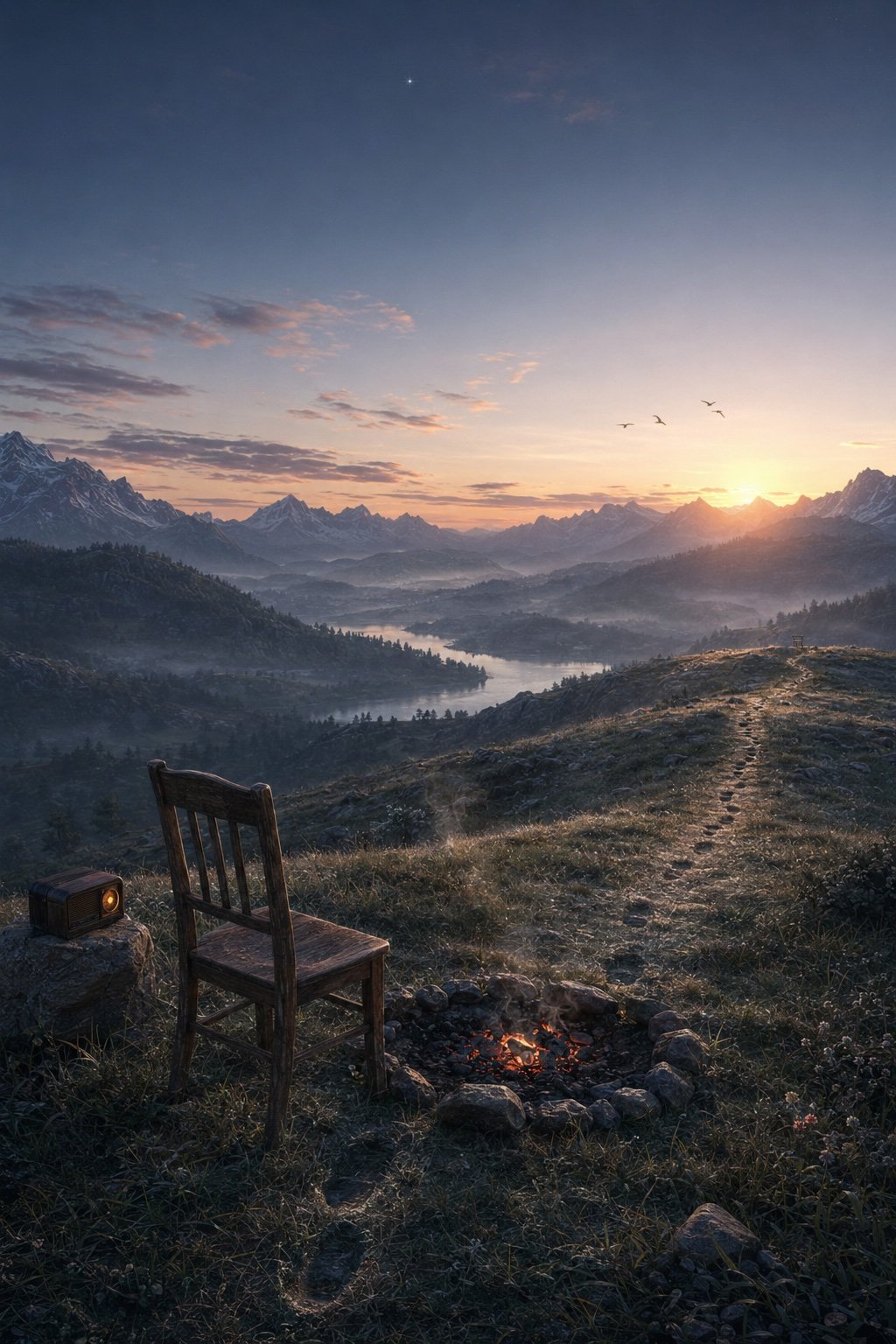
If you’re reading this, then our signal found you.
I rather like that sentence.
A century ago it might have sounded mysterious. Today it simply means that, somehow, across distance, across time, and across a remarkable collection of wonderfully improbable events, these thoughts managed to find you.
That seems quietly miraculous. It reminds me that we Earthlings have always been trying to reach one another. Sometimes with campfires, with handwritten letters, with songs. Sometimes with radio waves slipping through the evening air. Sometimes with books.
The method has changed, but the hope has not. We have always been asking the same gentle question.
Can you hear me?
Since you have traveled this far with me, I think the answer is yes, and not because you agreed with everything in these pages. I rather hope you didn’t. Agreement has never been the purpose of a good conversation.
Conversation has.
If a few of these ideas made you smile, if one or two made you pause, if one quietly followed you into the grocery store three days later and politely refused to leave, then this little broadcast has already done exactly what I hoped it might.
Some books try to impress the reader but I have always preferred books that accompany the reader. The difference is subtle. One keeps pointing at itself, while the other keeps pointing out the window. If this book has succeeded at all, I hope it has done the second.
More than anything, I hope you notice more.
Not just because I suggested it either, although I suppose I did, but because noticing has gradually become part of who you are.
Perhaps you'll catch yourself watching rain gather on a window. Listening all the way to the end of someone's story. Smiling at a child who has just asked a wonderfully impossible question. Thanking the person who quietly makes your day easier. Turning the radio up because an old favorite song has somehow found you again. Or stopping, for no particular reason, to admire a sunset that has been happening every evening your entire life.
Those moments belong to you now, not to this book, and that is exactly as it should be.
There is something else I should probably confess. You see, when I began writing, I imagined I was creating a fun and creative novelty book.
Somewhere along the journey I realized I was really writing a letter to whoever happened to need it. Perhaps that was you. Maybe it will be someone else twenty years from now. Books possess a charming habit of waiting patiently until exactly the right reader arrives, and time, it seems, is remarkably willing to help.
One of the great privileges of broadcasting is that you almost never discover where your signal finally comes to rest, a sentence spoken into a microphone may quietly accompany someone through an ordinary Tuesday. A song may become part of a family's history. A joke may still be repeated years after everyone has forgotten who first told it. A simple kindness may continue through people who never knew where it began.
We seldom learn how far our words actually travel and maybe that’s just as well.
It encourages us to choose them carefully.
Throughout this book we have wandered through wonder, curiosity, kindness, listening, music, rabbit holes, campfires, broadcasting, friendship, questions, rainstorms, and beautiful little moments that many people accidentally hurry past.
At first glance, I thought they were different subjects. But as we have traveled through them, I no longer believe they are. I think they have all been very subtly trying to say the same thing.
To pay attention.
To the world, to each other, to yourself.
Because attention, offered generously, may be one of the purest forms of love we ever practice.
Which brings us to:
Keep going. Keep asking beautiful questions. Keep making beautiful things. Keep helping tired people find their way. Keep laughing at yourself. Keep changing your mind whenever better evidence arrives. Keep pulling another chair into the circle. Keep leaving the campfire a little warmer than you found it. Keep broadcasting hope.
The world has never had enough of it, and if you ever begin wondering whether your own small acts of kindness matter allow me to answer before that question grows too loud.
They do more than we know. Always more than we know. Because the remarkable thing about a signal is that it continues traveling long after it has left the transmitter.
I bet we do too.
So wherever these pages happen to find you, whether you are sitting on a front porch, driving a familiar road, listening to late-night radio, watching rain gather on a window, beginning an entirely new adventure, or simply trying to make it through an ordinary Tuesday… thank you.
Thank you for spending a little of your wonderfully finite life with me. It has been an honor to keep you company for a while.
Now the road belongs to you again. I have every confidence that you will discover beautiful things out there but even more importantly, I have every confidence that you will leave a few behind. And if, someday, our paths should happen to cross again, through another book, another broadcast, another song, or one of those delightfully improbable conversations that always seem to arrive exactly when they are needed, I hope we greet one another the way old travelers should.
Not by asking,
"Where have you been?"
But by asking,
"What beautiful thing have you noticed lately?"
Until then, travel well. Listen carefully. Wonder often. Laugh generously. Build bravely. Love deeply. Leave the world a little kinder than you found it, and never forget that the world has been trying to tell you something beautiful ever since the first day you arrived.
Thank you for reading along with Kevin Higginbotham and Avery.
Just...
on your frequency now too.
End of Transmission